The huge dining hall overlooked the trees in the backyard-turned-jungle.Lack of care !!
Two bathrooms flanked the hall on opposite ends.
At night, going to relieve the bladder, through the grills somebody in white could be seen standing there in the banana grove!
On a closer look …
No it was a white dhoti fallen from the floor above over one of the old banana trees.
The moonlight played the trick!!
But a man did move stealthily from underneath the fallen cloth a knife shining like silver in his hand.
It was time to attack…
Flop …
The big ripe banana flower dropped to the ground…
Time for celebration…
***
Trivia : Banana flower or Mocha is edible. It is cooked in various ways (curry, chops, cutlets etc.) and considered a delicacy in Bengal.
The post is edited (I had earlier used the word banyan for banana) and I stand corrected by Hazel. But an interesting fact came to light about the banyan (Indian name bargad or Bengal Fig) tree which is as under :
“The English name “banyan” originates from the term bania, a name early European traders used to describe Indian merchants they saw seated and doing business beneath these massive trees.“
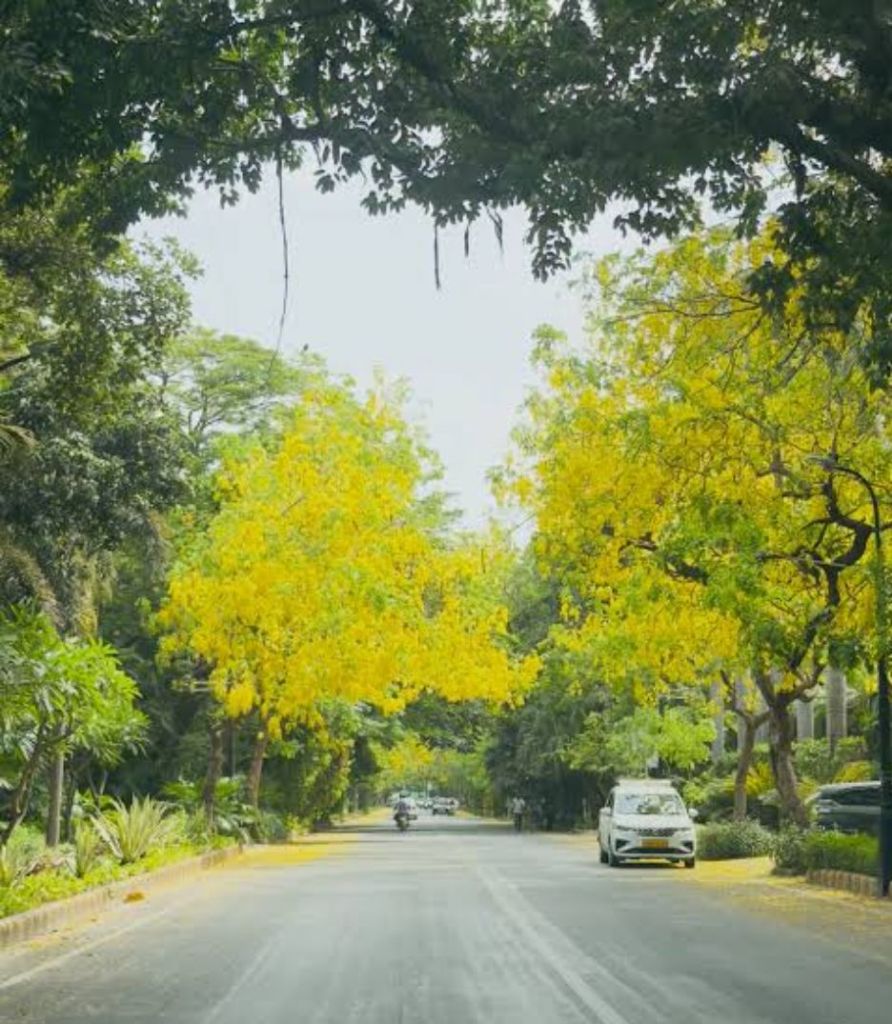
Trivia : *Amaltas or Cassia Fistula is also known as the Golden Shower Tree, Indian Laburnum, or Purging Cassia. It is native to the Indian subcontinent famous for its cascading clusters of vibrant yellow flowers that bloom in the summer. Amaltas flower lasts for roughly a week before falling to the ground, forming a bright yellow carpet, while the tree which is sturdier and has a life span of 30 to 40 years, remains in bloom throughout the summer season.” (Wiki)
Amaltas is the summer highlight of Delhi. The Amaltas lined arterial roads at the heart of the city are a delight to walk or drive through.
I commuted to school and later to the office through these tree lined roads but could never get time to enjoy sitting under the shade of the trees. The poem is an ode not only to the beautiful tree but also to those days gone by which I miss very much now.
When sage Vyasa Deva envisaged the versification of the Mahabharata he wanted Lord Ganesha, the epitome of cerebral power, to transcribe it for him while he narrated the verses. On Vyasa’s request the Lord consented on the condition that the flow of his quill should not be paused in any way during the process. If it did he would immediately discontinue writing.
Vyasa Deva was in a fix. He could not offend the Lord who had an awe inspiring aura. But he also required sufficient time to think in between verses to take the narration forward.
So he laid a counter condition in the form of a reverent appeal to Ganesha that he, in turn, should not put any verse down on paper without understanding it fully. Ganesha agreed.
Thus, while Ganesha took time to grasp the layered implications of each verse Vyasa Deva, in the meantime, constructed the next one.
It is said that seeing Ganesha’s unbeatable speed, Vyasa deliberately dictated highly intricate verses which compelled Ganesha to take time to ponder. In the meanwhile, the sage got a breather to weave the narrative further.
And in this way amidst a battle of wits the epic tale got chronicled.
***
Lately, this mythological story has been bothering me as to what it tries to tell or teach us. After a lot of reflection, I have pinned the moral of the story down to negotiation skill – that is not to get intimidated or awestruck by the immensity and eminence of the persona across. To stand your ground, apply your mind and work amicably and reasonably towards a level playing field beneficial to all the parties involved.
But what happens if execution gets tricky and consensus unreachable? Like Vyasa Deva, is resorting to mind games then justified….????
Only yesterday, a senior and respected poet friend of mine introduced me to a new form of Japanese poetry – Zuihitsu.
Google says :
“Zuihitsu (meaning “running brush” or “following the brush”) is a traditional Japanese literary genre that blends prose, poetry, and essay. It is characterized by fragmented thoughts, sudden juxtapositions, and random observations without a rigid, linear plot.“
Rather than following a strict plot or argument, it mimics stream-of-consciousness, stringing together seemingly random diary entries, lists, contradictions, and observations to create a cohesive mosaic.
A few examples of Zuihitsu courtesy poetryschool.com –
“Hahn’s introduction to her book, which is also the first poem, is written in the form of a letter and offers itself as a directional guide (it is titled ‘Compass’) as well as a demonstration of zuihitsu.
It begins:
Dear L– You asked for a little compass. Thank you! I was looking for a definition of the zuihitsu from my shelf of Japanese texts, but discovered none gave more than a sentence or two. None seemed especially scholarly–which might be a good thing. None offered the sense of disorder that feels so integral.”
***
A few more from poetryfoundation.org
Even when I was young, I loved peering at faces in films. The pleasure of watching and of not being watched.
***
Funny, the way we come to understand a place by wanting to escape it.
***
I can shake out the imprint of my body on the sheets each morning. But the mind–the mind is a different matter.
***
Long car trips where I sat in the back of our family’s used Nissan. The stale odor of plush seats and sun-warmed cola. My parents’ and my words do not touch. I grow adept at tunneling inward, a habit I have yet to let go of.
***
Someone once told me, before and after is just another false binary. The warmed-over bones of January. I had no passport. Beneath the stove, two mice made a paradise out of a button of peanut butter.
*** Suffering operates by its own logic. Its gropings and reversals. Ample, in ways that are exquisite. And how it leaves—not unlike how it arrives, without clear notice.
***
Nights when I shared a bed in a small room. Another’s body to the left, hooked by a heavy dream.
***
As is my way, I was in a hurry to try it out. Though mine are more direct and minimal compared to the ones I have cited which I think are more dramatic and metaphorical.
Here are a few –
A clear morning.
The sky is a startling blue.
A whiff of fragrance from the garden.
Spring outside!
But the grey in my hair says autumn.
***
By the open window
a steaming cup of chai goes cold
reading you…
the tears tickling my eyes
simmer like a pot of water ready to spill.
***
In my garden a batch of rodents
raking the soil
chewing the leaves
killing the plants
with such precision !!
Helpless… I watch every morning
how I build
and
how they destroy disdainfully
***
My monkey mind sprints
from a spiritual talk
to a murder mystery
to a motivational book
to the holy Gita.
In between the impatient dance of words
I vainly look for a moment to think
***
This month the burden of tax.
The rigors of filling up the forms !
Before….and…. after….
I feel lighter…
My pocket does too.
***
My name lost
in the maze of many
As they review…
Yet to prove
I am one of them
A lifetime after
on this sacred soil
I call my motherland
***
Self evaluating, I think I have just grazed past the form and perhaps transgressed a few techniques as is with me.
In spite of the randomness and fragmented musings of the poetical form I discern a conspicuous shift and link as in other Japanese style of writing – haiku, tanka, renga.
Let me know which poems, specifically among the traditional ones, appeal to you.
Follow the brush : Making Zuihitsu poetry Courtesy poetryschool.com
Two days back I finished watching a Pakistani drama which stretched to 84 episodes. Somewhere close to the 60th I lost interest and took a break. Then my eye surgery happened which again extended the period of abstaining though the surgeon said, “Watch all the serials you want.”
But a week or so back the binge bug bit me again and I resumed watching the series – the last few episodes at a stretch. It was a family drama revolving around three families having one vamp each (yes, quite a handful) who as usual made their mission to disrupt the lives of the rest. Without going into a detailed critique, in brief, the story was all about good versus evil. The good showing exemplary level of tolerance throughout and the evil , in the long run, getting their dues in accordance with their vicious karma. Needless to say , the climax saw the former magnanimously forgiving the latter.
When it comes to forgiving I always wonder whether it can be absolute and really lead to a complete erasure not only of the evil but also that gnawing sense of injustice in the hearts and minds of the victims.
Does prolonged endurance mellow the endurer to such an extent that the thought of forgiving comes with greater ease than feelings of retribution? Or perhaps the forgiver becomes adept in suppressing or is rendered totally incapable of the raging desire of counter vengeance as a result of prolonged period of victimization? Is this very act of forgiveness actually transformative for the forgiven or is it just an interim pause to strike back again?
In this context, I am reminded of one of Tagore’s poems wherein he expresses his inability to forgive the wrong doers in accordance with the timeless prescriptions of morality. That’s human isn’t it ? Though motivational speakers and spiritual gurus would harp on ‘forgive and forget’ – the mantra of moving on.
I remember, once frazzled by the mis- conduct of one of my domestic helps, I had repeatedly complained about him to a spiritual practitioner I used to visit then quite often. She heard me out calmly and advised me to give blessings to him whenever his misdemeanor rankled. She said if I did not forgive him the karmic chord that bound him to me would not get severed. And as long as his misdeeds haunted me I would keep hurting and remain tied to the spot where I was mentally. At that point of time, her words vaguely made sense. And it took years for me to get out of the clutch of remorse and anger borne out of misplaced trust.
There’s a beautiful story by Paramahansa Ramakrishna about three drunkards who wanted to cross a river at night. So they got on a boat and rowed till morning. However, in the morning, they realised that they had not reached the other bank because they had forgotten to untie the boat in the first place.
I admit that I made elaborate plans of bringing the miscreant to book. I lodged a police complaint followed by an FIR. I kept following up with the SI in charge of the case so that an early action would be taken in the matter. However, nothing concrete came out of my incessant follow-ups and the investigation fizzled out after a while.
Perhaps the victim in the series realises the futility of getting into the continued rut of revenge and counter revenge – a vicious circle without a way out. After all what is to be achieved out of it? Personal gratification and a perceived sense of justice meted out? But will this vengefully earned satisfaction stand the test of time?
I vaguely remember the outline of a short story telecast when I was in my formative years. A convict wanted to take revenge on the persons who were responsible for his long sentence in jail. However, to utilise his time in the prison he started reading books on various subjects which were supplied to him on his request. By the time his sentence was complete he had lost his initial desire of revenge as his perspective had changed with acquisition of knowledge.
Perhaps it’s best not to be on that seat of judgement. Poetic justice is brought about by the natural laws of the Universe and not by human hands after all (though some may or may not agree). Let the karmic accounts unfold in line with divine machination which honestly is beyond the immediate comprehension of the forgiver as well as the forgiven. It’s only in hindsight that the jigsaw puzzle of life seems to get fitted in with such precision that there is no scope left for anything else except immense awe and incredulity.
God’s orchestration surpasses human manipulation at every step. To us, mere mortals, justice may appear to be delayed at times but never denied in the cosmic court of law. Even that delay, if we analyse impartially, must be having its own justification too. We, blinded by our anguish, fail to see that whatever happens in life is actually for our very best, even if it seemingly impacts us adversely. At times, perhaps even a closure is not the answer. Perhaps the reins are kept loose by the Puppeteer for a larger purpose which our limited vision fails to gather. Isn’t it then wiser to recognise our own limitations and repose absolute faith in the Master Planner for the ultimate decisive move? I guess, that’s what forgiving is all about. Leaving the final say to the Divine unquestioningly.
When the Company decided to downsize, the earmarked lot was not outrightly thrown out of the job. Designated as “Officers On Special Duty” they were just made to sit the whole day in a room without any assignment for an indefinite period.
A few incorrigible optimists thought that it was just a temporary phase and that they’d get reinstated in no time in the mainstream, wishfully, with a promotion. A few, after marking the daily attendance, went about their personal work, unperturbed. Then there were a few who took to spirituality – creatively utilising the hours getting connected to their innermost core in a state of deep meditation till the cover got busted by loud snores emanating from their disloyal nostrils.
The clever ones banked on the ‘goodwill’ of their seniors and took advantage of this golden opportunity to build greater professional rapport by selflessly running their personal errands and facilitating meticulous execution of their domestic chores.
Most welcomed this leisurely interlude contented that at least the salary was not being stopped from getting regularly deposited in their bank accounts at the end of each month.
Unfortunately, I, a workaholic, was admitted to a mental hospital by the end of the second month.
Acute depression, they said it was.
***
In the asylum, after the initial period of medication and counseling, I took upon myself the task of tending to the garden, sweating it out in the heat of peak summer, planting banks of fresh seeds which soon erupted in a flood of tiny green shoots to the delight of the staff responsible for the beautification of the gloomy facade.
In the afternoons I read out volumes after volumes of motivational tomes to the ‘quieter ones’ which put them into a soporific state in surprisingly lesser and lesser time compelling me to suspect more and more the intent of the writers as days wore on.
A few got themselves released before completion of treatment to the chagrin of their medical and nursing attendants. As I was not privy to the closed door exit interviews the cause of their hasty retreat and the huffed look on their guardians’/care person’s visages seemed utterly baffling.
Notwithstanding, in the evenings I’d robustly deploy myself in providing meaningful assistance in the Administration Office, infusing order in dealings that appeared to be chaotically managed till then.
In general, I made myself exceptionally useful for whatever time my stay in there was destined to be.
In fact, with my active involvement in the day to day functioning, I had almost come to enjoy my incarceration.
***
I knew the inmates found me extremely helpful and cooperative.
The staff visibly valued my presence.
The doctors looked immensely satisfied with my astonishing progress.
My Evaluation Report read in bold “enthusiastically work oriented.”
***
But despite my undisputed achievements as an unusually ardent patient passionately committed to providing excellent in-house services, I, could not, for the love of God, figure out why a month later they decided to put me on sedation for most hours of the day.
In case you have any idea pray illuminate, will you ?
Have you ever noticed how the taste buds behave according to the change in seasons?
Even a decade back I was a cha-khor , that is, a person addicted to tea. From six to eight cups a day I have now brought the consumption down to two – morning and evening. However, in the extreme heat of summer by evening my craving for tea vanishes.
But as rain splatters on the window panes, I have an irresistible urge to have a cuppa more soon after my usual early morning one. I resist that temptation but as Didi (elder sister) says the soul should not be unnecessarily tormented I have that tantalising second cup this morning. As I have boiled tea it is stimulating but at the same time kadak or strong on the palate.
The uniqueness of Indian (especially Bengali) cuisine is that the same dish can be prepared in a spicier as well as milder way depending upon the weather. In hot summer I hanker after a paatla maachher jhol – fish in a translucent gravy. Whereas in extreme winters the taste buds salivate over a maachher jhaal that is a fish curry made with lots of green chillies.
Another staple in Bengali households (of course mine as well) in the summers is posto or poppy seed paste which is used as a main ingredient in potato and many seasonal vegetable curry. It can also be had as it is with hot rice or as fried bodas or round shaped dumplings with a binding of the all-purpose floor. No, it doesn’t give a high but Posto is a great relaxant. Mustard paste or shorshe is another indispensable ingredient in curries and gravies – tangy and slightly bitter to taste it leaves a tingling sensation on the tongue.
As in many North Indian dishes, onion, ginger , garlic, diced or ground to a paste, form the basic masala or ingredient in Bengali cuisine as well. However, Bengal also has a wide variety of vegetarian cuisine which is less talked about. As the watery vegetables confidently march inside the kitchen in summer , the basic masala changes from the heat generating onion-ginger-garlic combo to a more soothing summary mix of ginger-tomato-asophoetida-cumin seed paste.
The choice of vegetables changes too with the change in seasons. The gourd family – bottle gourd, sponge gourd, bitter gourd, pointed gourd, ridge gourd, apple gourd – and the pumpkin family – green and red – become the summer ‘frontliners’ while in winter a yearning for chicken, egg, fish takes over. The cooking becomes spicier too in comparison with summer’s lighter versions which in Bong lingo is called haalka, that is, which does not put much pressure on the stomach.
Another summer essential in my kitchen is raw green mango which is used for pickles and chutneys, in curries as a vegetable and also as an ingredient in red lentil for that lip smacking toker daal. So is tamarind which I have rediscovered this season in tangy fish curry or maachher tok.
The South Indian Sambar (a lentil variant) is by itself a one pot meal which I relish with rice in humid afternoons. But what I have really taken a fancy to is the probiotic curd rice and the Nepali aaloo chukauni (recipe posted earlier).
The rich North Indian gastronomical delights with a few experimental side dishes gatecrash as winter knocks on the door.
But as of now, let me slurp over a bowl of paanta bhaat – boiled rice soaked in water and kept in the fridge overnight – with a helping of dim aloo sheddho – boiled potato and egg mashed with clarified butter/mustard oil, diced onion, coriander leaves and green chillies. The egg is replaceable by boiled bitter gourd anytime.