Tara, Chandra, Sunita And Keli


Our house help, a woman of indeterminate age, had almost half a dozen daughters. Some were married, a few engaged or going to be married and the youngest, Tara, was unmarried. Though older in age she was my playmate.

She used to often sing a particular song which went like this :

tamatar bade mazedaar

tamatar khane lage to

daant tutey chaar

Translated it meant :

The tomatoes are fun

When I ate them

I lost four teeth at once

Considering tomato is a soft vegetable how eating one four teeth can be lost raises a serious question as to the logic of the lyrics. But childhood has its own rationale. I loved this song and the way she danced on it and would often request her for a repeat performance.

Tara’s elder sister was Chandra – a rustic beauty – but an irregular worker. She’d often remain absent for days. Married and a mother of two she’d come to work when it suited her – the cuts and bruises on her body clearly visible. But she giggled a lot and hummed when she washed clothes and cracked jokes about how she got beaten up by her husband and mother-in-law. And then one day she eloped with a stranger leaving behind a drunkard and two small kids.

Sunita was a different cup of tea all together – unmanageable and quite a madcap. Sloppily dressed, hair unoiled and unbraided, she would announce her arrival by throwing the broom in the middle of the room with a loud, cheerful, singsong “main — aa — gayee” (“I — have — come”). Thereafter, she’d break into a dance and even in between chores making us all laugh.

However, Mother Nature swayed her magical wand at the appropriate time. Sunita attaining puberty stopped coming to our house. Soon she got engaged. The drastic change that came upon her thereafter was something to observe. The focus deficient girl with boundless energy transformed into a saree clad, shy, well behaved teenager!!

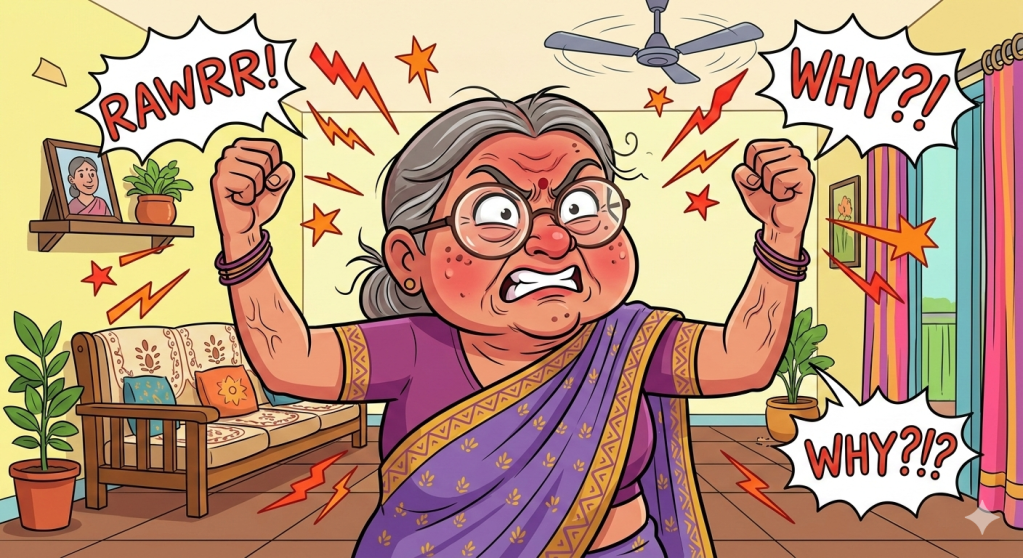
Keli came to work not because of want of money but because she wanted to keep herself busy. She maintained her dignity and freedom of choice and refused to work in any other household except ours. She was a good but moody worker. Not even my mother could tell her how to perform a chore. She would do it as per her own wish and will.

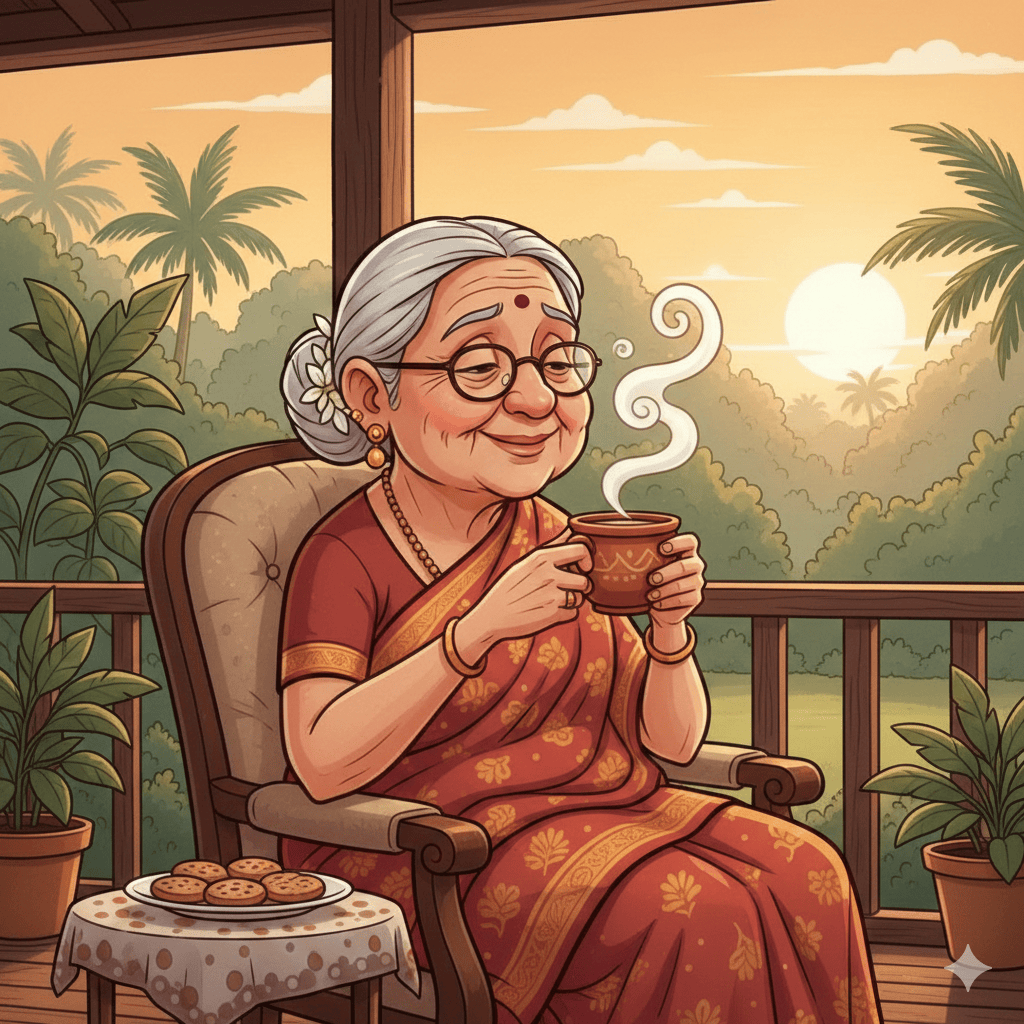
I don’t know where they are now.  Tara must have got married. I wonder whether Chandra settled into family life  given that nomadic streak in her. Sunita must be now doting over her grandkids while Keli must be heading a large family as a no-nonsense matriarch. Wherever they are I wish them all well – love and peace.
Binging On…


More than half the unbearably hot and humid month of July has passed without much achieved. The weather does not favour walks or outings. For the past two nights it’s been raining quietly. But without any cooling effect.

My reading has again slowed down as I have taken up a few personal projects which are time bound as well as time consuming. However, the binging bug is still at play with an eclectic mix of Bengali, Hindi, English and Korean series and movies on the watch list.

Chaddobeshii (The Masquerader)

Bengalis have a fetish for detective, ghost and treasure hunt stories. This mini series is based on Abhirup Sarkar’s Chowdhury Barir Rahashyo (The Mystery Of The Chowdhury Household) the audio adaptation of which I have already written about.

The series is sketchy and the characters have been altered a bit. The rookie detective is now a married man on the verge of separation. He has a little daughter. His disgruntled wife is in the habit of unintentionally throwing clues at him which ultimately help him solve the case – a whodunnit with a twist.

Having narrowly escaped three accidents, Mandakini Chowdhury, the erstwhile film diva and now the second wife of the business tycoon, late Subir Chowdhury, appoints an inexperienced private investigator, Aditya Majumdar, to find out who wants to kill her.

Shaptodingaar Guptodhon (The Hidden Treasure Of The Seven Ships)

This is now Bengal’s favourite treasure hunter Shonada’s third adventure film. Shonada or Shuborno Sen is an Oxford returned historian. His nephew, Abir , a lawyer and Abir’s fiance, Jhumur, a post grad in comparative literature, are his sidekicks.

A Cambridge returned Professor of history, Nishanath Chatterjee,  invites Shonada to solve a riddle which can lead to hidden treasure. Shonada  is contemplating whether  to take up the case. But in the meantime the Professor is murdered. Shonada becomes a prime suspect because he is the last person who has seen the victim alive. The police want him and so does the murderer. In a cat and mouse chase, Shonda is again pitted against his arch nemesis, Dashanon Daw in this engaging thriller having a unique combination of history and mystery.

Ikka (The Ace)

An unbeatable lawyer, nicknamed Ikka,  known for defending the downtrodden, is compelled to take up the case of a rich, spoilt son of a powerful politician who is charged with attempted murder. As the assaulted woman dies in the hospital it becomes a murder case subsequently. The accused was once Ikka’s junior whom he himself had got debarred from legal practice.

A good story poorly acted and directed.

Sheep Detective

George, a loving and caring shepherd , treats  his herd of sheep as family. While in the mornings he takes good care of them at every night he reads them a bed time story –   not ordinary kid stuff but whodunnits!!

The sheep not only take avid interest in listening but also discuss amongst themselves who the killer can possibly be if the story is left unfinished.

So when George suddenly dies under suspicious circumstances, his beloved herd of sheep take upon themselves to play detective and find out who the real culprit is.

This is the most adorable and watchable movie I have seen this year. Highly recommended for all age groups.

Agent Kim Reactivated

Mr. Kim , a North Korean spy, leads a quiet, low profile life with his young daughter, in South Korea.

His home country identifies him as a defector. The country where he has been given refuge has deliberately kept him alive so that they can utilise him as and when required.

However, life takes an unexpected turn when Min Ji , Kim’s daughter, suddenly goes missing one night. Kim, with his long time friends and associates, Seong Han-soo and Park Jin-cheul, embark on a do or die mission to locate Min Ji and get her back home.

A limited episode series, this Korean spy thriller has conspiracies and counter conspiracies, revenge and counter revenge, violence and counter violence, gore and blood and fisticuffs  and whatnot – all  macabre stuff which I promised not to consume. But by the time I realised what I had gotten into I was so terribly hooked. 😂

Summer’36

Set against the backdrop of  World War II, this limited episode series is more than a murder mystery.

A notorious prosecutor is found murdered in his room in a luxury hotel , The Riviera, in Nice. Present in the hotel are many guests who have solid reasons to be suspects. Amongst them are four ladies – the prosecutor’s ex fiance, his current lover, the hotel’s head housekeeper who owes him a huge poker debt and the one from the Police Auxiliary Services assisting in the investigation of the murder.

While the Nazi invasion of France looms large in the background, four bold, determined and beautiful women put up a deadly fight of wit and grit against the apparent class divide and the culture of contempt born thereof, racism, misogyny, capitalist exploitation and sinister plotting of the vested interests to bring the perpetrator to book.

A must watch.

The Mosquito Story


There was a king who couldn’t sneeze.This was a big problem because as you know everyone would like to have a good sneeze now and then. Gradually his issue with sneezing became so large that he couldn’t concentrate on his job – that is to say, rule his kingdom.

So his head minister, an old, gentle fellow, called many doctors, physicians, naturopaths, homeopaths, ayurvedic healers etc. etc. to examine the king and find a cure. But to no avail. They all returned unsuccessful.

Even magicians and sorcerers were called upon to do some magic on the king but unfortunately they too failed. When the king and his cabinet of ministers had given up all hope there arrived a miniscule mosquito who claimed that it could cure the king of his inability to sneeze.

Though a little disbelieving yet the ministers allowed it to try its luck. The mosquito whirled around the king for quite some time chanting mantras in its own musical language and then suddenly it entered into the king’s nose. As soon as it trespassed inside, the king’s nostrils started tickling and twitching and in no time the king let out a big, noisy sneeze.

It was so loud and forceful that one of the sturdy pillars of the royal court cracked hideously and the old head minister, who had just closed his eyes to whisper a silent prayer that the king be cured of his age long disease, jumped up in fright and fell off his chair.

However, the king looked relieved and happy. The joyous message of the royal sneeze spread like wild fire and the entire kingdom rejoiced for a fortnight over it. The king was so pleased with the mosquito that he requested it to stay put in his kingdom so that in future, if required, it can again help the king sneeze.

The mosquito agreed, married  a she mosquito, settled down, had children and the clan grew and evolved over the years so much so that their personal requirements grew by leaps and bounds too.

I am not an AC person but one night being terribly bugged by these pests I couldn’t sleep.  What with the heat and turning and tossing in bed for quite some time I thought of putting on the AC to cool down a bit. And lo! As soon as the AC was on the mosquitoes stopped bothering me. But after a while when I turned it off they were again back in action!!

Now I have to pay a hefty electricity bill just for the mosquitoes!! Can you beat that ???

PS : This month the Government did sneeze out a big mosquito…

…ahem$$….ooh##…eek**…guess I have gone off the track again …sorry!!

All pics AI generated

Our Sartorial Ventures


One of the vloggers I follow occasionally, very recently commented in one of his reels that in Germany, where he is now based, a premium  is put on daily output of an employee and not how he is dressed in the office. Back in India, where he belongs and worked for a while, aside work output, it was very important how an employee dressed to work.

I agree with him as in our office there was a dress code too – saree or western formal for women  and shirt and trousers for men. T-shirts and jeans were permitted only on  working holidays and not on week days. In high profile meetings men came in two-piece or even in three-piece suit (smelling of moth balls) and women in their best cottons and silks. More adventurous ones put on a tie with a pair of shirt and trouser. Sum and substance of the story – it was easy to figure out the bosses’ schedule from their outfits!!

In certain industries, like hospitality, men are found in black trousers and blazers on white shirts even in hot summers. And they invariably smell of stale food!! I wonder why.

Coming to think of it we do have an unwritten dress code for every occasion. You have got to “dress right”. In fact, we are known by how we dress. For walks it has to be in casuals for gym in sports wears, for outings (depending on the time of the day) informals , for marriages embellished ethnic attires heavier than the body weight, for mourning usually whites.

We cannot think of anybody walking into the office in tracks or shorts (Oops! So revealing) even if you are snoozing most of the hours or knitting socks. After the occasion comes who you are going with or the kind of society you will be in. What nature or thinking they have. Whether male or female. If you are with somebody who is considered to be of a conservative mindset or a certain class you should dress accordingly not to offend his or her sensibilities and not to make a caricature of yourself.

One of my fashionable female colleagues, would strictly subscribe to salwar suits with flowing dupattas when she had to visit the offices of  the transporters. From my personal experience, I know as a woman how difficult it is to get work from that clan because in their ecosphere women are only seen and not heard. If you went overboard with your attire it was most certain that you would end up being an object of their utmost contempt and ridicule.

During the second dosage of vaccination for COVID, I had to go to a rural dispensary to get the shot where it was customary for the women to cover their faces in long ghunghats or dupattas. I felt quite unsuitably dressed in a t-shirt and pajama!!

More important is the role being played by you. If you are slotted as the “buzurg” (i.e. the elderly) you have to wear “serious” clothes, like sarees or salwar suits. Interestingly, you easily get a seat in the Metro if you are in a saree. I have tried that out myself. 😊

In Bengali culture, it used to be more age related (I don’t know about now). Women who have crossed the 40s were not supposed to wear darker shades or dress charmingly. More so, if you had a few grey strands visible in your hair. Widows generally wore white or off white sarees with thin borders.

My paternal aunt, married into a joint family, was very cautious about the colour of the sarees she draped much much before her daughter, who was of my age, got married. One of our teachers only wore crisply starched white sarees with simple borders. Was it her personal preference or a family stricture I don’t know. Our Physics teacher, her mix of black and white hair tightly knotted in a bun, wore dark red lipstick and darker shades of sarees. In those times it was considered quite ‘out of the ordinary’!! We had categorically  told my mother not to give in to white after my father’s early demise.

And then how one dresses changes with the region or community a person belongs to…

However, now times have changed. With the migratory nature of the workforce, most millennials working in MNCs and families travelling frequently out of the country,   dressing has gone global. Jeans have hijacked the populace. Long dresses are also much in vogue as they are very convenient. Fusion wears are upbeat and comfortable.

The long and short of it is that every individual is now making  a statement by the way they choose to dress. And that is quite remarkable!!!

The Recording


Image with the help of Chatgpt

This is in response to Rochelle’s Weekly Photo Prompts For Friday Fictioneers.

Word Count : 100

I never had those fancy gadgets like music system, karaoke etc. Returning from school I’d practice on a harmonium religiously.

When I got a chance to audition for a Radio Station I practiced harder.

I passed the audition and was called for the recording.

Where I sang with all my might with the accompaniments arranged by the Station.

When the recording was over, one of the musicians, an old man on the Sarangi, had to be woken up as he had gone off to sleep all the while I was belting!!!

91 Words

***

You can read the other stories here.

Trivia : In those days there was a Radio Station called Yuv Vani for the youth. The musicians (middle aged to very old) used to be on the permanent pay roll of the Station who accompanied the novice singers during audition/recording. The musicians were in  Government jobs. I guess the rules were slack and these old hands could continue on a prolonged tenure with an indefinite retirement.

Sarangi is a string instrument which is used as an accompaniment. It is also an instrument played solo for classical music performances.

Here’s a video clip of Pandit Ram Narayan playing the Sarangi

The Twins Who Never Were


What’s the funniest misunderstanding you’ve ever been part of?

Me and my sister were born seven years apart. But being of similar facial structure , build, height and weight we were often confused as twins. Seen together we did not need a formal introduction as it was quite obvious that we were sisters though at times people did ask whether we were twins but when we visited the same place separately that was when funny anecdotes happened.

Once my sister went to one of the local markets to buy vegetables. When she asked for coriander leaves the surprised vegetable seller said, “Why, you’ve just bought a bunch. How many more do you require?” My sister knew immediately that I had visited the same vegetable seller a little while ago. 😊

Another incident….When I went for a hair cut the parlour lady smiled and greeted, ” Oh! This time you have come early.”  I was always late for a cut and to think that I had come early meant my sister must have visited her not so long ago. I confirmed with my sister and you know what my guess proved to be correct. 😁

But the greatest embarrassment would be when I had to go anywhere with my brother-in-law while my sister stayed back. I had to invariably explain that I was not my sister but ‘the sister-in-law’. Repeated awkward incidents like this made me avoid going out with my B-I-L. But then there were certain situations which were unavoidable. Even recently a remark by  someone made it quite clear that I was being confused for my sister. 😳

After a while as I gained weight and my sister made a conscious effort to reduce, the difference between us could be discerned but even then confusion remained as most people thought I was the elder one when it was the other way round. 😂

Now again we look alike because I have lost a lot of weight. We both have similar hair styles. But since most of the time we travel together I guess the confusion is a little less from our interactions. She naturally bosses over me and I mostly comply. 😊

Hackneyed, Harried And Humoured


There were three types of buses in Kolkata – the mini bus, the private bus and the State owned bus. Why the distinction was made between the first two types I am not sure because both the categories of buses were privately owned. The State owned ones were big and spacious. The mini bus was like a match box and the private buses were a bit larger versions of tin boxes. But whatever the size or capacity of the buses they were always overloaded with a few bodies precariously dangling from the door, their feet in air and hands clutching just the tiny bit of the iron  bars of the side windows.

These were the modes of transport by which I commuted from home to office and back year after year till I managed to get membership of a chartered bus wherein seats were limited and allotted to members only in lieu of a fixed payment each month and no standing passenger was allowed.

This was a much better facility because the buses, though not air-conditioned, had large windows which permitted proper ventilation inside upping the comfort level of the commuters by a few degrees.

In the other buses, the inside temperature rose due to their size and structure and the piles of  human bodies dripping with sweat glued to each other and small windows hindering air passage. There would hardly be enough space to even place the feet properly while standing. But Bongs being Bongs they took these everyday commutes in their stride. They read classics, hummed Tagore songs under their breath and even had a good snooze while just about balancing their bodies with a practised ease developed over the years.

But amidst this chaotic commute God forbid if any female passenger objected to the misbehaviour of a co-passenger. In a jiffy the laidback crowd could turn into fierce  mob beating the offender into an unrecognisable pulp. Thus, in spite of the acute inconvenience, these were the safest modes of transport for me and any other lady who would immediately be helped while boarding or deboarding and seat, if unavailable, would be arranged for them either by the conductor or the passengers themselves.

These were, like me,  ordinary men and women who  travelled long distances to meet both ends and coped with the vagaries of life with unwavering fatalism. If you wonder what enabled them to keep at it I’d say it was their innate sense of  humour, a generous dose of which could be experienced during these journeys making them the most enjoyable.

Once a young man running after a bus which had just left the stop, shouted, “Rokkey! Rokkey! Jenaana hai!! (“Stop! Stop! There’s a lady who wants to board the bus!!”) Hearing the word ‘Jenaana’, meaning lady , the conductor dutifully stopped the bus. Huffing and puffing the man got in  but there was no lady in sight. When the conductor asked where the lady was, the man answered pointing to his chest, “Dil mein!” Meaning “Inside my heart!”

One day going homeward, the bus stopped at a junction. It was the last trip of the bus. A man, obviously waiting long for a transport, asked expectantly to the conductor whether the bus would take him to the opposite end of the route. The conductor smiled and replied politely, “Oh yes! But tomorrow.”

One day an irritable man got in midway and immediately picked up a fight with another passenger. The debate was over something very trivial and quite unnecessary lasting only a few stops after which the man got down. Summing up the situation, another commuter said dryly, “Meet Mr. James Bond! He came, played , won and left!”

In a crowded bus it was very common to step on another person’s foot unknowingly. A passenger, his foot being crushed under the weight of another elderly passenger’s boot, politely retorted, “Dada, anek to holo. Ebaar ei paataa nin.” Translated it meant, “Brother, you have been standing quite long on my foot. Leave this one. I will give you my other foot to stand on.”

Thus, these contraptions on wheels wherein we spent quite a few hours, sometimes even longer, accommodated each one of its users on a day to day basis, like a machine with a mammoth heart, ungrudgingly and with a touch of  bizarre humour.

Reading Again…


The books that I read the most were the ones I had as a child. Like the epics –  Ramayana and the Mahabharata – written in a concise manner for children, Bengali translation of The Three Musketeers and Ben Hur – again abridged versions for children. But my favourite writer was/is Abanindranath Tagore (fondly called Aban Thakur ) because not only did he have a way with words but most of his books were replete with sketches that he made himself. The visuals along with his magical storytelling were enough to trigger the imagination of a child.

Growing up I rushed through one book after the other as with life hardly getting any time for a re-read. It is said that the formative years have a life long impact on the mind of an individual. No wonder that even now I get fascinated by Aban Thakur’s stories. I am again reading his Raaj Kahini (Royal Tales) set in the backdrop of Rajasthan. But now there is a difference.

One of the stories in the book goes like this –

Shubhaga, a young widow, seeks shelter in a Surya Mandir (Sun Temple) one fateful evening. The old priest of the temple takes her in. Soon after, the priest departs for heavenly abode. Shubhaga in her loneliness requests the Sun God to bless her with two children – a son and a daughter. The son grows up to become a handsome boy.

He meets a young princess , falls in love at first sight and marries her. However, their paths diverge thereafter. The young boy becomes a fierce warrior king having a number of conquests to his credit, consolidates power, sets up his kingdom and marries twice. One sultry afternoon  hearing a beggar girl sing the same song that the playmates had sung during his secret marriage to the princess, triggers  memories of his first love. He embarks on a search mission to find her but returns unsuccessful because the princess had by then renounced the material world and become a sanyaasin (i.e. embraced monkhood).

As a child I was mesmerized by this and other stories in the book. But now I see inequality of treatment, gender bias and patriarchy. The hapless princess renounces the world estranged from her lover. Her lover conquers the world , has two wives, luxuriates in glory, power and riches and forgets all about her till one day accidentally he is reminded of her.

Shakuntala, based on the Sanskrit poet Kalidasa’s Abhijnyanam Shakuntalam, is another story by Aban Thakur written for children. It’s a simplified version of the original. Shakuntala is the adopted daughter of sage Kanwa. She is lovingly brought up by the sage and his wife, Gautami, along with their two daughters, Anusuya and Priyamvada. Shakuntala grows up to be a young, beautiful girl.

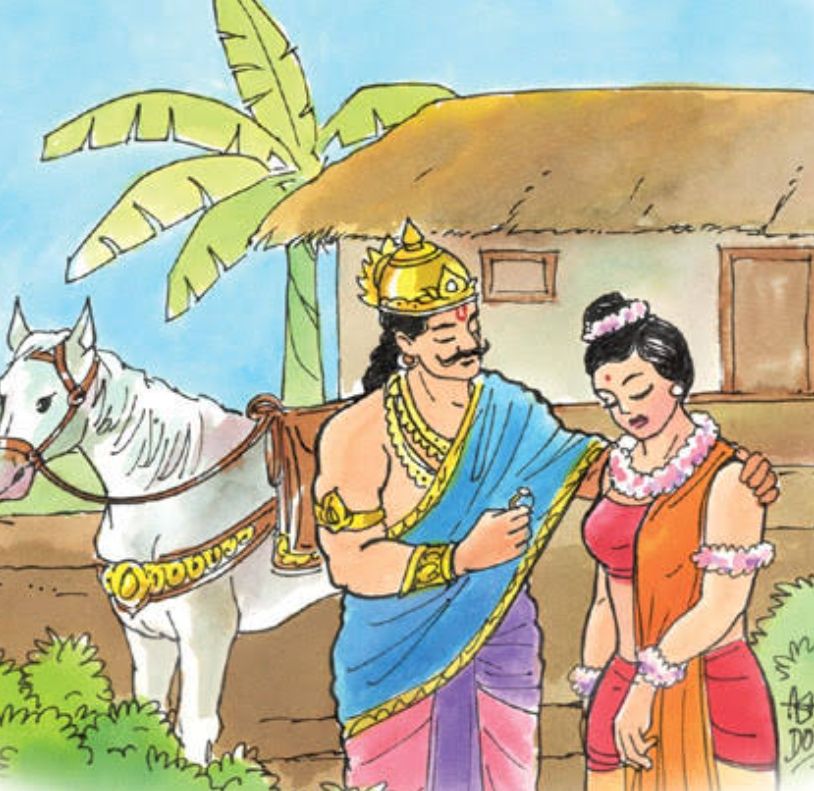
One day King Dushyant, having lost his way  hunting, arrives at Kanwa Muni’s asharam and falls in love with Shakuntala at first sight. He marries her with the sage’s blessings and after a while leaves for his kingdom with a promise to return and take Shakuntala back with him. Before leaving he gives her his royal signet ring as a promise of his return.

Days pass but the king does not come back. Shakuntala is expecting his son. So the sage advises that she be escorted to the king’s palace. On the way, Shakuntala loses the ring given to her by the king which falls in the water while she is being ferried across a river and a big fish gulps it down.

When Shakuntala arrives at the king’s court , the king fails to remember her.  Shakuntala reminds him of their marriage and living together in the tapovan (secluded sanctuary in a forest where sages and hermits live and meditate). The king asks her to show some proof to corroborate her story. But Shakuntala having lost the ring can produce none.  The king humiliates her. Heart broken  Shakuntala leaves the palace. Eventually, a fisherman catches the fish and finding the royal ring in its stomach brings it to the king who immediately remembers Shakuntala. He is extremely repentant and goes looking for her high and low but cannot find her.

However, the story has a happy ending. But is love so fickle that the loss of a ring can make a lover forget everything ?

Childhood in its innocence accepts everything as it is. An adult mind asks too many questions. Age and experience rob that  innocent power of acceptance of childhood What remains is a  restless, skeptical and interrogative mind. Is this cynicism or maturity?

Courtesy Boloji.com

Gratitude


A questioning mind is not always a disbelieving one. When dear blogger Sadje in one of her posts mentioned that we should be grateful for whatever we have in life as there are many who do not have even the basic minimum, I wholeheartedly agreed.

But since we live in the age of information and technology, I think our mind is conditioned to probe into the mechanics working beneath our emotions too.

So , why gratitude?

I got the answer in the book The Power Of The Subconscious Mind wherein the writer, Dr. Joseph Murphy says, “The thankful heart is always close to the creative forces of the universe, causing countless blessings to flow toward it by the law of reciprocal relationship, based on cosmic law of action and reaction.”

A grateful heart is supple and receptive to the divine blessings. Dr. Murphy calls it the Infinite Intelligence. Ungratefulness is a reflection of ego which makes us rigid and unreceptive.

Gratitude makes us humble. A humbled heart attracts health, healing, wholeness and  happiness, Humility, therefore, is an enabler. As it is said in one of the Sanskrit shlokas in Hitopadesha –

विद्या ददाति विनयं विनयाद्याति पात्रताम्।

पात्रत्वाद्धनमाप्नोति धनाद्धर्मं ततः सुखम्॥

vidyā dadāti vinayaṁ vinayāddyāti pātratām।pātratvāddhanamāpnoti dhanāddharmaṁ tataḥ sukham॥

Knowledge gives humility.  Humility gives worthiness (or capability). Worthiness helps in obtaining wealth. With wealth one does righteous deeds (dharma). Righteousness leads to lasting happiness.

The crucial thing here is we choose and be on the right path unwaveringly. Becoming worthy we should not fall prey to our ego and with wealth we should only focus on using it for good deeds.

Thus, the mool mantra (or the basic mantra) is to be forever gratitude and make it a habit rather than a practice.

I guess I am going to talk about this book more as I read on.

Post Script : This post is more a referral for my own self. If any reader benefits from this, it will be a bonus.

The Conspiracy


This is in response to Rochelle’s Weekly Photo Prompt for Friday Fictioneers.

Word Count: 100

The dungeon was well guarded –  its stone floors were cold and unyielding…its iron doors were strong and impassable. The dim lanterns hanging from the ceilings cast grim, ghostly shadows on the damp walls.

In short, inescapable and formidable.

But as they say no man made edifice is invincible or impenetrable.

Mr. Jerry knew exactly how that slim, tortuous passage was to be navigated running underneath the infamous cell wherein Mr. Tom was wrongfully incarcerated for stealing the neighbour’s milk.

And his plan to liberate his frenemy from the shackles of tyranny was so inconceivably flawless!!

***

96 Words

You can read the other stories here.