
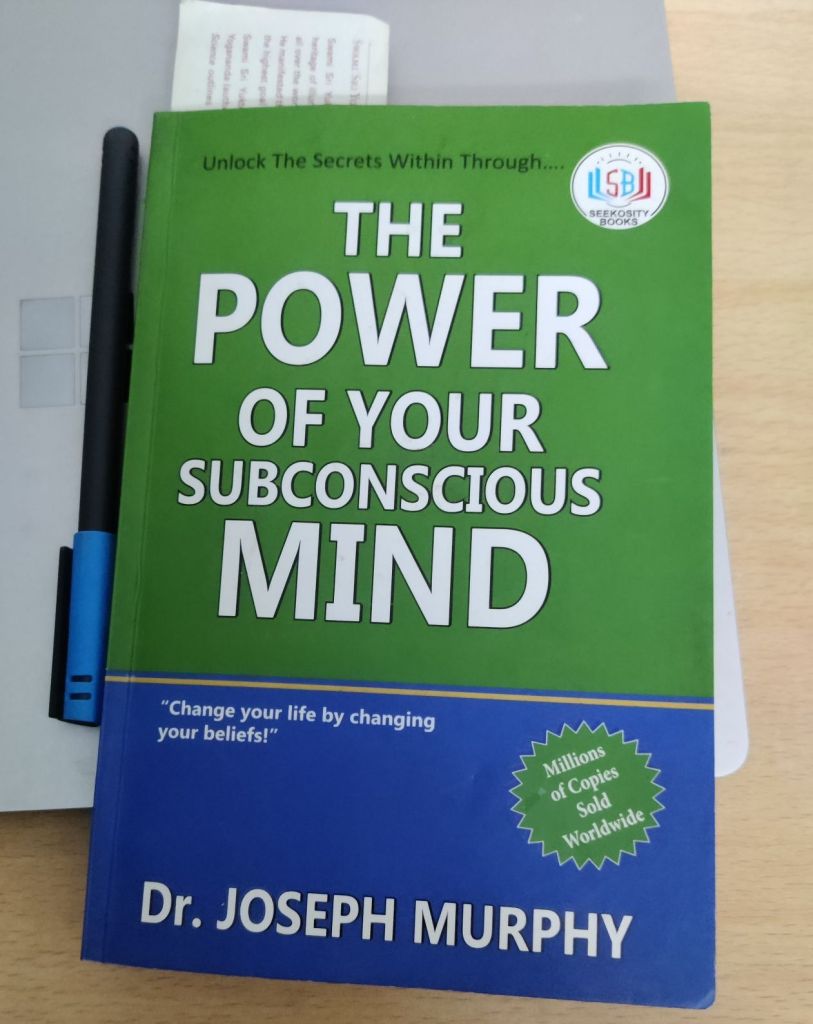
GenZ has taken to slow reading says an article in the daily. Choose a comfy spot – a garden, a bench, a corridor with least footfall – take a book and savour slowly every word, every line, every para , every page with no hurry to finish it. That is what is slow reading.
I too read The Power Of Your Subconscious Mind by Dr. Joseph Murphy slowly for greater assimilation.
As we all know the human mind has two parts – the conscious and the subconscious. The conscious mind receives various inputs through the five sensory organs – eyes, ears, nose, tongue and skin. Its reactions to these inputs are passed on to the subconscious as thoughts and beliefs. The subconscious is the storehouse. It is also the healing centre and the hub of creativity – the Infinite Intelligence.
Dr. Murphy tells us the various ways the potentials of the subconscious mind can be tapped to fill our lives with happiness, health, healing, peace and abundance. For this the conscious and the subconscious minds have to be in harmony with each other. He cites numerous case studies and generously quotes from the Psalms in favour of positive affirmations and prayers which can effectively bring about this harmonious alignment, thereby, allowing the manifestation of all the good in life.
The book is divided into twenty chapters. Each chapter ends with a summary of the content therein. A transformative read, it occasionally reminds of The Secret by Rhonda Byrnes.
A few points from Dr. Murphy’s chapter summaries:
Great men of all ages had the ability to contact and release the powers of their subconsciou mind.
The subconscious mind controls all the vital processes of the body and knows the answers to all problems. Prior to sleep turn over a specific request to your subconscious mind and witness its miracle working power.
Plant the seed of faith (idea) in your mind , water and fertilize with expectancy, confidence and conviction. Mentally and emotionally unite with that idea. What you consciously affirm do not negate or counter it after a few moments. This will neutralise the good that has been affirmed. Believe in the reality of your idea, plan or invention, and as you do, it will become manifest.
The tendency of the subconscious is lifeward. What you affirm consciously and feel as true will be made manifest in your mind, body and affairs. Affirm the good and see it manifest. Choose your thoughts cautiously. The subconscious accepts the dominant thought. It does not argue or contradict. Negative thoughts are stumbling blocks. Substitute the negative thoughts by positive thoughts.
You do not always get the answers overnight. Keep on turning your request to the subconscious mind. But you must not doubt or question its powers. Guidance comes as a feeling, an inner awareness , an overpowering hunch by which you know what to follow. Think wise and right to get the right response from the subconscious.
Right action, right thought, right belief, right words and right approach will direct you to peace, harmony, prosperity, security, happiness, health , creativity and wealth.
Love is understanding, good will and respecting the divinity of the other. Rejoice in the success, promotion and good fortune of the others. In doing so, you attract good fortune to yourself.





What is your view on William Shakespeare’s statement, “There is nothing either good or bad, but thinking makes it so”? if we were to equate good with right
LikeLiked by 2 people
This is also what Dr. Murphy says in this book.
LikeLiked by 1 person
I also believe the human mind is a powerful tool and that we have yet to understand even a small portion of its capabilities.
This seems like an interesting read. I’ll have to add it to my “to be read” pile. 🙂
LikeLiked by 1 person
Agreed wholeheartedly. You can refer to it time and again. Thanks for reading the post.
LikeLiked by 1 person
Just be happy for other’s success is a good attitude. The book’s message is so similar to Rhonda’s perspective. Love it, gc
LikeLiked by 2 people
Yes, Hazel. Positivity comes from our attitude towards others. The book also reminded me of Rhonda.
LikeLiked by 1 person
Through prayers,gratitude, positive thinking and good thoughts we can achieve peace and happiness.It is how sufis,rishis,saints turn their souls into Nafs-mutmaina which means a Soul at Peace.
It never means thinking makes a thing good or bad,it means to have positive thoughts and actions which in turn will bring positive results in a person’s life.
As children our grandparents and parents advised us never to say think or say bad words as they return.
LikeLiked by 2 people
Dr. Murphy gives an example while referring to Shakespeare’s quote. If anyone criticizes you it can be taken badly or it can be taken as a good opportunity for self introspection and self improvement, if required. It is how we react to a situation, thought, view that defines it for us. Nothing is good or bad but it’s our own thinking that gives it the colour of good or bad.
You are right Nusrat, ancient wisdom also speaks of the same things as does this book.
Even my grandparents and all the other elderly members of the family had the same ‘hidayat’ for all of us.
LikeLiked by 1 person
फिर में ने इस good Or bad वाली quote को सहीह से समझा नहीं बल्कि में तौ कहूँ गी बहुत सराय लोगों ने नहीं समझा.आप जो कह रही हे इसका मतलब तब यह quote ठीक हे.
Shukriya
LikeLiked by 2 people
चूंकि मैं बहुत लंबा पोस्ट नहीं लिखना चाहती थी इसलिए सिर्फ सार ही लिखा है।
LikeLiked by 1 person
बढ़िया गीता दी,आप से हम सीखते हे, अच्छे दोस्त भी खुदा की blessing हे
LikeLiked by 1 person
Same feelings here. आज मैने दीदी से कहा चलो कश्मीर चलते है। मेरी दोस्त मुझे बुला रही है।
LikeLike
आप ने अच्छा किया,उनको राज़ी करो आने के लिये और आ जाओ
LikeLiked by 1 person
👍👍
LikeLike
Thanks for sharing these brilliant ideas Geeta.
LikeLiked by 1 person
You are most welcome dear Sadje. It’s my pleasure.
LikeLiked by 1 person
Thank you dear sister
LikeLiked by 1 person
This was such a calming and insightful post, Geeta! I love that you started with the concept of ‘slow reading’—taking the time to digest every line without rushing really changes how deeply ideas like Dr. Murphy’s sink in. The takeaway about planting a seed of faith and not neutralizing it with doubt a few minutes later is such a powerful practical reminder. I really enjoyed Nusrat Khan’s reflection on how this mirrors ancient wisdom and the state of Nafs-mutmaina, and I completely agreed with Hazel that rejoicing in others’ success is one of the best ways to invite positivity into our own lives. Thanks for sharing such a wonderful summary!
LikeLiked by 2 people
Thank you OM for your deep engagement with the post and the comments on it. Slow reading turned out to be a very gradual learning state of mind. Thank you for appreciating it. Nafs-e-mutmaina is a brilliant and ancient concept which the sages of yore have strived hard to achieve irrespective of their religious pursuit. There is a keen spiritual element in this book which is very appealing.
LikeLiked by 1 person
Nafs-e-mutmaina—that state of a calm, contented soul—captures the essence of slow reading so beautifully. Reaching that quiet state of mind through reflection is such a universal pursuit across traditions. Although I’ve heard the term before but today I read about in detail. Earlier I have read a lot about Hazrat Nizamuddin Auliya and Baba Farid who used to practice Hatha yoga and Nafs-e mutmaina. It’s so interesting that all the physical and spiritual practices which elevates our soul don’t value religious boundaries much rather they serve the better world.
LikeLiked by 1 person
This was a post I went through the comment section! Very thought provoking write up! Yes, need to believe in ourselves!
LikeLiked by 1 person
Very well summed up Ganga
LikeLiked by 1 person