The Buddha In Us


There are heavy  and not so heavy reads. Then there are very light and comfy reads. There are comedies and romances. There are page turning thrillers, suspenses and mind boggling whodunnits and howdunnits. There are fun and cozy mysteries. Fantasies and mind awakening self helps, motivational and spiritual uplifters. But have you read a cute book ? A cute read?

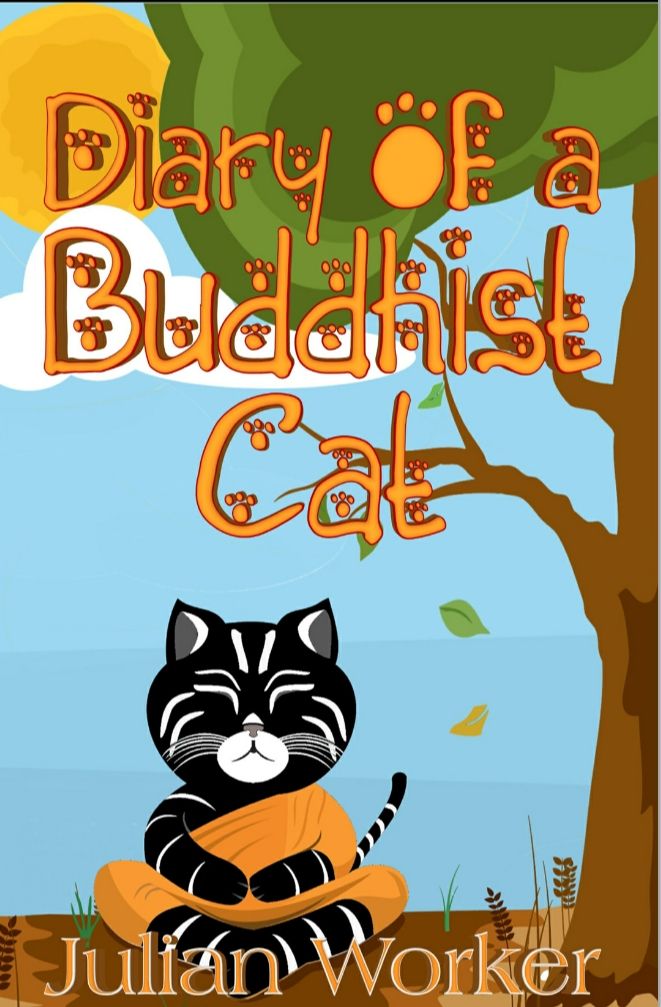
Today I am going to tell you about one such book whose protagonist is Frederick or Freddie , the cat, who thinks he is Buddhist. He is curious, ambitious, an explorer, a knowledge seeker and like  a true Buddhist a thorough follower of the eightfold path of righteousness and good deeds. He believes in peaceful coexistence and the good side of humans and animals and birds and bees.

Freddie has been adopted by two loving and caring humans, John and Mary, and lives in a house with another cat called Gemma. Gemma is a contemptuous , opportunistic human hater with different levels of snear which she applies on Freddie to demean and intimidate him. In short, Gemma is the exact opposite of Freddie. Then there is Sid the Crow (along with his extended family), Freddie’s self appointed mentor, who makes it his mission to introduce Freddie to the neighborhood and caution him about not to cross the busy road without Rufus the Squirrel who is an expert navigator. There is also Freddie’s next door neighbour Holly the Hamster.

Freddie has been brought up well by his mum whom he misses very much. But he remembers all the lessons taught by her and follows them without fail. He is kind and respectful to all fellow animals and even non living things like the wire mesh which helps him climb up and down the gym. He bows to his bowl of food before eating. He chews his kibbles 42 times and leaves a little food in the bowl for the next meal. He does not overeat which keeps him svelte.

Being explorative he visits the kitchen and nibbles on forbidden food sometimes. Being observant he knows how to open the library (situated in the neighborhood) door working on pressure pads and also the photocopier. Being artistic he sits on the photocopier and makes a copy of his rear end. Being non materialistic and detached  he leaves his creation on the machine which is later discovered by the terrified, blue haired librarian, Angela or Ange, who thinks it’s a work of a ghost and gets the premise exorcised. Though Freddie is a bit hurt that the humans do not have the acumen to appreciate his artwork yet being soft hearted  Freddie feels sorry for the tearful and frightened Ange. Being friendly he gets along with all the neighborhood birds and animals. Being thankful he is filled with gratitude even for the littlest pleasures of day to day living (read exploring). He even bows to the Lancashire Rose, if you know what I mean. Being stoic Freddie takes fame like a “fleeting  comet in the sky”. Being philosophical he observes, “The more I travel, the less I know about where I’m going. There’s no time like the present.”

Freddie’s human parent, John, is also appreciated by the birds and squirrels because he leaves nuts and seeds for them and cleans the litters off the park.

However, nobody likes Gemma who spreads negativity by her hateful and scornful attitude towards all and sundry. She criticizes Freddie for being collaborative with the humans. She does not approve of Freddie being pally with the crows. She cynically notes that it will not take minutes for them to pick on Freddie’s carnal remains if he happens to get crushed while crossing the road. But Freddie being Freddie , is not bothered about what happens to his carcass  once the soul leaves his body.

For Freddie every day is today. Not yesterday or tomorrow. Being a voracious reader and philomath he is keen on visiting the library at least once a week which requires him to master the exit and entry without getting noticed. He is helped by the corvine team in this adventure. Being innovative he finds ways and means to take Holly and Rufus along with him to the library.

But this book is not about Freddie’s exploits in the library or the park. It’s about him being empathic to his fellow creatures. It’s about observing them and not just seeing them. Understanding them and just not watching them. To know who needs help in what and how to make it possible for them to be better placed in life.

Being a good listener and despite his differences with Gemma he listens to her and learns why she is so hateful towards humans. Every reaction has a reason. Freddie’s compassionate heart touches Gemma  and some of his “Buddhist” traits rub on her too in the long run.

The characters of this book may seem like those out of a kid’s play. But Julian Worker ensures that they exude charm and higher intelligence so that there’s something for the humans to learn from them.

This book can have a wide spectrum of readership – from kids to young adults to adults. Every age group can perceive the story and the characters in their own way. For some it can be just a fun read. For others it can have a deeper meaning.

I think what the author wants to make his readers meditate over is who we want to become? Do we wish to become like Freddie who lives life fully and honestly in the moment? Or like Gemma who carries baggage that makes her see the world through the lens of cynicism, anger and vindictiveness?

Think over…
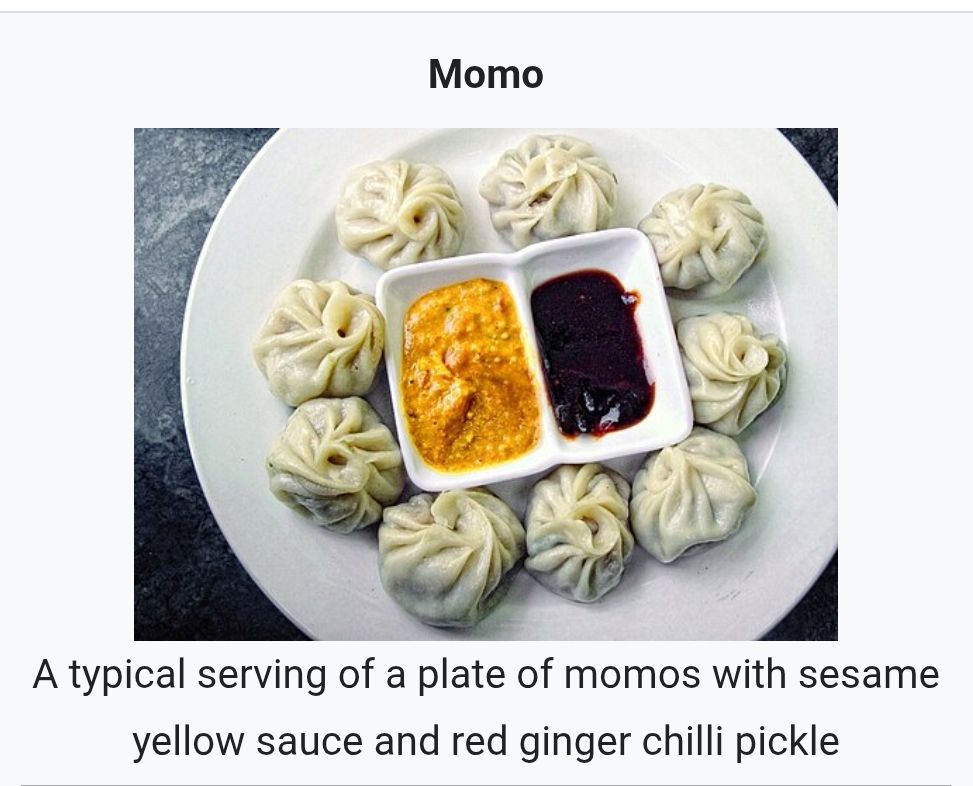
In Search Of Momos


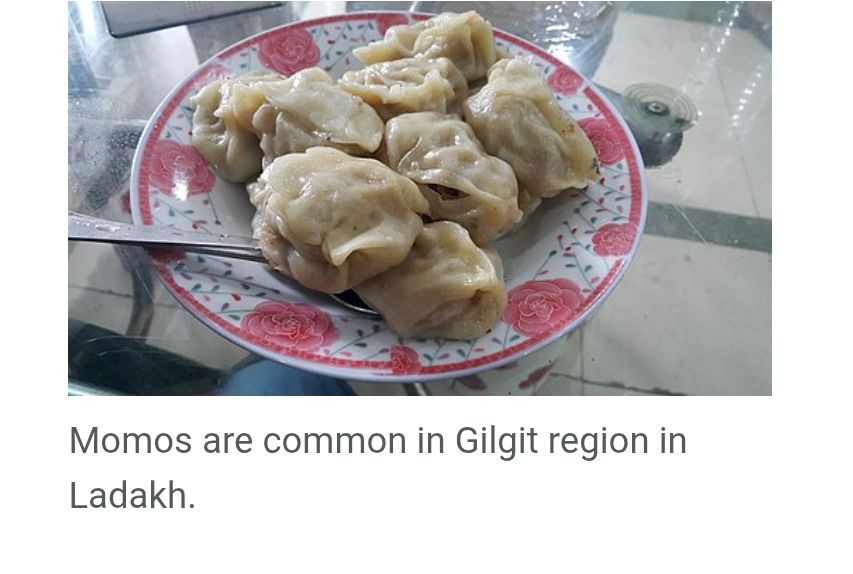
Momo is a type of steamed dumpling with fillings – part of Tibetan and Nepali cuisine. It is also popular in the neighbouring countries of Bhutan, Bangladesh and India. Tibetan momos are generally half moon shaped whereas Nepali momos are round. Momos are served with a chutney or sauce which is called achaar flavoured with spices and herbs  used in many South Asian cuisines.  Momos are also used in soups.

Momo is a Tibetan word, probably borrowed from Chinese, used for steamed wheat buns and breads. Legend has it that the 7th Century Nepali Princess, Bhrikuti, introduced Buddhism along with momos in Tibet.  However, despite the legend, it is generally believed that momos travelled from China to Tibet to Nepal where it is dated back to almost the 14th Century.

The Tibetan Uprising of 1959 saw a large number of Tibetan emigrating to India bringing momos along with them. The Civil War in Nepal saw Nepalis coming to India in search of livelihood. They popularised the ‘Himalayan’ style momos in the Southern half of India – Bangalore and Chennai.

The typical Tibetan momos have a filling of meat (yak) or potato and cheese. To cater to the large population of vegetarians in India momos with mixed vegetables and paneer stuffings were introduced. For non vegetarian Indians the meat filling got substituted by minced chicken.

The fillings are stuffed into a thin layer of casing of flour and steamed. It’s soft, non spicy and has no oil. The chutney or sauce served with it is hot and spicy. Momos have become a very popular part of Indian Street food. Vendors selling momos have mushroomed in every big and small market of the Capital. Momos are a big youth favourite snack. Many innovative variants of  momos are also served in local and posh restaurants like fried momos, tandoori momos, achaari momos, afghani momos, wheat momos etc.

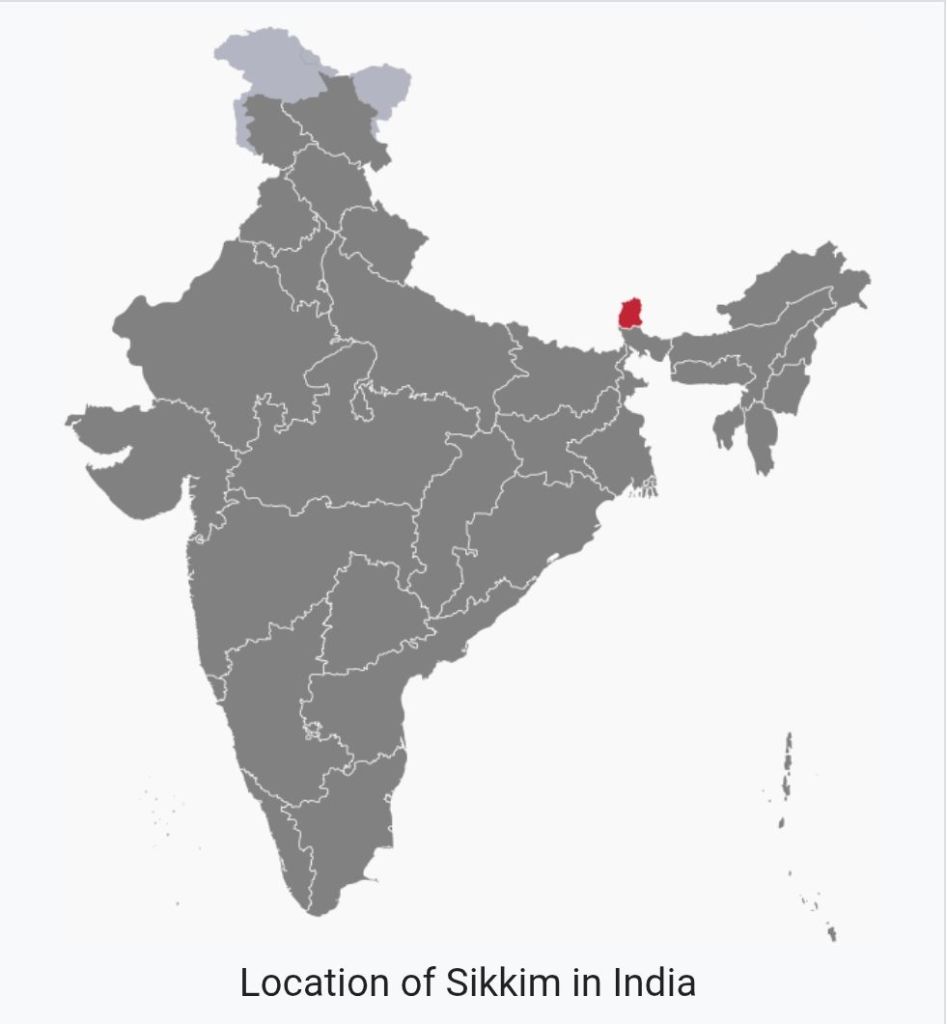
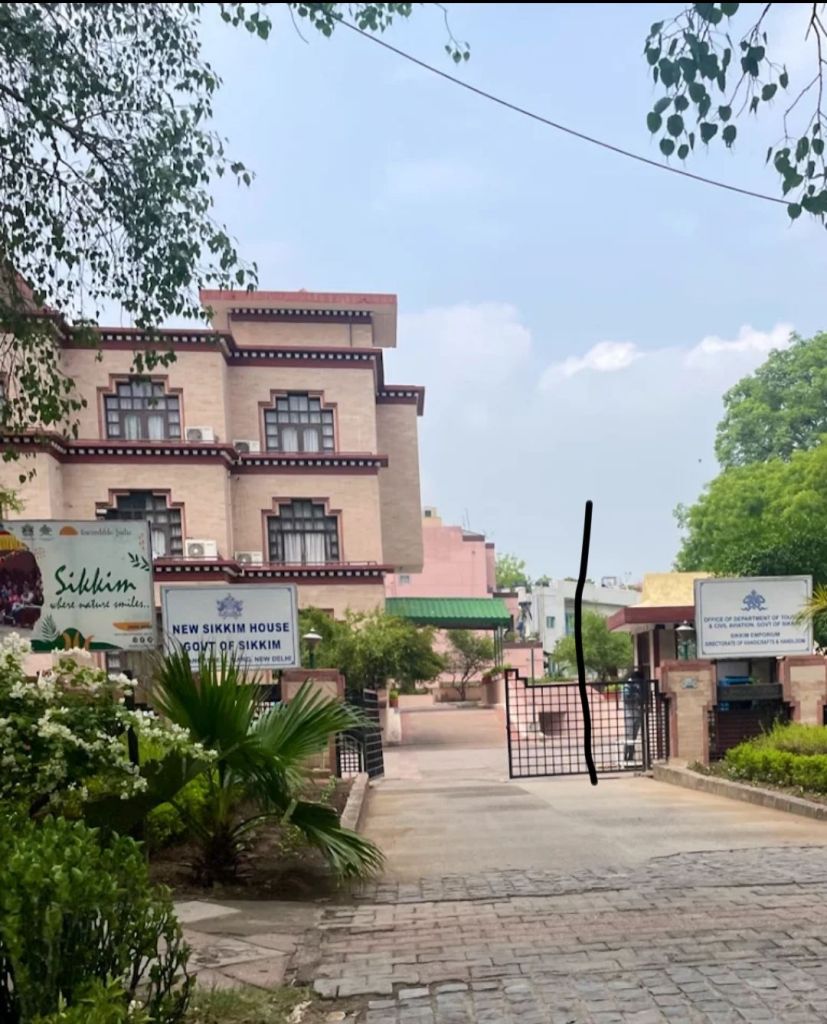
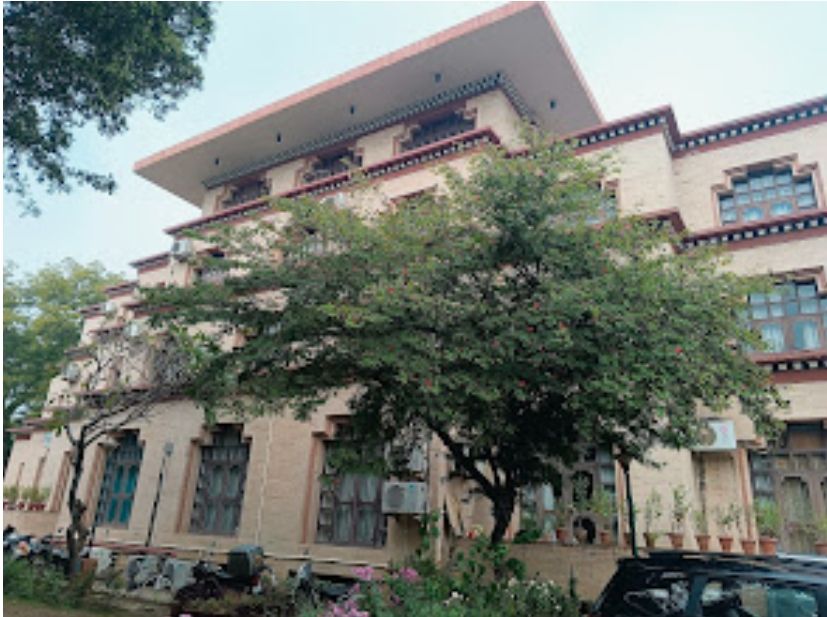
Sikkim House in Delhi is the official State Guest House of Sikkim representing its authentic cuisine, culture, arts, handicrafts and administration. Sikkim , nicknamed as Valley of Rice, is a North-eastern State of India known for its biodiversity, scenic beauty, alpine and subtropical climate. It is the least populated State and also host to Kanchenjunga, the highest peak in India and the third highest on Earth. Sikkim shares its border with parts of Tibet, Nepal, Bhutan  and West Bengal. Its capital is the beautiful city of Gangtok which is a high attraction point of tourist visits in India.

The restaurant housed in Sikkim House serves chicken and veg momos with authentic Tibetan and Sikkimese flavours.

Photo Courtesy Abdul Muzak

Soon after my retirement, me and my sister, in one of our adventure sprees, visited this restaurant to have a bite of the momos. The freshly made  Chicken momos were really good with subtle flavours. I did not like the vegetable momos that much. The serving time is long as they prepare the momos on receipt of the order and serve hot and smoky.

The restaurant was spacious but a little stuffy as the doors opening on the back space were shut. I did take a lot of pictures but somehow they have been deleted from my mobile. As far as I remember , the decor was a mix of red and green and yellow with decorative motifs and photographs.

Momos can be made at home also. For the culinary queens it’s a test of how soft their dough can be so as to churn out melt-in-mouth momos which is the real yardstick of authenticity and perfection.

Sikkim House

Foodies can venture into this joint if into momos. I guess evening time will be more interesting.

Check it out.

Source and Pics : Wiki and Google

FF : Them


This is in response to Rochelle’s Photo Prompt Friday Fictioneers.

Word Count : 100

Them

When the Government decided to construct the Office Building ‘objection‘ was raised  from the most unexpected quarters –  the dead. 

It was an unauthorised graveyard.

But the buried  considered it their own. 

So, it took more time than planned.

A wall in shambles.

A broken window.

A door unhinged.

Cause unknown.

Yet the Building got completed.

Offices opened.

But the protest continued.

In due course, traffic exploded.

Gadgets got installed.

Professionals came to rule.

They questioned…

But the oldtimers?

They shook their heads and swore by them.

You see they had seen what the others had not.

(97 Words)

***

The flash fiction is based on the legendary tales surrounding our Office.

A few graves are still there. Legend has it that these could not be removed.

You can read the other posts here.

Upbringing


Upbringing simply means how we are brought up in life first by parents, then by the educational institutions we attend, then of course, by the interactions with the extended family and friends and in the larger realm, the influence of the society and various agencies of governance and non governance. It’s a life long process whereby we keep on learning, unlearning, modifying what we have learnt earlier and adapting to fresh scenarios as they emerge from time to time. Our upbringing has a bearing on our personality and how we conduct ourselves in life. And also how our life proceeds.

Generational conflict has become a very common topic of debate  today in so far as parenting is concerned. There is a gap in understanding and communication between the parents and children. Perhaps it’s because both belong to different time zones. Today’s generation is more informed , is able to deal with technology, has more exposure and knows what they want in life or so it seems. The earlier generation used to be basically guided by  parents and elders, teachers and mentors and followed whatever they said was right and must. However, exceptions were there to prove the rule.

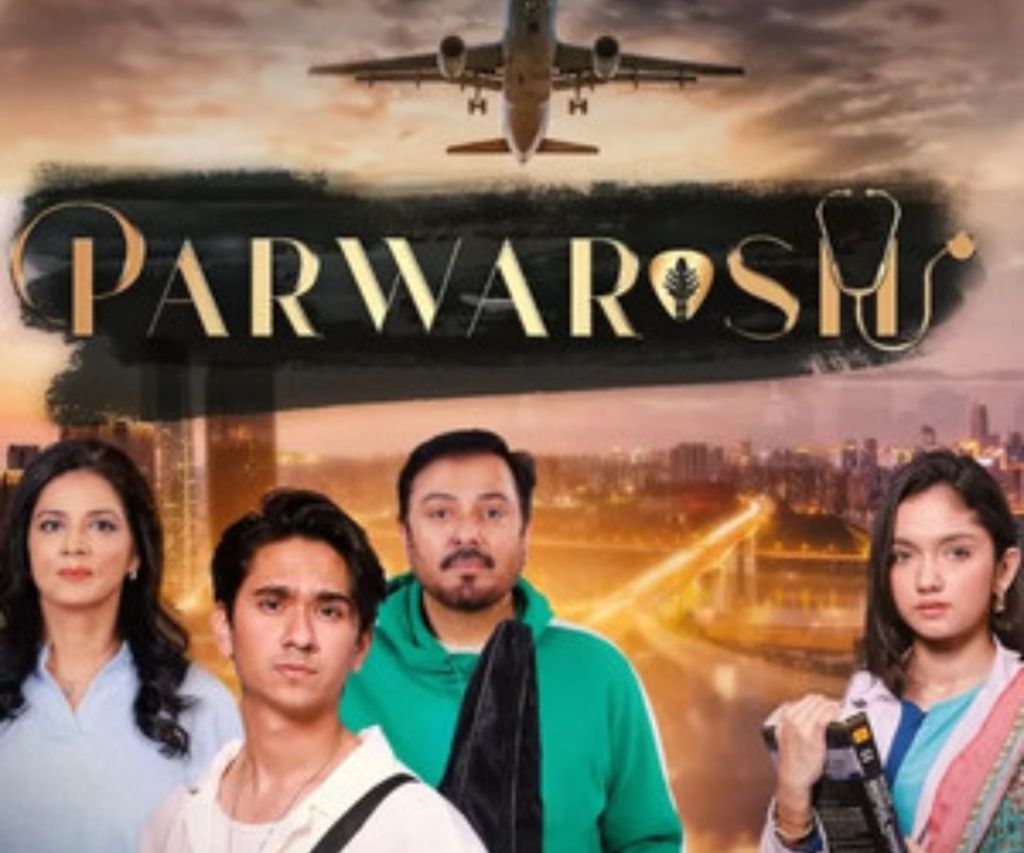
To be friendly with offspring is a modern concept. But what happens when the parents are old school? This is the crux of the Pakistani serial , Parvarish, (which again means upbringing), directed by Meesam Naqvi.

Jahangir and Suleman are brothers. Jahangir is based in Canada and Suleman is settled in Pakistan. Both love , respect and care for their parents. Jahangir showers expensive gifts on his parents , pampers Suleman’s children and in general expresses his love by expending money. Suleman is a job holder and does his best for the family within his financial means.

Suleman and Panha are doting parents and friends with their children. Amal, the daughter is an ace medical student and extremely caring and nurturing by nature. However, she takes a lot of emotional and mental load on herself which gives way to panic attacks.  Sameer is not such a bright student but is a loving and obedient son.

Whereas Jahangir is a control freak and believes in charting out the career paths and lives of his children because he has sired them. He does not believe in consultation with his wife Mahnoor or his children on any matter. One fine day he wraps up his business abroad and returns home with his family for good. Eventually it comes to light that his decision to come back is based on the fear that his children are going astray under the influence of an alien culture. Aaniya, his daughter, has psychological issues and considers herself the reason why her parents bicker all the time. Wali, the son, is passionate about music but is forcibly made to study medicine.

Aaniya and Wali are like fish out of water away from their known turf and friends, compelled to stay in a joint family set up sharing rooms with cousins, getting used to a totally different set of values, rituals and relationships and above all the lack of freedom and say in matters concerning their own lives.

Maya is Amal’s best friend. She is also an ace medical student. However, Maya’s father believes that her daughter’s security lies in early marriage so that there is a male figure in her life who can take care of her. Maya is, therefore, Waleed’s betrothed, an upstart who works in Dubai. Maya’s mother is always in the role of a referee trying to strike a balance between her husband’s outdated ways and her children’s aspirations. Maya also has a younger sister, Mashal.

Maya and Wali are class mates and soon come to like each other. But Maya keeps her engagement a secret from Wali. Waleed, who is possessive about Maya, often drops in at her college without prior intimation, whenever he is in town. This irritates and confuses Maya. On one such occasion, Wali and Waleed get into a fight. Waleed not only complains about the incident to Maya’s father but also humiliates him. Resultantly, the engagement is called off. Maya’s father , in turn, complains to Wali’s family which leads to a heated argument between Jahangir and Wali. Wali storms out of the house promising to return only when he is financially independent.

Wali’s rebellion disrupts the familial landscape. Aaniya goes into depression often contemplating suicide. Amal is unable to bear the pressure of being an exemplary daughter and confesses to Sameer that she has feelings for her cousin, Wali. Sameer starts spending  more time in bad company, gets arrested attending a rave party, is taken out of police custody and brought home by his father. However, Suleman does not criminalise Sameer’s  action instead makes his family understand that a child has to cope with many influences outside home including peer pressure and the urge to be cool and upmarket. A guilty and repentant Sameer promises not to fall prey to such temptations again.

Three sets of parents with three different sets of ideologies on parenting. Should they be judged because of the way they are?

Parvarish is a multi layered drama – a whistleblower for parents. A wake up call to make them aware of the expectations children have of them. It is not always the other way. There are many modes of resolving conflicts in relationships. Accusations and counter accusations widen the rift. Discussions and conversations open the doorway to camaraderie and goodwill required even in case of familial bond. To nurture is to be empathetic and give space to each other. A family is a unit. But this unit comprises different individuals, doesn’t it?

At the same time, it is a gentle nudge to children not to misunderstand their parents readily. It has to be understood that all parents are not equal. Every individual has his or her own way of expressing love and concern. If parents are stern it does not mean they do not care for their children. Strictness can also stem from insecurity and a strong desire to protect the loved ones from the big bad world.

Parents feel they have more experience and are therefore more knowledgeable to guide the children. Children, on the other hand, think they are capable enough to take care of themselves and do not want their parents breathing down their neck. The solution lies somewhere in between – the Golden Mean where both the generations can intersect and connect.

Children have differences of opinion with their parents not acknowledging the fact that sometimes parents know better and what they do or don’t do is to prepare them for the future. On the other hand, parental aspirations should not be forced down on the children. Even if their pursuits and inclinations are not what the parents wish for, children should be given the leeway to try their hand irrespective of whether they succeed or fail. If they succeed it’s a dream come true. If they fail the parents are there as fallbacks. Aren’t they?

All relationships are two way traffic. The stop, wait and go ahead signs are for both sides. One has to just recognise these signals and move accordingly.

This post is incomplete without your participation by way of comments. Tell me your thoughts on the issue. Respectful dissent is welcome.

Pic from Google

Simple Stories Deep Messages


Here is a  brief recap of my recent watches on Netflix :

The Life List

Alex is heartbroken after her mother’s death and even more surprised to learn that she is no longer the CEO of her mother’s cosmetics company. Instead she is handed over the Life List, that she herself had prepared when she was thirteen, to complete the tasks therein within a period of one year in order for her to get her deferred inheritance.

The list includes mending her relationship with her father who had separated from her mother when Alex was in her teens, taking up a challenge which scares her the most, going back to teaching which was/is her passion and finding true love.

On completion of each task she is to be handed a video of her mother by her young lawyer, Brad , to prod and encourage her to go further.

Will Alex be able to achieve what her mother wants her to and move a bit closer to what she really is?

A mother’s love and endeavours to guide her  daughter even after death is poignantly manifest in this story.

Also how by challenging your own potentials and facing your inner fears can you lean closer to your true self.

Sofia Carson as Alex or Alexandra, Kyle Allen as Brad and Connie Britton as Elizabeth, Alex’s mother, among others make the narrative of this movie moving and real.

The Intern

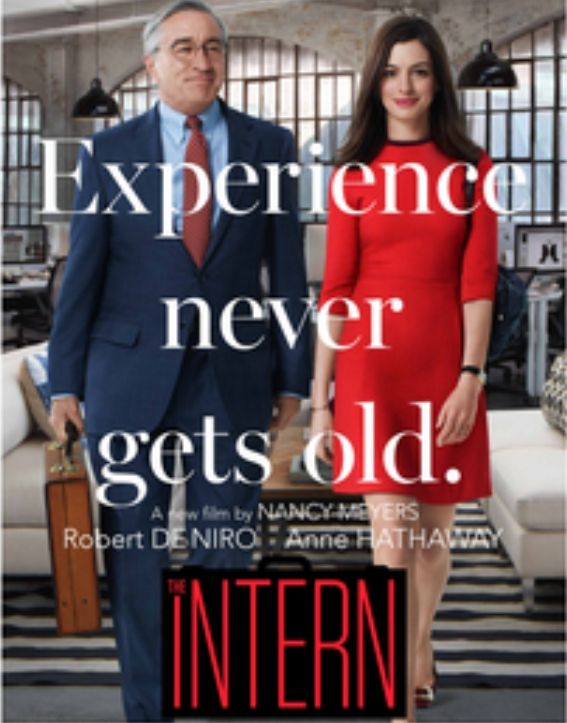
Seventy year old retired executive, Ben Whittaker, takes up the job of a senior intern in a fashion start-up out of sheer boredom of retired life. The start-up is run by a young, passionate workaholic Jules Osten who is looking for an able CEO as her own replacement  because of investors’ pressure and also because she wants to give more time to her personal life – her stay-at-home husband and her little daughter

At first though sceptical, Jules eventually comes to trust and rely on Ben. In due course a beautiful bond is forged between the two which helps Jules tide over the downturns in life.

The film reinforces that friendship does not have an age bar and can blossom between two unlikeliest of persons if there is understanding and empathy.

Robert De Niro as Ben and Anne Hathaway as Jules are heartstealers.

My Oxford Year

Anna De La Vega is an American student who gets enrolled in the University of Oxford to learn Victorian poetry which is her passion. Finishing the course she has plans to go back and rejoin her job as a financial analyst.

But as unplanned as it is, she falls in love with the young and handsome DPhil student and tutor, Jamie Davenport. At first it’s just fun but as their involvement becomes serious she has to revisit her decision to move back and face the unpredictability and harsh truth of life with courage and conviction.

This is not a “they lived happily ever after” kind of love story. Yet it’s not a “broken heart wallowing in grief” story either. It’s about strength to cope with pain. It’s about living with the wistful memories of love and togetherness. It’s about taking a path unthought of and walking alone with dignity.

The film has Sofia Carson as Ana De La Vega and Corey Mylchreest as Jamie in their sparkling chemistry.

All these three movies have very simple stories but the messages belying the simplicity are powerful and introspective.

Do watch if the excerpts kindle an  interest.

Pics from Wiki

A Paradigm Shift


It’s been raining cats and dogs since I don’t know when. Dawn looked like midnight. It was so dark and thunderous. To top it , the fridge was absolutely empty. Not even a tomato or a potato – the staples in the vegetable tray. Kalu, our mobile vegetable seller,  has scooted off to his village for a month which is kind of extendable to two to three more. I am told this is the sowing season for them. The online suppliers were not ready to deliver till a certain time.

An anomalous exigency for a once magpie-ish hoarder who believed in keeping the larder overstuffed to the extent that the veggies would rot in no time leaving no other option but to throw them away and guess what refill the tray again.

***

When the online purchase did get delivered the vegetables looked as though they had scurried out of a swimming competition. So I had to settle for khichdi or khichuri as it is called in Bangla) which is the quickest make, best comfort food on a rainy day.

***

In the meantime, did I tell you I repositioned the furniture in the hall so that I can now sit on a double cushioned sofa and watch the world out the window. Especially, on days like these when I am surged with  constant waves of inertia.

And sometimes in my state of indolence I do pick up the mobile and click a pic of Ms. Crow, my matronly neighbour , who has also segued  her visiting time from early afternoon to early morning.

***

Today is also Rakhi or Rakshabandhan which means Bond of Protection. On this day the sisters, cousins or anyone who is looked upon as a sister  ties a beautiful adornment called rakhi on her brother’s wrist and the brother takes a vow to protect her from all ills throughout his life.

There was a time when my favourite rant was how all our festivities are father, brother, son, son-in-law and husband centric. I guess it was rather fashionable to do so and not exactly a war cry for women’s liberation.

***

A rainy day coupled with Rakshabandhan means traffic snarl all over the NCR (National Capital Region).

One of my house helps took an off today. The other one came in late, soaked to the skin, in spite of that solid umbrella!

***

I am writing more often now. It’s an attempt to be disciplined. Implying readers are to be smothered by at least one post a day.

Figure that…


An Unexpected Fiasco


A flick of the remote and I chanced upon Bawaal (Fiasco), a Hindi movie on Amazon Prime. The star cast, especially, the lead male actor, with his lisping accent, did not present a preferable option. Another slapstick comedy, I thought.

Nothing much to do I continued watching till it dawned that this was not what I had guessed.

In the backdrop of Lucknow , the heritage city of culture, cuisine and intricate sartorial extravaganza, an average boy of an unassuming middle class family, Ajay (or as fondly called Ajju Bhayya, by his cronies), believes in surviving on the egg shells of pretentious image and make believe ambience. He has managed to orchestrate a superfluous aura around himself of an exemplary teacher and a maverick who is capable of creating practically unachievable larger than life grandiose by the flick of an imaginary wand.

Within the privacy of his bedroom he is a callous husband married to Nisha who unfortunately happens  to be an epileptic. He shuns her. Refuses to take her out lest she has an attack in public tarnishing his well cultivated image of suavity thereby reducing her to being a veritable social outcast.

He is a disappointment to his grounded parents too whose well meaning advice falls on deaf ears. Blinded by the glit and glam of an alternate universe Ajju aspires to be a part of, knowing fully well he will never be, he perpetuates the facade of a magical  overachiever.

Until one day he commits the mistake of thrashing one of his students who turns out to be the legislator’s son. Consequently, he is suspended for one month corporal punishment being a penal offence as per law. His reinstatement is now subject to the findings of an impartial Committee set up to evaluate his contribution as a teacher.

What does Ajju do to make amends ? He does what he is good at – engineering an extravagant ploy to reinforce his status as an extraordinarily devoted History teacher. He manipulates his father to fund a trip to Europe – Paris to Amsterdam to Normandy to Berlin to Aushwitzt – proposing to take online classes  on World War II from these historical venues – a real time learning for his pupils –  irrespective of his job being under suspension.

To his parents he pretends this trip to be an opportunity to make up with his wife. She is to accompany him though on the aside he tells her to be at her parents’ till his return. Nisha refuses to do so. Grabbing this as the proverbial last straw to save her marriage she compels Ajju to take her along.

And thus begins a transformative journey – from a hogwash to humungous learning – for Ajju, the incompetent to Ajju, the indubitably changed man. From Eiffel Tower where the French, before vacating the city so as to save it from the ravages of the war, had rendered the lift inoperable so as not to allow the Nazi the spectacular view from the top to Omaha Beach in Normandy where ten thousand young Allied soldiers were brutally killed by Germans to Annie Frank’s house – the basement where the family hid and knowing they would be caught anytime, Annie, an aspiring writer continued to keep journaling – to the Berlin Museum to the gas chambers of Aushwitzt to lastly meeting an Aushwitzt survivor, Ajju walks the path of self realisation confronting his weaknesses and lacking – how unfit he is as a teacher, how insincere he is as a son and how totally unequal he is to his smart, intelligent and resourceful wife Nisha.

This understated cinematic narrative boasts equally of undramatic performances though there are many moments in the script which could have been over exploited. But the critical question that the film raises is why it takes the most deplorable genocide in human history and the massive massacre of World War II for the protagonist to realise that life is too short for personal squabbles and petty inferiorities and too flimsy to hold on to the membrane of pretences for a happily gloating existence? Is it because, without fully realising the import of living in a war torn era where a sudden act of extremism or an unprecedented air crash or a full blown border skirmish can anytime blow off the cocoon of comfort , the complacently oblivious consumers continue to being ruffled in their daily rut?

Ponder for a while…

Pic from Google

FF : Together


This flash fiction is in response to Rochelle’s photo prompt for Friday Fictioneers. .

Word Count: 100

Together

Nowadays we do not talk much.

We used to. Not anymore.

But we do things together like going for walks, taking meals, reading , lounging, thinking, being in two different worlds.

And drinking coffee from two different pots – one silver and the other glass.

“It’s companionship”, says mom.

But I sometimes wonder whether we have forgotten to talk  or we have nothing more to say to each other.

The silence surrounding us is weighty and pressing till we learn to ignore and turn our backs to it.

And go off to sleep.

And inhale and exhale together without steam.

(97 Words)

You can read the other posts here.

A Knock To Awaken


I come back again with a Pakistani Serial  recently  watched. It deals with contemporary social issues which require to be addressed from the standpoint of an alternate perspective.

Dastak directed by Marina Khan deals with broken marriage, rehabilitation of a divorced mother and societal stigma with regard to single parenting.

Soon after finishing college Kiran is married off to an unhappy man, Saif,  who doesn’t want to be married despite doubts raised by Kiran’s progressive maternal uncle. In no time Kiran realizes that her husband is in love with another woman, Faryal, and her presence from her life cannot be obliterated. Her in-laws are aware of this  illegitimate alliance yet  have compelled their son to marry Kiran because they do not approve of this other girl.

Kiran tries hard to adjust considering the feelings of her own parents. She is liked by all except her husband. But the constant shadow of the other woman in her life and her husband’s displaced anger manifesting in aggression and violent reactions towards her foil all her efforts to  elevate a dysfunctional marital existence into  successful conjugal harmony.

A day comes when she has to leave her husband and also her new born baby in a fit of impatience and frustration. But she soon  realises that she cannot stay away from her infant son, Shani. Her husband is also not interested in keeping the baby. So he barters the baby boy for freedom giving full custody of the child to Kiran.

Divorce follows. Faryal and Saif get married. But it’s an unhappy marriage as the mother-in-law cannot accept Faryal and keeps comparing her with Kiran. Further, it also subsequently comes to light that Faryal can never bear a child.

On the other hand, Kiran struggles to become financially independent with her mother’s support. Her father, of course, is dead against her career of an event planner which entails flexi timing, late home coming, leaving the child with her parents due to unavoidably prolonged  working hours. Ultimately, Kiran decides to have her own set up forced by her father’s obstinacy.

At this juncture, Moieez, Kiran’s former college mate, re-enters her life. Moieez belongs to an affluent family and has always nurtured soft feelings for her though unexpressed. He now wants to marry her. But Kiran is undecided because she knows Moieez’s father does not want a divorcee as his daughter-in-law. He also suspects that she is a gold digger. 

However, on Moieez’s insistence they get married. Moieez has a beautiful relationship with Kiran’s son. All  are happy together except the father-in-law who has somehow grudgingly accepted Kiran but not her son, Shani. To make things worse, Kiran’s ex-husband, Saif,  now wants  his son back because he is his blood, right ? Kiran does not know how to handle this chaotic situation because she has never told Shani about his biological father.

How will Kiran cope with the overbearing stress of an uncooperative father-in-law whom Shani has nicknamed “Monster Uncle” ? How will she save her second marriage with a man she loves and respects? What will happen to Shani when he is told that Moieez is not his real father?

The narrative of this engrossing serial becomes all the more relevant in the backdrop of the joint family system wherein the patriarch is the decisive figure as to how the women and even the men of the household are to conduct their lives. Kiran’s first marriage is her father’s decision. He has difficulty in accepting the failure of the marriage arranged by him. After the fateful divorce he wants his daughter to consider re-marriage without being sympathetic to her wish to become financially secure to bring up her son without anyone’s help.

Kiran agrees to marry Moieez , in spite of her would-be father-in-law’s unwillingness, to fill up the vacuum in Shani’s life created by the lack of a father figure. Moieez fits in perfectly. The dichotomy in father-in-law daughter-in- law equation wherein the former has reservations in accepting a divorcee of a bahu (daughter-in-law) along with a son by her first marriage is a burning example of effete and hypocritical norms. The woman of the house has to be so called pious, pure, puritan (read untouched) whereas his own wife (Kiran’s mother-in-law) dedicatedly runs an NGO defending and rehabilitating hapless and helpless women (like Kiran?).

The three sixty degree turn in Saif’s attitude to get back his son after five years of ex-communication is again driven by preconceived and prejudicial societal expectations. He wants his authentic bloodline to carry forward the family name completely refuting the idea of an adopted son whom his wife Faryal is emotionally and psychologically attached to. Selfish again he forgets how for a short term gain he himself had given up his son when the child needed him the most.

Dastak means a knock not only to wake the viewers up to these glaring issues marring the progress of a society by at least starting a conversation if not by instigating a retaliation but also to think how to actively participate in changing the narration. Therein lies the power of social drama aimed to instill the dire necessity of imminent change in approach and outlook towards women – their plight under patriarchy even though they are so called educated and conscious of  imperatives to better their lives –  pulled back by existing agencies of social system which are blind to the sunshine of adaptivity and evolution.

The Serial has some power packed performances especially by Sohay Ali Abro as Kiran and Ali Raza as Moieez lending authenticity to the storyline. Their emotional togetherness fraught with hardships , unduly inflicted by their own near and dear ones, mirrors the regression embedded even in upper class ‘enlightened’ society, irrespective of urbanization and the endeavours of developing nations to become unified into the matrix of a world fast graduating into a  global entity culturally fusing the West with the East in the wake.

Surprisingly and interestingly, the Serial also calls for a re-alignment in the protagonists’ mindsets too for a more inclusive and positive upbringing of the next generation emerging out of broken families who are the biggest sufferers in the bargain.

In brief, Dastak reinforces that no relationship or experience in life can be water-tightly compartmentalized into categories of black and white ignoring the ever present shades of grey.  While taking into cognizance the choice of path onward, which may be uneasy but correct, thorny yet in the long run fruitful, the prospect of a fuller, healthier and more encompassing canvas is required to be perceived and sought overlooking the immediate frictions and factions which may colour perceptions for the time being with personal biases and prejudged notions.

Pic from Google

In Search Of A Utopia


Monday evening was my second outing post surgery. The first was to the temple to offer prayer for thanksgiving.

We went to a nearby mall though I am not a mall person. I don’t have any overly interest in brands and window shopping. Of course the food courts are alluring but they are out of bounds now.

I had thought of gifting myself something. Anything. So I bought a nice co-ord set at Trendz which was within my price range. Sis bought something too. (That was totally unplanned. We just ambled in …kind of..)

However, Trendz was not our destination. We had gone in search of a Book Cafe which Google said was situated inside the mall. But it turned out to be merely a Book Store. As you know, there’s a difference between a Book Cafe and a Book Store.

Book Stores are where you go buy books. Book Cafes have a tranquil seating arrangement where you can read sipping coffee or snacking. I am told that Book Cafes are cropping up in the National Capital Region which also doubles as an interim workplace. A modern and updated  version of the good old library. Now libraries are almost extinct. So are avid book readers.

I won’t say people don’t read but they read now on mobiles, laptops, ipads and tabs. Read on the go, they say. But holding a book in hand, inhaling the musty fragrance of its pages , drinking the words and getting lost in the pictures the story creates is a fascinating process which is sorely missed in online readings.  Don’t you think so ? Though I understand online readings are cheaper. And that pops a very practical issue of cost effective reading.

As a child my afternoons and nights were devoted to books. Now we look for a space outside the home where we can do a lot of browsing of our own choice. My idea of an ideal book read space will be where minds meet. Where you can, not only read many books of different genres in peace, but also meet like-minded people, have cozy, healthy discussions, make friends, watch creative people work live, participate in workshops , lounge (read daydream), do research, work on your projects and be part of a community who you can consider your own.  Time no bar. In short, making reading a learning space too.

Additionally, this comfy corner should be pet friendly and smell of fatigue freeing coffee and mouthwatering snacks. The cherry on top! The aroma of tea is also welcome.

Do you have such a space nearby? Let me know. Also, anything else you wish for in your go to Book Corner?

Unfortunately, most of the time I find Book Stores empty which brings me to the crucial question of sustainability. How does business survive in a lean period? Is there really any lean season for Book Stores? If yes,  that’s a pity because I thought books were there at all times. People wanted to read irrespective of the seasons!! No?

The Book Store we visited had no customers which was disappointing. The ones who came did not find what they were looking for. Surprisingly, the store did not have some of the well known bestsellers. Popular novelists.  Choice of books kept in a store is also an important factor in attracting the crowd. Don’t you think so?

Also it’s equally important to provide space to readers who are looking to read from their personal collection in a space outside the four walls of their homes. Do you know a place like that ?

What about soft music playing in the background? Will it hurt focus? How about a small plot of green – relaxing and smoothing? Read amidst Nature!! How about occasional book readings by authors ?

There are many writers, craftsmen, artisans, musicians who do not get appropriate exposure to showcase their penmanship/workmanship. If you owned a space of your own would you lend it to them as a platform? If we are talking of a business module it can be at a nominal cost. What say you ?