
Neelabho Bagchi is an illustrator. He is greatly inspired by another senior illustrator who works under the pen name Abadhut Chaki. When Neelabho’s friend, Poritosh, tells him that he has seen Abadhut Chaki’s residential house in Madhupur, which is viewable from the Shimulpur Halt Station on the way, Neelabho too wants to visit the place once to know his role model a little more.
Poritosh tells him that Abadhut Chaki’s house is unoccupied and no one stays there any longer. Strangely, the railway station of Madhupur (Shimulpur Halt Station) has a weird nickname – Suicide Halt – because many have committed suicide on its railway lines including the great Abadhut Chaki.
Neelabho makes up his mind to go to Madhupur. His choice of career has been influenced, rather shaped, by the sketches of Abadhut Chaki. Perhaps there are still a few of his art works preserved in his home which nobody has seen yet. He wants to curate an album of Chaki’s illustrations as a tribute to his mentor.
Neelabho takes the trip on a weekend. The house, as Poritosh has said, comes to view as he exits the Shimulpur Halt Station. Upon arrival at the gate the precinct looks desolate. But after a lot of hollering, a servant appears – Michhrilal – who has been taking care of the property after Abadhut Chaki’s untimely demise. Neelabho explains why he is there and wants to know if he can see Chaki’s works. To his disappointment Neelabho comes to know that Chaki has destroyed all his works before his death.
As evening is approaching, Neelabho wants to know if there is a hotel nearby where he can spend the night and wander a bit around. Michhrilal generously offers him a room in the house itself but cautions him not to prowl around at night. As Michhrilal leaves for home in the village, two miles away from the backwater town, Neelabho decides to take a walk to the station.
The halt station seems unmanned. No locals or goods trains pass this line. Very few barring one or two Express trains pull up at this station. The entire area bears a deserted look. Not even a menial worker is seen to be around let alone railway employees. Neelabho, in a pensive mood, sits on a bench to pass some time.
As dusk falls and he is about to leave a middle aged bespectacled gentleman happens to stroll in. He pleasantly greets Neelabho and introduces himself as Aniket Chatterjee, a local who used to know Abadhut Chaki. Neelabho tells him why he is there, his disappointment in not finding any of Chaki’s works at his residence and that he is leaving empty handed the next day after spending the night in Chaki’s house.
Aniket tells him that there is still some brilliant work of Chaki remaining in the house. He knows where his sketch book is. Michhrilal, he says, is loyal to Chaki and does not disclose this piece of information to anyone. But Aniket promises to come by at night and show Neelabho the masterpieces which will prove once again what a talented illustrator Chaki is.
Neelabho is grateful for this unexpected turn of event and promises to wait for Aniket however late he may be. Night deepens. Neelabho keeps waiting. Aniket does not arrive. Neelabho is sure Aniket must have forgotten his promise. But no. At about midnight there’s a knock on the door. Aniket has come.
Aniket seems to be well conversant with the whereabouts. He takes Neelabho from room to room showing where Chaki used to sit and illustrate, where he burnt down his sketches and finally to the cupboard wherein the sketch book is kept containing his last works. As Neelabho opens the sketch book which has five of Chaki’s awe inspiring drawings he is stunned to find that each of the artist’s sketch corresponds to the views around the premise which surprisingly pulsates to life page after page.
Aniket tells Neelabho to take a walk with him and open the pages as he reaches the vantage points from where these have been drawn to compare them with the live scenes in order to fully comprehend the extent of the master’s brilliance and talent – the window from where the moon is smiling down on the trees, the short wooden walkway over the narrow stream between the station and the house and finally to the station, no, the railway tracks on which rushes the Express train at night – his ultimate signature of stupefying artistry.
Neelabho follows Aniket hypnotically drawn by the enchanting spell of the scenes so immaculately captured page by page not realising he is moving inch by inch towards his own end….
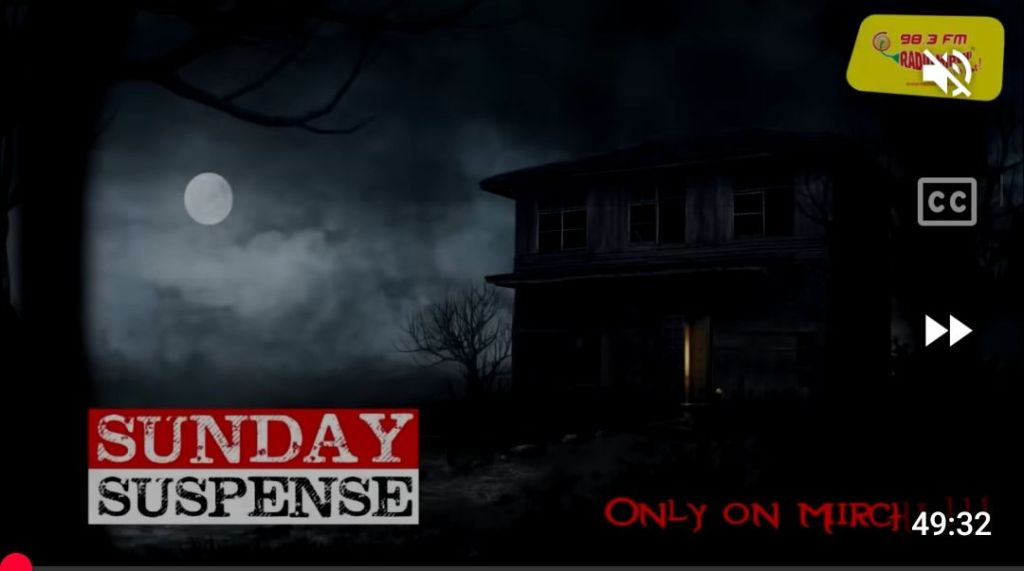
Aankar Khata or The Sketch Book, a short story by Himadri Kishore Dasgupta, is a spell binding tale of afterlife revenge brought to life by engrossing audio narration on Sunday Suspense on Radio Mirchi.
Bengalis have a fetish for ghost and detective stories. No wonder I choose to go back to these genres again and again. As the caption suggests, Radio Mirchi does an enthralling job of audio adaptations of such stories of master wordsmiths.
A Little About The Author:
Born in 1973, Himadri Kishore Dasgupta emerged as a promising storyteller in 2005. This story has been taken from Sandesh Magazine (2018 publication). Sandesh is a children’s magazine started by Satyajit Ray’s grandfather, Upendra Kishore Roy Chowdhury, and later managed (after his death) by his son Sukumar Roy (Satyajit Ray’s father) and thereafter by his grandson, Satyajit Ray himself.
Trivia:
It is to be noted that this short story probably predates the inception and pervasion of the internet. Abadhut Chaki presumably does not have a public profile or domain. His personal details are little known to his readers and admirers.
A Little About the Internet in India :
Public internet access was officially launched in India on August 15, 1995, by the state-owned Videsh Sanchar Nigam Limited (VSNL). While public access began in 1995, the internet first arrived in India in 1986 through the Educational Research Network (ERNET), which was restricted to academic and research communities. The service was initially launched in Bombay, Delhi, Calcutta, and Madras.
Since 2005, the growth of the broadband sector in the country accelerated but remained below the growth estimates of the government and related agencies due to resource issues in last-mile access, which were predominantly wired-line technologies – (Source: Wikipedia).
All said and done, this is a scoop of Saturday spook to regale you all amidst the mundanity of life.

Himadri Kishore Dasgupta





Chaki’s arts sound intriguing. I think there’s something profound in it. Interesting story, gc
LikeLiked by 2 people
Nice wordplay in scoop of a spook
LikeLiked by 2 people
I am glad you noticed that and pointed it out. Thank you so much Derrrick 🙏
LikeLiked by 1 person
Very interesting story Geeta. Thanks for sharing
LikeLiked by 2 people
Thank you very much Sadje
LikeLiked by 1 person
You’re most welcome
LikeLiked by 1 person
Enjoyed reading the story!
LikeLiked by 1 person
Oh! Good. Glad you liked it.
LikeLiked by 1 person