

There was a time when I used to wear only sarees that too in extreme tropical weather. The six yard of unstitched fabric would stick to my legs when humidity shot up to more than hundred percent making it impossible to walk. In a torrential downpour it would cling to the body like a weighty garb.
I am glad there are more choices of attire now, especially, the practical ethnic and fusion wears, specifically with ankle length lowers, easing maneouvres around potholes and puddles. But I so miss my sarees, duly starched and ironed, hanging in rows in the wardrobe. I look for an opportunity to wrap them now.
Our office had a dress code – for female employees it was either saree or western formal. Nothing in between. There are so many decent ethnic wears but no. All this because one of the erstwhile chairmen spotted an employee in jeans and t-shirt on a weekday. 😊
The young girls in the office would tell me, “Ma’am, we love sarees but can’t manage it the whole day.” I used to tell them it was just a matter of practice. I grew up watching mother and elder sister in sarees and learnt how to drape it when I was in school. For us wearing a saree on special occasions in school and college was the highest form of fashion. In the latter part of my working years sarees were only for meetings and gatherings. Not that they were cumbersome but it was just a matter of time – no more a mindset.
What to wear to work was always my last priority. Most times I would rummage for a two minute wear at the last minute. Not that sarees took a lot of time. I had once clocked and seen – it took less than ten minutes if everything was laid out before. But I could plan my next day wear only some days and most times not. Now sarees have become the universal party wear, more so, with the new draping culture. On the ramp saree is now inspiring dresses.
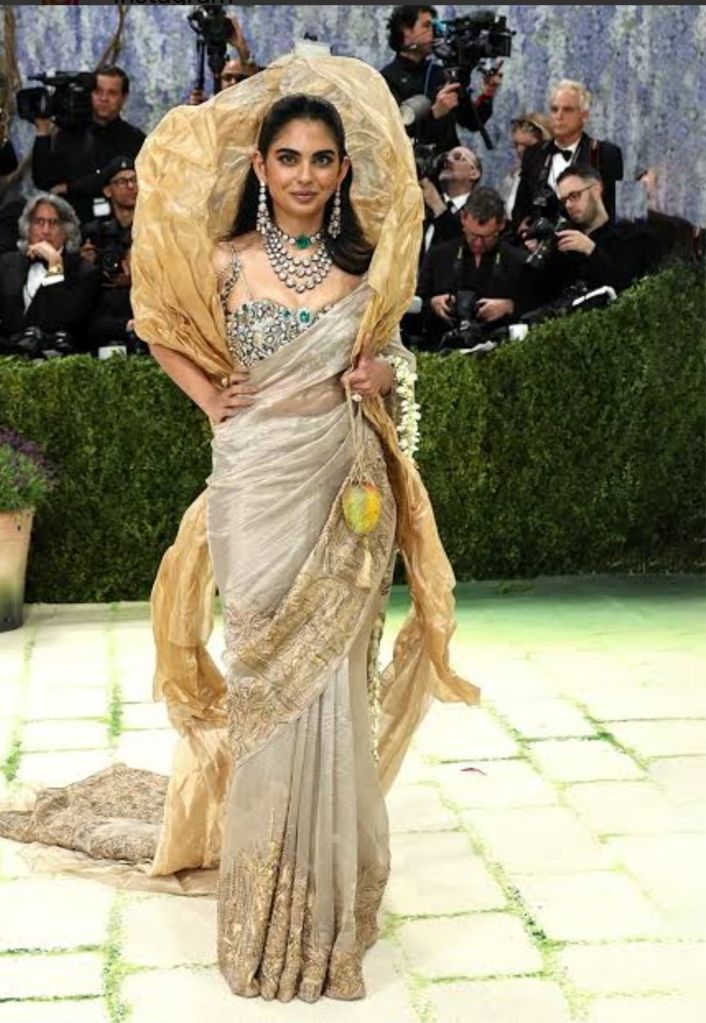
In this year’s Met Gala , Isha Ambani walked the red carpet in a designer saree with an opulent head gear symbolic perhaps of the ghunghat or the pallu (loose end of the fabric), traditionally used to cover the head. I once had an elderly lady co-commuter in Kolkata who always went to the office in well starched cotton sarees with the pallu over her head. Belonging to an aristocratic family she had started working in exigency. Used to covering her head at home, she continued to do so in the office as well, as a matter of habit.
With changing times, dress codes are also changing. Recently, the newly appointed Chief Minister of Tamil Nadu created an uproar by attending the Legislative Assembly in a formal black and white suit instead of the ethnic sparkling white cotton veshti and shirt. The Opposition Leader has made history attending the sessions of the Parliament in t-shirt and trouser instead of the crisply starched Churidar Kurta. Everything nowadays boils down to convenience.
But who says sarees are not convenient. Watch the women working at the construction sites helping men, shoulder to shoulder, carrying heavy loads up the ladder or the scaffold. They are in sarees!! The housemaids galloping from one household to the other, cleaning, mopping, dusting, cooking, washing – yes, in sarees.
Certain schools still insist their teachers wear only sarees. However, what comes as a big surprise is the women in the government departments, once the most traditional workplace, attending duty in western formals. The one most versatile Indian wear is getting sidelined as a daily wear day by day though inspiring designers to create magnificent couture on the other hand.
Every region has its own style of draping saree. Every individual has her own way of wrapping it around. It can be worn the functional as well as the grand dressy way. But did you know the saree, as it is worn now, with front pleats and pinned up aanchal (with petticoat and blouse) , was first popularized by the womenfolk of the World Poet, Rabindranath Tagore’s family? During British rule, the educated girls of the Brahmo Samaj wore sarees with socks and shoes – a distinct cross-culture fusion heavily influenced by the way the then English ladies dressed.





What a great piece. I really enjoyed finding out more about saris. When I lived in Leicester, I used to like looking at all the different saris in shops along Belgrave Rd. Wonderful.
LikeLiked by 1 person
Thank you very much dear. I don’t know your name.
I am glad you liked reading about sarees.
LikeLiked by 1 person
🙏 I’m Liz 😊
LikeLiked by 1 person
Hullo, Liz. Glad to know you.
LikeLiked by 1 person
Isha would look beautiful however she dressed.
LikeLiked by 1 person
😊.
Glad to know you are an Isha fan
LikeLiked by 1 person
I love sari as it looks so graceful but I find it hard to carry. No doubt after wearing shalwar kameez, we get used to its convenience.
LikeLiked by 2 people
Yes, Salwar Kameez is a very comfortable dress. I used to wear them regularly to the office along with churidars.
As regards sarees, it depends. There are light and heavy ones. Chiffons and Kotas are very light , cool and comfy. Cottons, silks and heavily embroidered crepes are difficult to manage.
LikeLiked by 2 people
Very true. People accustomed to wearing a sari have no issues carrying it gracefully. While those like me, who would wear one very infrequently can be sure to feel that I’m doing something wrong. 😜😁
LikeLiked by 1 person
I’d again say it’s just a matter of practice. But I have observed that switching from saree to salwar suit and vice versa is uncomfortable. Wearing sarees regularly I’d feel a little awkward in salwar kameez or churidar kurta – somewhat like being inadequately dressed since I did not carry folds of fabric on me. Similarly, managing a saree seemed difficult if I wore suits continuously. In order to get over this awkwardness I’d wear sarees some days and salwar on others. That went perfectly.
LikeLiked by 1 person
That’s cool. Thanks for sharing.
LikeLiked by 1 person
I have a deep soft spot for sarees, even if it stays in the closet these days 😊. I gave away a lot of my sarees to family and friends when I relocated.
LikeLiked by 1 person
Yes, we all have that deep soft spot. Yes, in your case it is understandable what you did during relocation. Attire is actually very climate and location dependent. My friend who is settled in the US only wears sarees on occasion
LikeLiked by 1 person
I really like sarees
LikeLiked by 1 person
It is a very graceful attire. Thank you so much Derrrick 🙏
LikeLiked by 1 person
I once wore a saree,my friends mom helped me to wear it ,took some photographs and that was all.
A year ago,my daughter wore a saree while attending a conference at her college.She told me nowadays ‘ready to wear ‘sarees are available, anybody can wear them easily.
Kashmiri pandits too have switched over to kurta pyjamas or western outfits,that is what I saw my pandit colleagues wearing to the office.
If only one could carry the saree gracefully,there is no dress more elegant than it.
LikeLiked by 2 people
Yes, there are pre-stitched sarees available in the market. But I don’t know how comfortable they are.
LikeLike
I got an education on this topic! I knew next to nothing about it! Thanks for enlightening me!
LikeLiked by 1 person
You are most welcome. It’s entirely my pleasure.
LikeLike
My mom has made multiple trips to the States and never wore anything other than a saree. Yes in winter too here. (she had layers but her basic outfit was saree😃) She says that is her comfort wear. It is just practice!
LikeLiked by 1 person
Absolutely. It is what is comfortable and with which one identifies.
LikeLike
Beautifully written, Geeta ji. Your reflections on sarees, tradition, and changing times were both nostalgic and insightful.”😊
LikeLiked by 1 person
Thank you so much Maha. Do you like wearing saree ?
LikeLiked by 1 person
Yes, Geeta ji, I love sarees. 😊 I wear them on special occasions, though for daily wear I prefer more comfortable outfits these days.
LikeLiked by 1 person
Yes, I understand. Even I follow the same.
LikeLiked by 1 person
Indian clothes are stunning.
LikeLiked by 1 person
Yes, that’s true. Thank you dear Mary
LikeLiked by 1 person