
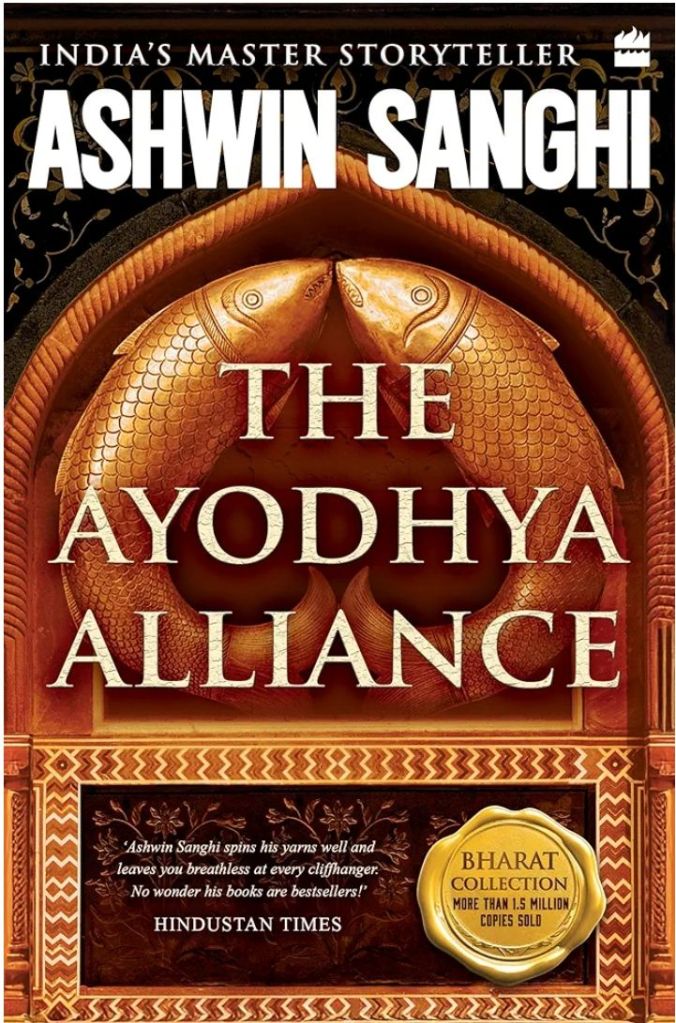
It took more than a month to finish reading The Ayodhya Alliance. I was determined not to hurry and went with the pace of the book. Every book needs to be read the way it is written. This book heavily relies on history. There are many characters. The narrative goes back and forth from present day to ancient to prehistoric times and back. The chronology at times is not always symmetrical. At times the narration jumps from one period to the other making it hard for the reader to retain continuity.
There are three main streams on which Ashwin Sanghi has based his story –
First – An ancient and powerful but secret technology which predates even the times of the epical battle of Lanka between the demon king Ravana and the exiled prince Rama, as chronicled in the Ramayana. On his deathbed the Mahagyani or the super intellectual but arrogant king Ravana passes the secret of the Atmalingam to Lakshmana, brother of Rama. It’s only with Rama’s touch that the Atmalingam gets activated into the Dwaitalingam – the cosmic balance of preservation and destruction – the catalytic technology subsequently lost in time.
Second – The journey of the 157th Dwaitalingam Rakshak (Protector of the ancient technology), Padmasen, from Saketa, that is present day Ayodhya, to Korkai , that is present day Kerala. From the position of a trusted advisor to the power crazy Saketa king, Vidushika, to being demoted to a cruelly tortured prisoner of the same king to narrowly escaping to Korkai with the help of once-a-beggar Somadutta and returning to Saketa to become the benevolent king initiating an alliance between the four corners of the world – Damascus in the West, Korea in the East, Korkai in the South of India and Saketa in the North of India – called the a-yudhya (which cannot be battled) or the Ayodhya Alliance for peace, progress, development and defence, through trade and transference of a technology, guarded by him with his life.
Third – The legend of an Indian princess, named Suriratna or Shambavalam or Sembavalam, also known as Queen Heo Hwang-ok, navigating high seas to marry the Korean King, Kim Suro, as per Korean chronicle Samguk Yusa. Millions of Koreans trace their matrilineal lineage to her.
These three streams merge with the present day search for a unique and invincible technology to power the defence of the country to safeguard its volatile and in parts porous borders.
As usual, Sanghi dabbles in history, debatable conjectures, symbols, science, technology, myths and mythology and imagination to build up the plot weaving in the sub plots lending credence to his craft. The geographical expanse and the time span through which the story gains momentum are enormous. Known as the Dan Brown of India he does justice to the epithet though faltering in parts.
Given the date of publication of the book, the reference to Operation Sindoor is confusing – the dates seemingly overlap. Likewise, the mention of Ram Janmabhoomi and the effort of infusing a correlation between the temple site and the site of the hidden technology gives the book a motivated perspective.
Those who are well versed with the mythological epics will know better – though it is mentioned that Ravana did impart profound knowledge to both the brothers, Rama and Lakshmana, before breathing his last, whether he transferred any cosmic secret received as a boon from Lord Shiva remains dubitable.
I loved the preciseness and lucidity of narration, the fitting and economical use of words and expressions throughout and more specifically to describe the battle scenes. The violence depicted in the book is not overdone and seems required in tandem with the plotline. Sanghi’s delicate venture into romance in one of the sub-plots is pleasantly surprising. His signature information overload is spread over five hundred odd pages and therefore not that overwhelming.
However, the character arc of Somadutta from a destitute to a disloyal prison guard to a rebel turned kingmaker seems in need of more detailed development perhaps at the expense of lengthening the narrative. Similarly, the root of antagonism between Soju or Kim Suro and Talhae, both orphans and brought up by the respective chieftains of Garak Confederacy of Korea, again requires a little more depth and clarity. And above all, how the successors of Lakshamana, the first Dwaitalingam Rakshak (to Padmasen), were chosen through the course of history, remains unexplained.
Sanghi has time and again reiterated that he is not a historian but primarily a fiction writer. The liberty taken by him in fictionalising history and raking up conjectures in a bid to plug in the gaps in tracing the historical roots of development of science, technology and human civilization, in the final analysis, appears justified though a bit far fetched and tests the elasticity of imagination, especially, the utopia of Kumara Kandam.
Having said that, this is, no doubt, my first significant reading of the year.

Ashwin Sanghi’s image courtesy Google





The legend of the Indian princess sounds enthralling for me. I think I’ll enjoy that part. India’s history sounds so interesting and so different from us. Interesting review, gc
LikeLiked by 1 person
Thank you so much Hazel. If you search you will get the legend of Queen Heo Heang ok on the net or you can use the link given.
LikeLiked by 1 person
Thanks for the recommendation, gc. My pleasure
LikeLiked by 1 person
Significant, indeed
LikeLiked by 2 people
Thank you so much Derrrick 🙏
LikeLiked by 1 person
From your review,this book seems weaving together history, science and legend.
LikeLiked by 1 person
Yes, it does Nusrat. You are absolutely correct
LikeLike
Haven’t read about it only heard… now that I have your review here I will be adding it to my TBR..!😇🌷
LikeLiked by 1 person
Thank you very much Aparna. These are my absolute personal views. You may have a different opinion all together after reading the book. Waiting for your assessment.
LikeLiked by 1 person
A great review Geeta
LikeLiked by 1 person
Good morning and thank you dear Sadje
LikeLiked by 1 person
Good morning dear friend. You’re most welcome
LikeLiked by 1 person