
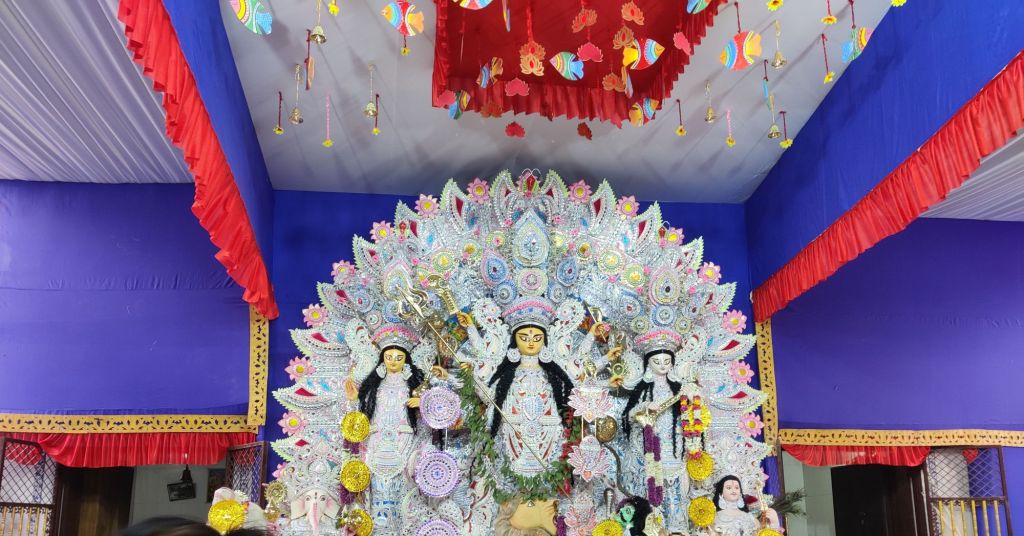
For Bengalis Durga Puja or Durgotsav or the worship of mother Goddess Durga is more than a religious festival. It is an emotional journey.
Beginning with Shasthi or the sixth day , the worship continues for three more days till the Navami or the ninth day of the month of Ashwin (September-October as per Gregorian Calendar). On the tenth day or Dashami the immersion takes place.
On the day of the immersion the married women play with vermillion with the Goddess and with one another signifying an intimate relation with the Mother – as though she were the daughter-in-law of every household. Goddess Durga is called the Mother or simply Maa underscoring a childlike devotion to the eternal mother.
Many mythical stories surround the Mother’s arrival on the Martyalok or the land of mortals.
Devi Durga is married to Lord Shiva who is the embodiment of all discards. His body is smeared with bhasma or ashes. His torso is draped in tiger skin. His long unkempt tresses curl into jataa (tangles). He lives the life of a beggar and is surrounded by ghostly creatures. He sits in meditation in Kailash Parbat and spectates the world with utmost detachment.
It is said that Durga married Shiva without the approval of Durga’s parents. So when Durga expressed a desire to visit her mayka or parents’ house Shiva refused to accompany her.
Durga left with her four children – Ganesha, Kartik, Lakshmi and Saraswati. But without her knowing Shiva followed her to see whether she is being treated well by her parents.
Thus, in many Durga Pratimas (statues) along with the four deities of Lakshmi, Saraswati, Ganesh and Kartik, a small idol of Shiva or Mahadev is also found at the top looking down or spying on his wife and children.
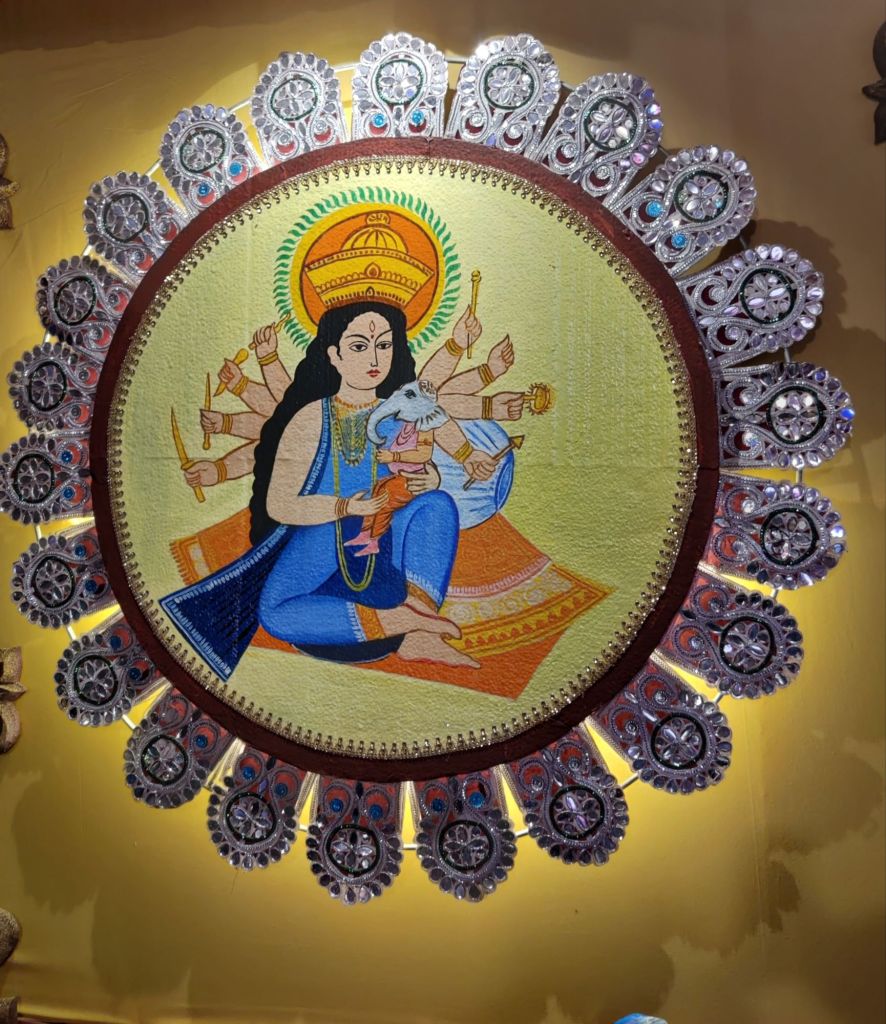
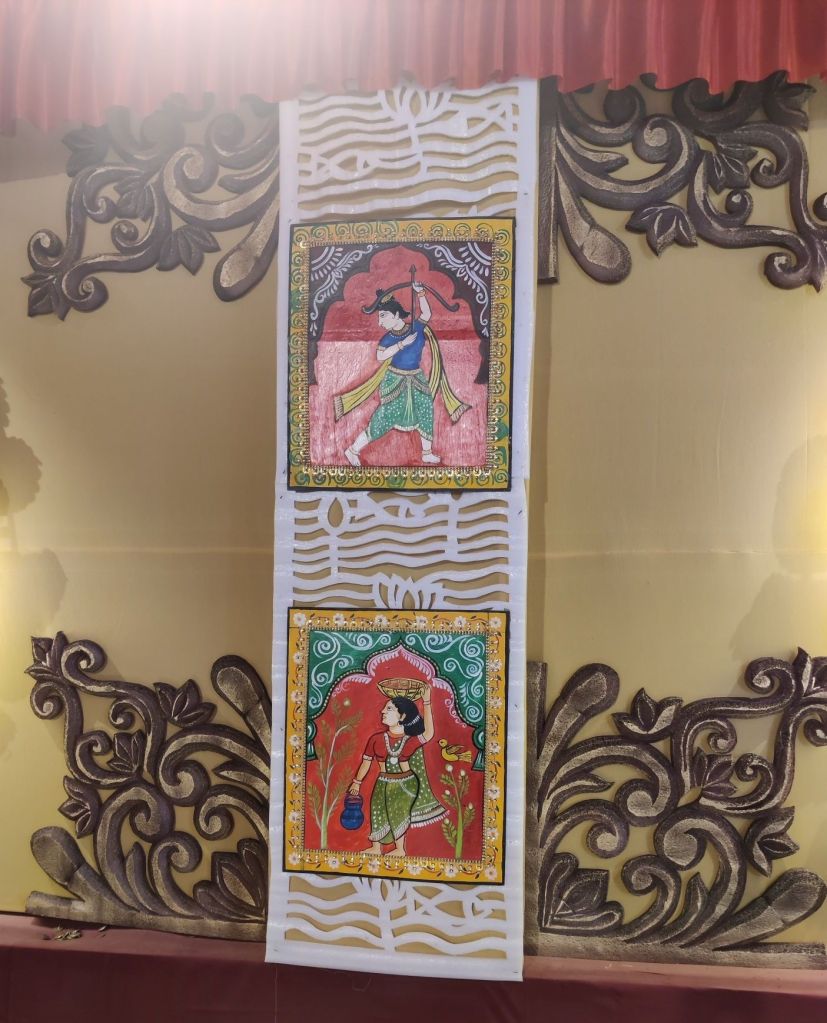
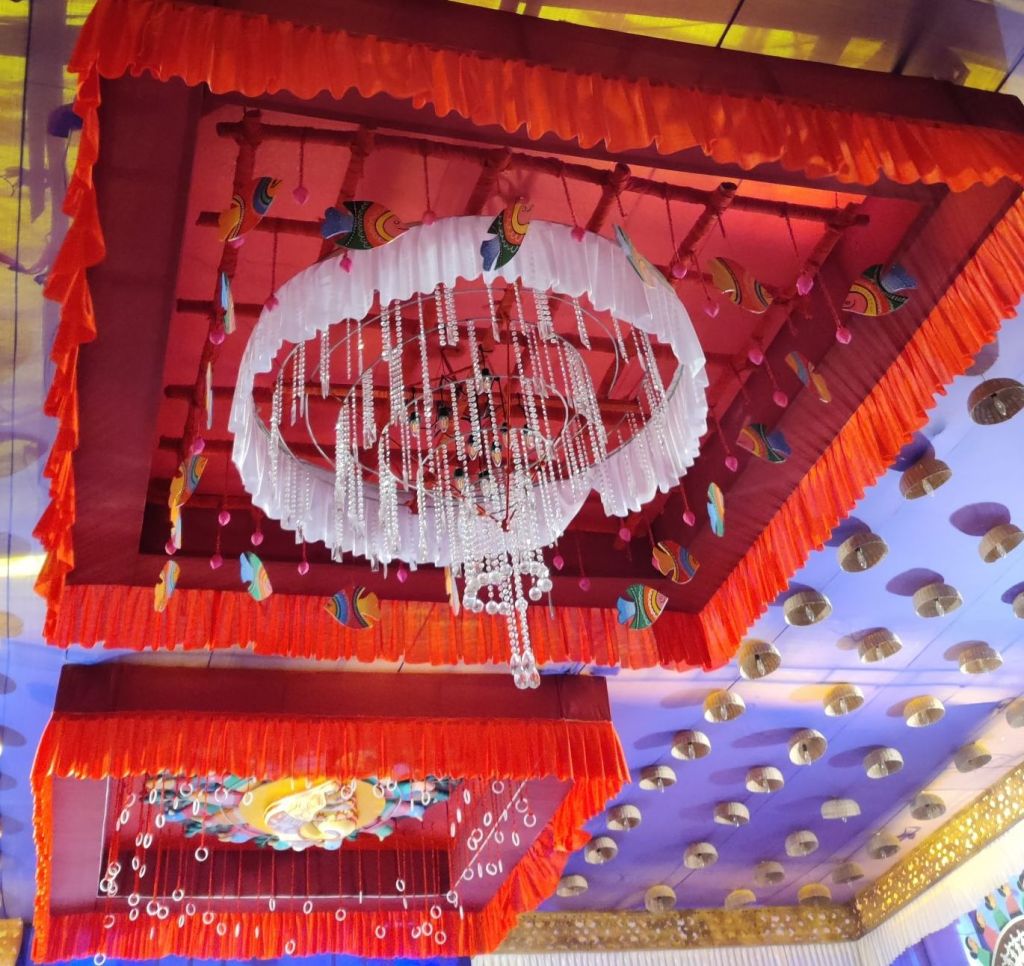
Pandaal decoration is one of the highlights of Durga Puja.
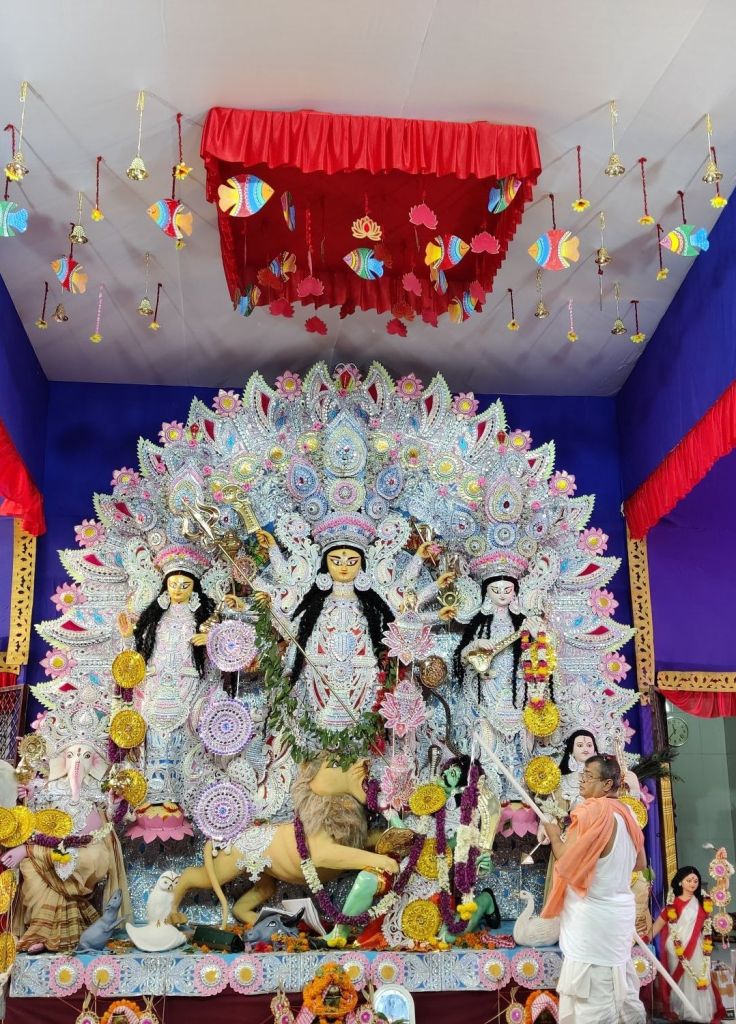
On dashami or the day of immersion of the idol priests and devotees bid a tearful adieu to the mother and her family with a plea to come back soon the next year.
The mystic of Devi Durga symbolizes the social, religious and cultural ethos of Bengal.
Today is dashami, the day of immersion. As I write this post my humble abode vibrates with the loud music played on the vehicle (truck) carrying the mother Goddess and her family to the designated water body for immersion.
When we were small the tradition of immersion included aarati (lamp lighted with clarified butter/mustard oil and camphor waved in circular motion to venerate the deity) , sindoor khela (playing with vermillion) and dhunuchi (censer) nritya, a dance with big earthen holders with handles in hand in which incense was burnt with dhuno (aromatic substance used especially in worship) , camphor and coconut fibres. The entire atmosphere would become smoky and fragrant – the aroma of worship!
The huge idols of mother Goddess and her children would be placed on two boats rowed in unison to midstream where they would part in opposite directions letting the idols immerse in water slowly. The tearful cries of bolo Durga mai ki jai (Hail mother Goddess Durga) would reverberate in the air as one after the other idols from different localities would get immersed in the holy waters in similar fashion. Gradually evening would set in. It would be a sight to behold – against the backdrop of the setting sun the silhouettes of the idols capsizing one after the other in the liquid golden waters of river Yamuna. Devotees standing on the ghaat (river bank) would join hands and touch their foreheads in the gesture of pranaam or namaskar reverently bidding farewell to an elderly member of the family. The sound of conch shells and ululations would gradually diffuse into twilight hues leaving a fragile note in the air – a gossamer memory of transient rejoicement.
Perhaps the significance of celebration lies in the parting. Perhaps the festival encapsulates a soul’s journey – the birth, the evolution and the final emancipation. Perhaps the ephemerality of all that is beauteous is manifest in mother’s arrival, short stay and departure.
I am jolted out of my reverie by the passage of another carrier and cacophony of high decibels, thundering Deejays and raucous, raunchy dancing.
In the quiet that follows as night advances I wonder whether this is worship…whether this is celebration…whether this is religion.
Or have I become too ancient to find the spirit of jubilation in its unconventional expression?
The immersion of the idols on dashami is followed by Bijoya Dashami – a fortnight long festival of meeting with family and friends, getting the blessings of the elders and feasting to the heart’s content.
How the grief of parting merges into the joy of uniting with family and friends! The circle of life continues without a beginning and without an end.
Shubho Bijoya to all my co-bloggers!
Greetings of the festive season!
🙏 🙏 🙏 🙏





While reading your post, it felt as if the very soul of Durga Puja came alive before my eyes. Childhood memories, the joy of worship, the sorrow of the Mother’s farewell, and the reunion of Vijaya Dashami all have been portrayed by you in such graceful language that the reader is deeply moved. Indeed, a festival is not just about celebration, it is also a symbol of life’s transience and the soul’s eternal journey. Your writing has revealed this profound truth with remarkable simplicity.
Wishing you endless blessings of Shubho Bijoya! 🙏🚩
LikeLiked by 2 people
Thank you so much Vijayji. It fills my heart with great joy to receive this comment from your end. Shubho Bijoya to you and your family 🙏🙏
LikeLiked by 1 person
So colourful
LikeLiked by 2 people
Thank you Derrrick
LikeLike
Thank you, Geeta, for the beautiful description of Maa Durga celebrations and the profound meaning of the festivities. I like all the images!
Joanna
LikeLiked by 2 people
Thank you so much Joanna. You would have been deeply moved had you been in the Puja and witnessed the immersion. I was missing you.
LikeLike
Thank you, Geeta. I missed not being there with you!
Joanna
LikeLiked by 1 person
You are most welcome dear Joanna 🙏🙏🙏
LikeLike
Thank you so much, dear Geeta!
Joanna x
LikeLiked by 1 person
🙏🙏
LikeLike
The vivid imagery truly captures the essence of Durga Puja—the joy, the devotion, and the bittersweet farewell.
Shubho Bijoya to you all.
LikeLiked by 1 person
Shubho Bijoya to you and your family
LikeLiked by 1 person
🙏🙏🙏
LikeLiked by 1 person
🙏
LikeLiked by 1 person
🙏🙏
LikeLiked by 1 person
Shubho Bijoya!
LikeLiked by 1 person
Shubho Bijoya
LikeLiked by 1 person
The temples, the sheer decoration and colours are so beautiful. Thank you for sharing.
LikeLiked by 1 person
Yes, the aesthetics are astounding and they vary from pandaal to pandaal.
LikeLike