Un-Ladylike


Society has certain  unwritten prescriptions for its members. One of them is that well brought up ladies should subscribe to a certain vocabulary – controlled, composed and courteous.

But sometimes we do cross the line in our exasperation. Don’t we ? I personally feel ventilation is required at times. How ? That is relative. Sometimes we  involuntarily adopt ways and means that are locally used.  The colloquial dialect especially that we are used to hearing in public. Somehow the oft-heard slang seem to express our spur of the moment feelings precisely.

Once I was going by a cycle rickshaw which stopped midway because a car was reversing while the driver was intently looking at his phone. Hence totally distracted. Had I not shouted at him he would have bumped into the rickety contraption toppling us over.

When I narrated the incident to my colleagues their instant query was, “But Geeta ma’am, what did you tell him?”

I tried to circumvent the question and said, “No gaali-galouch (profanity) as you all are thinking.”

“But still,” They cried.

So I quietly told them the epithet I had used which met with a round of applause. No, it was not a gaali yet not a so-called sophisticated word either – but just the exact adjective which aptly described the blunderer or his momentary action – a term common to the dialect of the Hindi belt in the North, however, used in this context assumed almost a jocular flavour.

There is a fine line of demarcation between crude expressions and unmouthable , unprintable expletives.  Who defines what is respectful and disrespectful???

Our conscience, morality and self esteem most probably. Or perhaps our lingual sense  – implications! Connotations! Intonation! Or the age old norms set by society. 

Recently I read an article which said the usage of defamatory word/language is as ancient as human interaction itself and has been resorted to as the easiest weapon to psychologically “disarm” the opponent.

While threatening somebody is legally actionable (as per Bharatiya Nyaya Samhita) subjecting somebody to continued derogation is mental abuse. But what about using colloquial upfront (or behind someone’s back) just to let the steam out ? It may result in a contentious situation or jolt in some sense or more optimistically catalyse an epiphany (? 😂).

However, words spoken are a reflection of our image. So even if it is a teeth gnashing , jaw tightening situation composure is appreciated more than verbal diarrhoea.

It is revealing how certain profanities are considered ‘fashionable’ and generously used in normal conversation nowadays….!!! Apparently even the perception about profanities also changes with time!!!

Interestingly, one of the chapters in our holy book Gita written in ancient Sanskrit describes the demonic tendencies of an individual  in one eloquent expression –

“Naṣṭātmāno’lpabuddhayaḥ” (नष्टात्मानोऽल्पबुद्धयः)

Without going into the deeper spiritual context, the phrase can be safely attributed to a person who has completely lost it.

Perhaps it will come handy  next time I feel like lambasting a brainless nincompoop on the road….?

This post is part of Blogchatter’s Half Marathon 2026


Siddhi Vinayak


Yesterday was Ganesh Chaturthi. It’s  one of the biggest religious festivals of the State of Maharashtra – now celebrated throughout the country. On this day Lord Ganesha is ‘brought home’ with joy and fanfare. The Lord is the epitome of everything that is pious and pure. He is also the God of Supreme Knowledge. He is dukhharta – remover of sorrow, sukhkarta – harbinger of prosperity and joy and vighnaharta –  remover of all obstacles in life. Before every auspicious ceremony at home or at work/business fronts , the Lord, fondly addressed as Bappa, is invited and his moorat invoked for his blessings.

‘Brought home’ means placing his idol at home for stipulated number of days. Since I have a very old idol at home, which has been kind of handed down through generations, it is already placed in the mandir permanently and I don’t believe in the immersion process. The only thing is that I need someone who can repaint the murti as its paint has chipped off over time.

Bappa’s homecoming signifies the beginning of the sacred season of His worship. On this sacred day I remember my visit to Bappa’s temple in Mumbai where He is called and worshipped as Siddhi Vinayak. The  Siddhi Vinayak Temple is a very powerful and famous place of worship known for fulfilling the devotees’ wishes.

It must have been more than a decade ago. I don’t remember the exact year. I was in Mumbai – the financial capital of India – on training. We were a big group and all of us wanted to have a darshan or visit the Siddhi Vinayak Mandir, which was luckily very close to our transit accommodation.

I remember walking down to the temple with a few others early in the morning. Usually devotees make it a point to walk  to the temple bare feet. Even at that early hour the temple had a number of devotees standing in queue for the sacred darshan. We got the flowers, sweets and incense for offering beautifully laid out in a leaf packet. 

The priests do not let the worshippers stand long in front of the deity but even a few seconds is good enough. Bappa is omniscient, omnipresent and omnipotent. There is a very cute ritual followed in the temple. If the devotee wishes to communicate his/her deepest wish to the Lord that has to be whispered in the ear of his vaahana or the vehicle that carries him – the mushika or the ubiquitous rat.

The all important communicator has an idol of its own near the front gate. The procedure is to whisper the wish in its one ear while shutting the other ear with the cup of the other hand so that the playful and restless carrier retains what you asked for in its mind. Being of the corporate mindset I am curious to figure out the process of communique. How and when and why the vaahana passes on the message to its Rider. Does it add it’s own interpretation to it ? Is there a discussion between the two of them before they reach a conclusion how and when the wish is to be granted ? That’s the human side of me. Worrying as usual about the nitty gritty even after delegating the job to The Know All.

I  am still learning not to seek answers to such questions, rather, not to ask these questions at all.

Well, to quench readers’ curiosity the wish did get fulfilled but not immediately though. A few years hence. Because His Divine Machination is beyond our limited comprehension the wish was finally granted at the time I or the time was  ripe for it. Not one single moment before or after.

And we need not go into the ‘how’ part of it. What we should be satisfied with is ‘suntaa hai woh‘ . We are heard. (Remember these immortal words of Kabir’s nirguni bhajan sung by the one and only Kumar Gandharva ji??? )

He hears and that is what keeps us going.

Rest is immaterial.

Ganapati Bappa Moreya…

I am participating in Blogchatter’s Half Marathon

Dream


I always wished

For a little house

With a garden

The house

Sunny

Airy

Roomy

The garden

Fragrant

Well tended

Verdant

And chirpy

With birdsong

I live in a flat now

Well built

Spacious

Cozy

Peaceful

But somehow I feel

I would have been

Happier

In my dream house

More comfortable perhaps

More at peace with myself

It’s just a thought

But it plagues me

Day and night

Unreasonably so

Recreating Childhood


There are days when I don’t feel like writing or posting.  Sometimes I am too exhausted or confused or not in the right frame of mind to think coherently. I spend those days reading – books, posts, news dailies and stuff.

There was a spell like that last week. Even partly this week. The day I locked myself out of my flat. Yes, I did right that. Don’t ask me how. But as you all by now know that I am quite capable of doing the weirdest possible things that go beyond normal comprehension.

Well, after a few frantic calls and ‘technical help’ later, I managed to enter my flat, pick up the right set of keys and walk out again. The main thing here is that I did walk out again which  implies that I was not dissuaded by my own mistakes to carry on with the job I intended to do that evening.

😂😂😂😂

I am proud of myself even after making that gross mistake.

Coming back to readings…

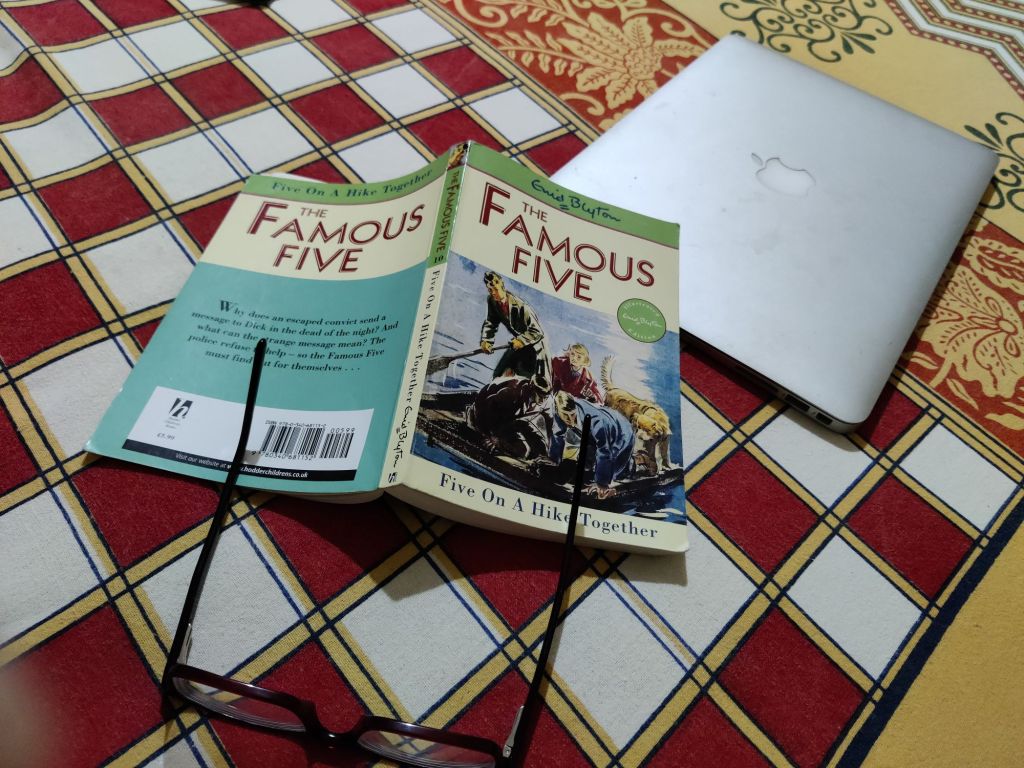
A very easy way to recreate childhood is to read the books that I used to read as a child. As I shared with you all earlier I got hold of an Enid Blyton during my last outing to the Public Library. It was a fun read after a very very long time but then I could make out how time has flown and what seemed quite reasonable as a child now allows uncomfortable questions to rear their heads.

The Famous Five On A Hike Together – as the name suggests Julian, Dick, Anne, George and George’s pet dog Timmy go on a hike together on a long weekend after their half term. Timmy , chasing rabbits, hurts his legs and the group breaks into two – Julian and George part to get Timmy checked by a village local while Dick and Anne trek on forward, as planned earlier, towards the Farm House where all of them are supposed to spend the night. However, Dick and Anne lose their way and end up in  another deserted Farm where a stone deaf old woman resides with her shady son.

She is scared that if her son comes to know that she has allowed the kids to spend the night there he will be very angry. So Anne is secretly put up in the attic while Dick hides in the barn. But strange things happen in the night – a runaway convict mistakenly delivers a hand written note carrying coded direction to a hidden loot to Dick. The adventure starts thereon.

The whole story sticks on the premise that the children are not able to communicate with each other after they part ways though they reunite the next day. But would the premise tick if they had mobiles ? Just a wayward thought !!

Also without being critical Julian’s statement that the boys get more pocket money than the girls or that girls are to be taken care of somehow do not jell with the modern day perceptions. Though I do believe girls should be taken care of but I guess in a different way.

Well, again these are just observations like what the thinking was during that time and what it is now – pointing again to the lapse of time I guess. The book was first published in Great Britain in 1942 – so whatever seems not in line with today’s times is quite understandable.

In the meantime, the physiotherapy sessions have given me relief from the handicapping vertigo. So I’ll be a little more active in writing, posting and reading you all.

But as one of the patients at the Therapy Centre remarked, “Saarey shareer mein dard hi dard hai. Kahaan kahaan lagaaye?” ( The entire body is plagued by pain. Where all should we get the therapy done?)

That made me chuckle…We Old Bones !!!

Incidentally, all the patients are mostly ladies. Does that mean that this particular gender is more battered by life? 

Hehh…Hehh…Again just a passing thought 🤔🤔!!

Cheerio!!!

PS : I am greatly disappointed that the  library (of Bengali books) nearest to my home has closed down because nobody now reads an actual book!! 😭📖😔

So I have to do with audio stories for the time being. Sad!! There’s nothing like reading an actual book. Is there ???

Bondage Of Expectations – Concluding Part


A heartfelt thanks to all my esteemed readers who read Part I and Part II and expressed their views. The discussion was most enriching.

My Take On The Issue :

Men are seen to have an upper hand in a  patriarchal set up. They set rules, dictate terms, build opinion and enforce order. Women are considered secondary compared to men. They are  slotted, misused, mistreated, misjudged and commodified. But men, under patriarchy, are equally exploited and pressurised.

Society creates roles for both – men and women. Roles create expectations. Those who are not able to fit into their pre-decided roles and fulfill the expectations are branded as failures. All other concepts like equality, liberty and justice flow from these roles which come with benchmarks.

Those who do not adhere to these benchmarks are the “other ones” – unfit and unpardonable – and therefore worthy of punishment. It is this process of “othering” which is still covertly or overtly prevalent in every society even today. It is convenient to normalise it overlooking the fact that it is the root cause of all evils.

Society, by nature has a conservative knit. There is no scope for any exception because to accept an exception requires change in perspective. Society rather work on convenience. That is why it maintains the status quo and falls back on precedence (which may have over time outlasted its usefulness and relevance). These precedents are loosely called tradition and reflect society’s reluctance to espouse anything new and fresh.

In a system predominated by hierarchy, the superior subordinate relationship thrives on exploiting personal weaknesses, victimization, discrimination and harassment.  Whether it is the illegal rustic practices perpetuating age old beliefs and value systems prevalent in the hinterlands or the unabashed demoralisation of self motivated workforce in modern cosmopolitan urban work centres the grinding machine of society works on the same lines – extraction of obedience and compelling subjugation in the name of organized uniformity.

Bondage Of Expectations – Part II


This is in continuation of Part I of this post which can be read here.

The Second Story

Babita Singh Reporting is a Hindi crime thriller set in Reva, a small town in Central India.

Babita or Baby, as she is fondly called, is a woman in her thirties. She is ordinary –  obese and nothing much to look at.

Posted at Bhopal Police Station as Assistant Sub Inspector (ASI) she is not at all the dreaded super cop. The job has been given to her on compassionate grounds after her father’s in-service death. She is an out and out novice. Inexperienced. Untrained. Relegated to desk job. Her immediate superior Sethi is a cunning person with political connection.

At the home front, Babita routinely performs her wifely duties. She cooks, washes clothes and does the daily shopping. Her husband runs a small electronics shop. The couple is looking forward to having a child which is delayed due to Babita’s ongoing treatment for thyroid. Babita is also under pressure to take leave at least for a fortnight to pay a visit to her mother-in-law on the occasion of her sister-in-law’s (husband’s sister) baby shower. But her leave application is perpetually ‘under consideration’ on Sethi’s desk.

However, Babita is a learner too. She educates herself by reading books on police procedurals during her (mostly) free time in the office. She has applied for field posting too. But her boss’s (un) enthusiastic question “what will you be doing in a field job” poorly disguises his derision for her capabilities for the post. Yet, Babita remains persuasive.

In the meantime,  there is a media leak in a high profile case. The SHO (Station Head Officer) wants to know who is behind it. Sethi, the actual culprit, persuades Babita to take the blame on his behalf. As per procedure, the punishment for the leak is two weeks’ suspension from the job.  Sethi reasons with her that it is  equivalent to the leave that she has been asking for which otherwise is never going to get sanctioned. Babita agrees to take the blame and gets suspended.

The couple leaves for Reva. The husband does not know that Babita is under suspension. On reaching, they unexpectedly meet Babita’s childhood buddy, a local artist, at the railway station. He requests Babita to meet him in the evening to discuss something urgent. But Babita is not able to keep that appointment. The next day the man is found stabbed to death. It is when Babita sees the dead body that her curiosity to unearth the truth  is piqued.

As Babita doggedly pursues the case her naivety gets exposed at every step. Every question she asks to every suspect is taken as a personal slight. The local police station refuses to share the forensic report with her. Her dead buddy’s childhood sweetheart, who is now married to a formidable police officer, does not want to co-operate with her. Her husband accuses her of giving undue priority to a self initiated investigation at the cost of peace and harmony at the home front. The deceased’s elder brother, a no good , teases her for getting suspended from her job which she has managed to get not on merit but on compassionate grounds. He demeaningly addresses her as Anukampa meaning pitiable. The widowed wife has her own grudges against the dead man for not fulfilling the role of a “good husband” and a “dutiful father”. Also she has her reasons for not telling Babita what exactly happened on that fateful night of the suspected murder.

Babita, the subservient bahu  (daughter-in-law) dutifully plays the role of a referee as in a football match, at her in-law’s to maintain the facade of a balance in her marital life. She apologises when she doesn’t need to. She battles with fear as she accosts druggies, chases suspects and in the process endangers her own life.  She is also the sponge board for her husband who teeters under the burden of social expectations of being the only son of the family having married late to a girl of his choice but now unable to father a child.

(To he continued)

Bondage Of Expectations –  Part I


Today let’s talk about two different stories set in two different backdrops but pivoting around one theme – societal expectations from both men and women in a patriarchal set up – quite explicit in the narrative itself.

The First Story

Zanjeerein (Chains) is a tautly scripted and directed Pakistani drama revolving around two feuding tribal chieftains, the apple of discord being the barter of a woman of the family of one to the other as a compensation for a crime. This system is known as swara wherein the patriarch of a family having committed a crime (in this case murder) gives away a woman of his own family (his sister) to the victim’s family in marriage in a kind of “out of court settlement” to put an amicable end to a dispute. The only difference here is that this entire redressal or dispute settlement is carried out in the presence and with the consent of a tribal council called the jirga which is sort of  law unto itself. There is no police. No FIR. No formal investigation into the matter. No trial. No intervention by the advocates of human rights. The entire resolution is based on so-called tradition perpetuated by the elders of the council.

But does the feud end with this transaction?

No.

The bartered woman, called badley ki aurat or woman-in-transaction, is looked down upon in her new family. She dies giving birth to a son. The motherless child is not accepted either and is made to feel like the “other one” in the household. His maternal uncle (mother’s brother), who has his own axe to grind, takes advantage of the situation. He does not leave a single opportunity to poison the young boy’s mind who grows up with a deep-seated  inferiority complex manifest in rage and hatred – his sole aim now is to get his rightful entitlement.

Time passes. Chieftaincy passes on to the next generation. So do the mutual abhor and mistrust. The new chieftain is committed and protective of his people but he does not keep well. Blood analysis reveals that he is subject to slow poisoning. The suspicion obviously goes to the step sibling and his maternal uncle who are after his chieftaincy.  Before the matter can be further investigated the chieftain and his wife are brutally killed on their way to the hospital. Again the suspect is none other than the step brother who is now an absconder.

So again a jirga is called.

The cunning maternal uncle of the step brother now offers his niece (elder brother’s daughter) in swara to the deceased’s family. The offer is rejected. This gives rise to another potent issue – who is going to accept a girl in marriage who has been rejected in swara or transaction?

The chieftaincy passes on, as per tradition, to the younger brother of the former chieftain. The young man –  urban bred, well educated – does not understand this way of life where violence, considered normal, is culturally embedded in its fabric. His dream is to move abroad, study further and get married to the love of his life – his betrothed (first cousin). But he is under oath not only to take on the responsibility of chieftaincy but also to avenge the death of his elder brother. His mother’s demand is head for a head.

In the meantime, in a macabre turn of events,   the young man’s best buddy is badly assaulted in Islamabad. Before breathing his last he entrusts his newly wed wife to his friend’s custody beseeching him to protect her from the assaulter in his absence. Learning that his dead friend’s sister has named the wife as the prime suspect in the FIR, the young man brings her, under a false identity, to his mansion far away from the city. But the grieving, traumatized girl is misconstrued as the “other woman” in his life.

He reveals her identity to his fiancee and pleads with her for support. She agrees and befriends the widowed girl. But one night, after a minor altercation with him, his fiancee mysteriously goes missing. Who is to be blamed ? Of course the “other woman” who is believed to be in an illicit relationship with the novice chieftain.

Now it all pans down on a young chief who, though pretends to put up a brave front,  is breaking bit by bit inside as all his near and dear ones are being removed from his life one by one. He suspects the perpetrator is not an outsider but somebody who is among the trusted household. His own life and that of his mother’s are also in danger. So is that of the young widow under his protection. The burden of promises and pledges on his shoulders is killing. He is in the throes of depression unsure whether he will be able to do justice to his role as a chieftain and bring the culprits to book.

To make things worse, in a dramatic twist in the plot, the jirga now wants him to marry the widow of his friend because a young , unchaperoned woman cannot stay under the same roof with him without the sanction of a wedlock. 

(To continue)

Grief


I have a solid grief
Tucked in somewhere
Like an ice berg
It is not fluid
It doesn’t melt
It doesn’t flow
It stays as it is
On very hot days
It trickles down a bit
That’s it

The other day
Somebody told me
Flash floods hit
The neighborhood
Causing havoc
Uprooting many
Displacing households
Decimating what was once
A flourishing civilization
Unaware…sudden… unanticipated

However my composure
Is unshakeable
My grief doesn’t play
With people’s lives
It doesn’t bring in
Any unexpected turmoil
Or avalanche
It is still …glaciated
Unyeilding
It only kills me
Inside time and again
Nothing else

PS : The Bangla version of this poem can be read here.

https://vanderloost.blogspot.com/2026/09/grief.html?m=1

Yesterday


Sometimes mundane experiences of life present striking examples of eternal paradoxes mostly overlooked in our myriad busyness.

Yesterday an experiment with myself – ordinary one – a long ride alone after a very long time (was I nervous!).

A cab to the salon  at the other end of the city for a hair cut. Why travel such a distance for a routine thing ? Take it as a whim…some me time….the exotic wanderings of a mind on wheels….a minor extravagance to luxuriate in…at least for the time being.

Self care!!

The going was uneventful.

Just a few minutes job.

Then return back home.

As I made myself comfortable in the cab the anathema hit me. The cabbie , a thin bearded fellow with long discoloured hair tied in a bun!!

The interior of the vehicle had a forceful stamp of his presence. Being allergic to overbearing odour I anticipated a nasal revolt. But as the vehicle picked up speed the AC became active –  a respite!

I observed him. Neat attire. Cautious driving well within the speed limit. No overtaking. Sticking to the rules. Lane conscious. Courteous reticence. An air of aloofness about him uncommon to the clan. Almost like detachment. His casual hair knot somehow invigorated my imagination.

Before I dozed off….

Soon the tresses would grow into a tangled mass. Soon he would leave his job and everything material that comes and goes with it. Soon he would be off to an isolated cave amidst iced peaks. Smoking marijuana and contemplating higher thoughts.

Now I could decode that bothersome aura about him. One could say almost a kind of “spiritual melancholy”…???

Reaching the destination I confirmed the fare before paying off.

“475”, He said

I corrected him.

“478.95”

Again unlike his breed he dithered.

“479”. I rounded off and paid online.

When I asked whether he had received the money again that uncharacteristic indifference, ” Aagaya hoga, ma’am.” It must have come. I could detect a note of exhaustion in his voice.

He carefully and efficiently parked the car for me to alight. Again unusual. No hurry.

As I entered the gated block my last nagging thought was hope he would scrub that smell off his body…a regular bath greatly needed.

Funny.

A very ‘earthy’ wish for a man who was on his way to renounce the world in quest of self realisation!!!

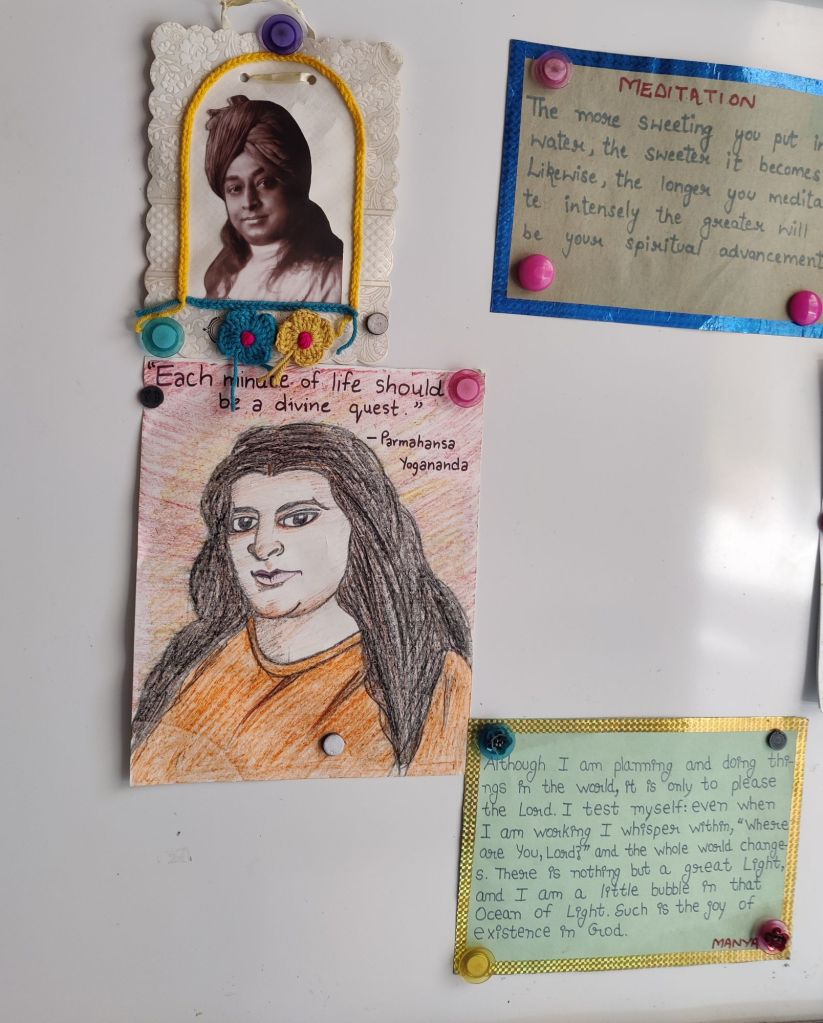
Public Notice Board at Yogada Satsanga Dhyana Kendra (Yogananda Meditation Centre)

August – A Monthly Wrap-Up


Every month, I and Didi enjoy a day out. In July we went mall surfing. I forgot to mention this in my July wrap-up. We shopped, had cold coffee( Hazelnut flavour) and shared a big fat walnut cookie. This month there was no such outing. However, the family took time off to visit a  restaurant in the southern part of the city to enjoy Bengali cuisine about which I have already written.

A visit to a free public library gave a fresh twist to Didi’s birthday celebration ending with a simple South Indian lunch. We did take up a cause this month and registered our protest in writing against a badly laid drain pipe, a wrongly placed water cooler and a growing dump stack on the way to the local temple obstructing the free way. Though not much progress has been made on this score I did post a tweet on X tagging the CM and the concerned Municipal Counsellor about it!!

This is also the month which saw many household necessities conking off one after the other resulting in an overdrive of market surveys which again took us to a nearby Mall. And surprise surprise!! This Mall which was not up to our expectations even a few years back has become so happening!!! It was therefore our moral responsibility to explore and splurge a bit. The household replacements also came from one of the big retail shops here. In fact, I went twice in one week to this Mall. The only disappointment – not many eateries here. We had lunch on the first day at KFC and milk shake at Keventers on the second visit.

At the fag end of the month I was hit by vertigo which put a stop to everything exciting including reading though I have purchased three books the day we went to the library. I listened to a few interesting audio stories instead. A brief –

Kaalo Golap (Black Rose) by Himadri Kishore Dasgupta: Sayok is entrusted by his Supplier Company to collect a black rose, from the outskirts of Agra, for one of their high profile clients. But does he know that the flower has a curse?

Aghor Babur Tyankghori (Aghor Babu’s Pocket Watch) by Himadri Kishore Dasgupta: Aghor babu , an antique collector, buys a pocket watch from an auction house. Soon after he narrowly escapes two fatal accidents. Will he survive the third one?

Kahen Kobi Kalidash (Thus Spake The Poet Kalidasa) by Sharadindu Bandopadhyay : The truth seeker, Byomkesh Bakshi and his friend Ajeet Bandopadhyay, are invited by a miner to nab the miscreants causing disruptions in his coal mine which also lead them on another trail of deceipt, betrayal and murder.

Mrityu Aashey Paaye Paaye (Death Comes Stealthily) by Saikat Bandopadhyay : An ace detective (now retired), Uma Shankar Choubey, narrates to his subordinate his first blood curdling case of sleuthing (before joining the Police Department) as a young boy fresh out of college.

The agenda of bathing and vaccinating my stray pets was also successfully completed this month.

Written for Natalie’s Monthly Wrap-Up