
Why do I like haiku? Because it tells a story – not the conventional one with a beginning, a middle and an end – but somewhere from the middle abrupt and not explained fully.
So that each time you read the same lines you get to unlatch a new door , loosen the drapes a bit or perhaps draw the curtains away from the window panes and let sunlight stream in.
Here are a few more fresh and fragrant from HaikuKATHA Volume 57 : July 2026.
Read through and I will tell you why I chose them.
the bell
that rings
the bell …
mother’s flashbulb memory
Gandhi ji’s Hey Ram
kala Ramesh
The one word that drew my attention to this tanka is “flashbulb” reminding me so much of the flash light of the erstwhile cameras. Like a sudden illumination. When I associate the word with memory I am instantly alerted of the winter years …. the fading twilight zones… the receding of tides…the waves pushing back into the sea.
The L-3 “Gandhi ji’s Hey Ram” comes as a jab – a below-the-belt punch. Sudden. Unexpected. Sharp. Such a shift!! At the same time such a subtle allusion to that eternal receding into the cosmic blackhole!!
***
did he wonder
why I always sent
a valentines card
two male penguins in the zoo
raising a chick
Alfred Booth
word by word
you dissect the lab report
with Google
how I wish we grew old
without these threats
Alfred Booth
Both these tanka seem in continuation of each other.
Both are so wistful….pensive….The silence in between heavy with those unpeeled layers of “what could have been”s… and “if only”s…
***
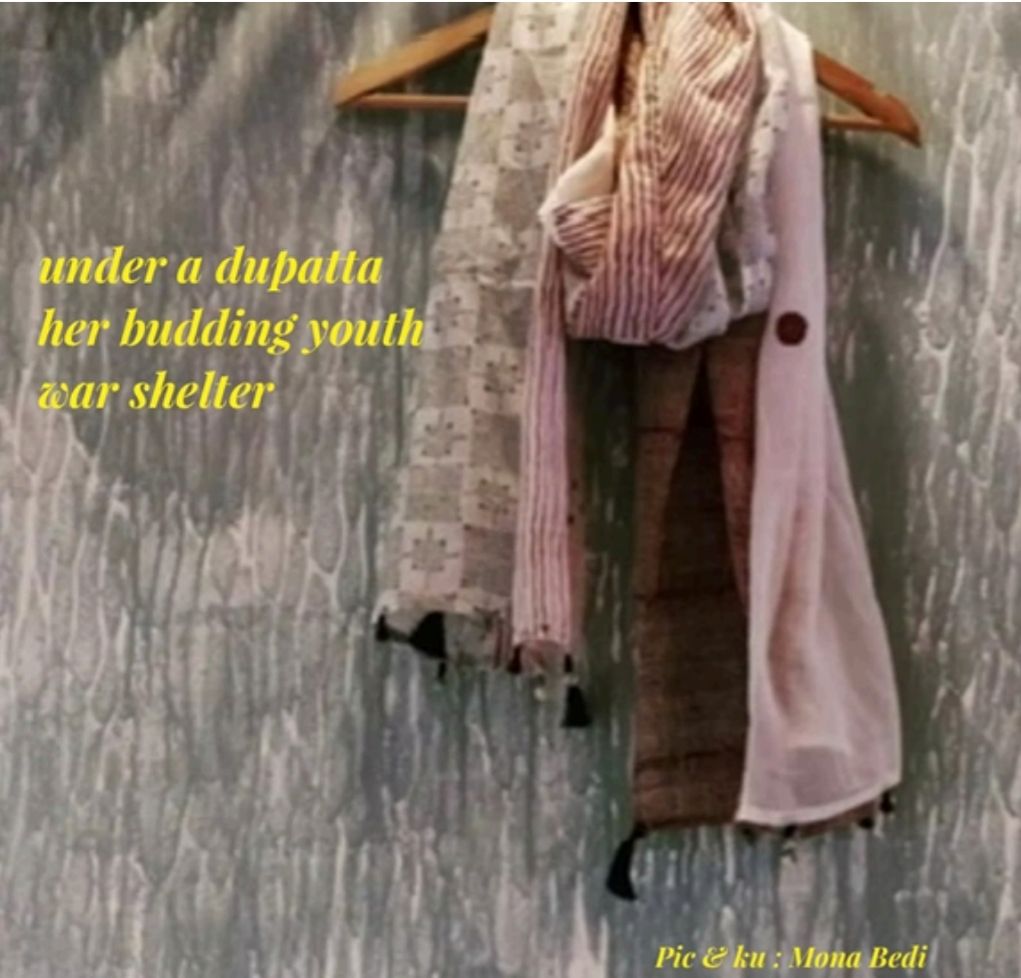
Need I say anything on this haiga by Mona Bedi ?
No…there is no didactics here.
Only that haunting realisation of the utter futility of man made devastation so boldly underlined.
***
summer cloud —
all the excuses
– Fatma Zohra Habis
This two-line haiku speaks of craft.
Usually excuses are associated with life half lived…. of remorseful remembrance.
But summer is just the prime of youth full of promises and boldness…
always too late
there is no way
to make it linger
the life of a flower
already in full bloom
– Fatma Zohra Habis
I see this tanka in continuation with the two-line haiku.
Almost a guilt runs through these lines – a guilt of not able to sustain all that is blooming and beautiful around us.
***
a box
full of handmade
Mother’s Day cards …
now how do I
save these text
– Baisali Chatterjee Dutt
night after night
i pour myself
into the darkness
through song —
daybreak takes my voice away
– Baisali Chatterjee Dutt
sleeplessness again …
which means
another night
replaying
my life’s greatest misses
– Baisali Chatterjee Dutt
In all these three tanka there is an unmistakable indulgence towards permanence (cards, songs, opportunities) which sharply contrasts with the temporariness of all that is living, breathing, growing around us.
***
HaikuKATHA is a well curated monthly journal of haiku, tanka, haiga, tanka prose, gembuns etc.
You can read the other submissions here.
Or click the link below 👇
https://www.trivenihaikai.in/post/haikukatha-issue-57
Take your pick from the post or from the journal and let me know in the comment section.





Great work! I really enjoyed this piece. I just released some new work at https://weurd.com, and I’d love to get some feedback. Thank you so much, and keep up the good work!!
LikeLiked by 1 person
Thank you very much Iuca.
LikeLiked by 1 person
of course! I’d be honoured for you to read my work, and I’d love to get your feedback.
LikeLiked by 1 person
What I love most about haiku is precisely what you have so beautifully described the story is not completed for us; it is left slightly ajar.
A few words become a window, and what enters through it depends upon the season of the reader’s own heart.
The finest haiku does not tell us what to feel. It merely leaves a quiet door open and every rereading discovers a different light behind it.
Perhaps that is why these little poems linger so long: they end on the page, but continue somewhere within us.
LikeLiked by 1 person
Absolutely Vijay ji. Therein lies the beauty of haiku. Thank you so much for engaging so creatively with haiku.
LikeLiked by 1 person
Fine examples well analysed. I like Fatma’s two-liner
LikeLiked by 1 person
Great pick
Thank you so much Derrrick 🙏
LikeLiked by 1 person
Beautifully explained Geeta ji🤍 A few simple lines, yet so many doors to open and emotions to discover. Truly lovely. 🌸🦋✨
LikeLiked by 1 person
Thank you so much Rajeshwari. I like the way you say so many emotions to discover 💝
LikeLiked by 1 person
Geeta ji, you’ve done something really important here. You’ve shown us not just the poems but why they matter. That line about haiku telling a story “not the conventional one with a beginning, a middle and an end, but somewhere from the middle abrupt and not explained fully.” That’s exactly it. Each time you read it, you get to unlatch a new door. You get to put yourself inside the space the poet left open.
And then you chose these. Kala Ramesh with the flashbulb memory. Alfred Booth with his wistfulness. Baisali Chatterjee Dutt holding on to permanence while everything temporary passes.
This is what curation is. This is paying attention. This is saying: look. These matter. And here’s why.
Thank you for this. 💙
LikeLiked by 1 person
Khadija,
Kala and team will be very happy to read your comment as the entire credit of curating such a large anthology with evocative submissions from around the world goes to them.
Your deep engagement, open appreciation and in depth understanding of the form make haiku a really collaborative creation of the poets and the readers.
LikeLiked by 1 person
Oh that would put smile on my face 🙂
Love and Peace
Khadz
LikeLiked by 1 person
Some wonderful haiku! I enjoy the different forms and styles. Makes them feel more…alive and personal.
And I appreciate your thoughts on each. It’s always interesting to know how poetry affects others. 🙂
LikeLiked by 1 person
Yes, there are many more different forms in the journal and it’s a pity I couldn’t include them all. Perhaps I will do that in some other post.
I personally feel that poetry should not be explained because it’s interpretation is very personal. I have thought loudly in this post. 😊
LikeLiked by 1 person
Less is more. Wonderful collection.
LikeLiked by 1 person
Absolutely. Thank you Rupali
LikeLiked by 1 person
That was really interesting, Geeta!
LikeLiked by 1 person
Thank you very much Chris
LikeLiked by 1 person
Brilliant share Geeta.
LikeLiked by 1 person
Thank you so much Sadje
LikeLiked by 1 person
You’re most welcome
LikeLiked by 1 person