
The books that I read the most were the ones I had as a child. Like the epics – Ramayana and the Mahabharata – written in a concise manner for children, Bengali translation of The Three Musketeers and Ben Hur – again abridged versions for children. But my favourite writer was/is Abanindranath Tagore (fondly called Aban Thakur ) because not only did he have a way with words but most of his books were replete with sketches that he made himself. The visuals along with his magical storytelling were enough to trigger the imagination of a child.
Growing up I rushed through one book after the other as with life hardly getting any time for a re-read. It is said that the formative years have a life long impact on the mind of an individual. No wonder that even now I get fascinated by Aban Thakur’s stories. I am again reading his Raaj Kahini (Royal Tales) set in the backdrop of Rajasthan. But now there is a difference.
One of the stories in the book goes like this –
Shubhaga, a young widow, seeks shelter in a Surya Mandir (Sun Temple) one fateful evening. The old priest of the temple takes her in. Soon after, the priest departs for heavenly abode. Shubhaga in her loneliness requests the Sun God to bless her with two children – a son and a daughter. The son grows up to become a handsome boy.
He meets a young princess , falls in love at first sight and marries her. However, their paths diverge thereafter. The young boy becomes a fierce warrior king having a number of conquests to his credit, consolidates power, sets up his kingdom and marries twice. One sultry afternoon hearing a beggar girl sing the same song that the playmates had sung during his secret marriage to the princess, triggers memories of his first love. He embarks on a search mission to find her but returns unsuccessful because the princess had by then renounced the material world and become a sanyaasin (i.e. embraced monkhood).
As a child I was mesmerized by this and other stories in the book. But now I see inequality of treatment, gender bias and patriarchy. The hapless princess renounces the world estranged from her lover. Her lover conquers the world , has two wives, luxuriates in glory, power and riches and forgets all about her till one day accidentally he is reminded of her.
Shakuntala, based on the Sanskrit poet Kalidasa’s Abhijnyanam Shakuntalam, is another story by Aban Thakur written for children. It’s a simplified version of the original. Shakuntala is the adopted daughter of sage Kanwa. She is lovingly brought up by the sage and his wife, Gautami, along with their two daughters, Anusuya and Priyamvada. Shakuntala grows up to be a young, beautiful girl.
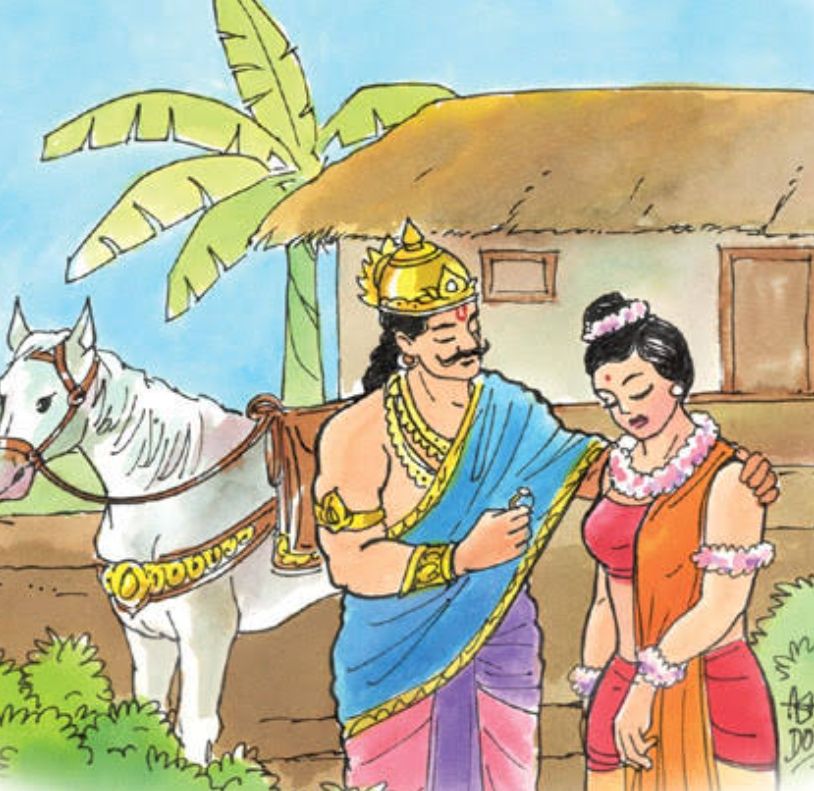
One day King Dushyant, having lost his way hunting, arrives at Kanwa Muni’s asharam and falls in love with Shakuntala at first sight. He marries her with the sage’s blessings and after a while leaves for his kingdom with a promise to return and take Shakuntala back with him. Before leaving he gives her his royal signet ring as a promise of his return.
Days pass but the king does not come back. Shakuntala is expecting his son. So the sage advises that she be escorted to the king’s palace. On the way, Shakuntala loses the ring given to her by the king which falls in the water while she is being ferried across a river and a big fish gulps it down.
When Shakuntala arrives at the king’s court , the king fails to remember her. Shakuntala reminds him of their marriage and living together in the tapovan (secluded sanctuary in a forest where sages and hermits live and meditate). The king asks her to show some proof to corroborate her story. But Shakuntala having lost the ring can produce none. The king humiliates her. Heart broken Shakuntala leaves the palace. Eventually, a fisherman catches the fish and finding the royal ring in its stomach brings it to the king who immediately remembers Shakuntala. He is extremely repentant and goes looking for her high and low but cannot find her.
However, the story has a happy ending. But is love so fickle that the loss of a ring can make a lover forget everything ?
Childhood in its innocence accepts everything as it is. An adult mind asks too many questions. Age and experience rob that innocent power of acceptance of childhood What remains is a restless, skeptical and interrogative mind. Is this cynicism or maturity?





I wonder if the fisherman got a reward bringing a royal ring.🤩 As adults, we have so many questions, and we don’t believe immediately.
Like the kids tv movies now like Peppa pig, the cars just stop on the slope hill and it never goes down. As kids, it’s acceptable and fine, but as an adult, I found it so funny and imaginative. 🤭
LikeLiked by 1 person
I believe the fisherman must have got rewarded handsomely as was the way with kings of those days.
Yes, the world of children is full of imagination and fun but for adults we see things through a different lens.
LikeLiked by 1 person
A lovely piece, as always Geeta ji, 🤍I truly enjoyed reading it. Thank you for sharing such beautiful thoughts. 🌸🦋
LikeLiked by 1 person
Thank you so much Rajeshwari and you are very welcome.
LikeLike
Interesting thoughts. Why is it that the men always forget the love of their lives, carrying on as if nothing mattered!
LikeLiked by 1 person
😊 That’s totally another perspective
LikeLiked by 1 person
A mature person retains childish understanding
LikeLiked by 1 person
Thank you so much Derrrick 🙏
LikeLiked by 1 person
Beautiful reflection, Geetaji. The same stories really do change as we change. Childhood accepts them with wonder; adulthood reads them with questions. Thank you for sharing this thoughtful perspective. 🌸
LikeLiked by 1 person
You have said it Maha
. Thank you so much 🙏
LikeLiked by 1 person
A thoughtful reflection. The stories remain the same, but the reader changes with time. Childhood accepts; maturity questions. Perhaps true wisdom lies not in losing innocence, but in allowing it to coexist with a deeper understanding of justice, love, and human nature. Beautifully expressed. 🙏
LikeLiked by 1 person
Thank you very much Vijayji. You have answered a question that was nagging me that innocence needs to be retained along with wisdom gained through lived experiences.
LikeLiked by 1 person
Same is true of life ,Geeta Di
Innocence believed in politicians and fought each other,today Maturity has questioned them and people have united for a noble cause at Jantar Mantar.
LikeLiked by 1 person
Yes, that maturity is being crushed inhumanly. Painful
LikeLike
When I saw the picture, I immediately knew you were going to write about Shakuntala’s story! I grew up with Amar Chitra Katha book and those pictures are still in memory. As kids, we accepted everything and I think our culture makes us accept what elders told us and no questioning them.
Btw Shakuntala has been made into a sanskrit movie if you are interested you can check on YouTube.
LikeLiked by 1 person
Yes, you are so right. Whatever the elders stated we believed as truth. I will check on the movie But I don’t know whether I will understand the Sanskrit dialogues fully. Thanks Ganga for the inputs.
LikeLiked by 1 person
You can use closed captioning.I did that 🙂!
LikeLiked by 1 person
Mahodara was one of the most prominent Rakshasa warriors in the Ramayana, serving as a trusted minister and one of the foremost army chiefs under the demon king Ravaṇa. Renowned for his immense strength, courage, and military skill, Mahodara played a significant role during the epic Battle of Lanka. Although he is not as widely remembered as Indrajit or Kumbhakarna, various versions of the Ramayana portray him as an influential figure in Ravaṇa’s court and an important member of the Rakshasa leadership. https://www.indianetzone.com/mahodara_ravana_s_councilors
LikeLiked by 1 person
These sound like stories with lessons. Beautiful, Geeta.
LikeLiked by 2 people
Thank you very much Mary
LikeLiked by 1 person