
This is in response to Rochelle’s Weekly Photo Prompt for Friday Fictioneers.
Word Count: 100

Once a sage asked his disciple to fill up a dried pond with water from a well farther away within a month’s time.
The disciple dutifully did as bidden but was unsuccessful in timely completing the task.
Remorseful he accepted his failure. But the sage said, “Look at the path down which you carried water everyday in the earthen pitcher that had a slim crack. Now that trail is lined with tiny saplings on either side.”
Moral of the story: failure and success are not absolute.
***
86 Words
You can read the other stories here.
Extroduction: I may have transgressed rules of the prompt write because this flash fiction is borrowed from one of the ancient Indian folk tales. However, the lone flower, in all its gorgeousness, peeking out of a wooden fence, strongly reminded me of this inspirational story which was shared in one of the spiritual workshops I attended a long time ago. There might be various versions of this tale as these got transmitted orally from generation to generation. So are its interpretations. Unlike the modern teaching method, which is heavily dependent on visuals, in days of yore lessons were taught through arduous tasks and results thereof.
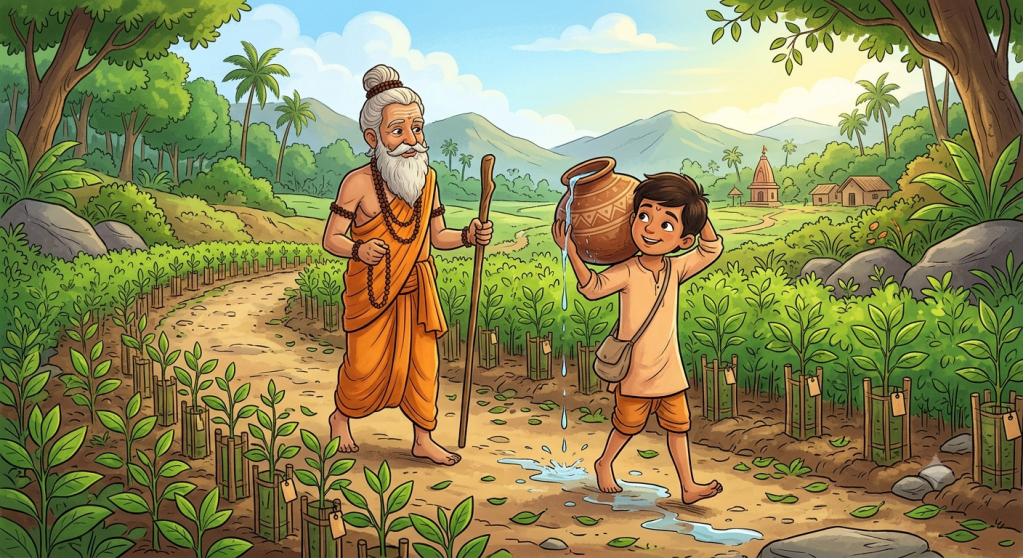
AI generated





I like the moral lesson of the story. I think it’s connected to Kaizen.
LikeLike
Hazel, sorry. I don’t know how your comment went into spam. I have recovered all your comments now. Sorry for the late reply. I have to now look into the philosophy of kaizen. The moral of the story is that failure leads to success.
LikeLiked by 1 person
No worries, gc. It’s all okay💚
LikeLiked by 1 person
Good Morning,GeetaJi
Your post reminded me of many such stories in our hindi textbooks where Gurus taught their disciples through arduous tasks.
The moral of the story you shared is a lesson to many such students who can’t accept failure and instead take the extreme step of suicide.
LikeLiked by 1 person
A very good morning to you too.
True Nusrat. Failure leads to success. We forget.
Another story that inspired me was that of Robert Bruce’s – Try Try Again And At Last You Will Succeed.
Have an awesome day.
LikeLike
In urdu literature there is a story of a man who was inspired to try and try again after watching an ant falling several times off a wall but not giving up and finally succeeding in the mission.
LikeLiked by 2 people
Sometimes the endeavours take a lifetime to come to fruition. That makes people lose courage. How does it feel to taste success after such prolonged efforts I wonder???
LikeLiked by 1 person
An inspiring story Geeta.
LikeLiked by 1 person
Good morning Sadje!
Yes, this story has stayed with me though I heard it a long time ago. Thank you very much for reading. Stay blessed.
LikeLiked by 1 person
Good morning dear friend! You’re very welcome
LikeLiked by 1 person
Yeah, at the end of the day, it feels really nice to just relax and read a book 😊
LikeLiked by 2 people
Chillax
LikeLiked by 1 person
The truth is rarely pure, and never simple
LikeLiked by 2 people
Yes, it is not simple at all.
LikeLike
A good thought
LikeLiked by 2 people
Thank you very much Derrrick 🙏
LikeLiked by 1 person
I think adapting your source material is fine. Many writers have influences that affect how they express themselves.
LikeLiked by 2 people
Thank you James.
LikeLike
You are totally forgiven, Geeta! This is a worthy fable/story to share and your adaptation is lovely.
LikeLiked by 2 people
Thank you so much Dale
You have put my doubts to rest.
LikeLiked by 1 person
Aha, an excellent moral, Geeta!
LikeLiked by 2 people
Thank you so much Chris.
LikeLiked by 1 person
A timeless and deeply meaningful adaptation.
What touched me most is that the story gently redefines success itself. The disciple believed he had failed because he measured the outcome against the task, while the sage revealed that life often measures us by the unseen goodness created along the way. That shift in perspective is both profound and liberating.
The cracked pitcher becomes a beautiful metaphor for our own imperfections. What we often perceive as flaws may quietly become the source of unexpected grace, growth, and life for others. True wisdom lies in recognizing that not every meaningful contribution is immediately visible or measurable.
Your thoughtful note at the end adds another layer of richness. Ancient folk tales endure precisely because they carry truths that transcend time, and you have retold this one with simplicity, humility, and relevance. A powerful reminder that the journey itself often blossoms into the real achievement.
LikeLiked by 2 people
beautiful exposition of a lovely lesson
LikeLiked by 2 people
Vijayji,
Your elaborate evaluation of my post , I always feel, has greater import than the content of the post itself.
How well you have described the various aspects of the story along with your interpretative analysis which has exponentially expanded the horizon of the ingrained lesson.
With deep respect,
Namaskar
LikeLiked by 1 person
I enjoy the moral lesson in these types of short stories/fables that never change with time. I wonder what the digital age has to offer?
LikeLiked by 2 people
Your question is worthy of deep introspection.
LikeLiked by 1 person
Great point you made. We became so much visually dependent! It is also interesting how when information passed through ears it might have changed yet the message remains strong!
LikeLiked by 2 people
I think over the years the relevance of such fables increases manifold. They are in fact timeless.
LikeLiked by 1 person
another lovely post, beautiful lesson.
agree – lessons were embodied, realized and focused: not simply memorized and echo chambered.
multiple-choices, checking the box, and limited attention spans: what else can we say?
thanks for making us think
LikeLiked by 1 person
Thank you so much for such a deep reading.
LikeLike
So true. Wonderful share.
It’s the journey that matters.
LikeLiked by 1 person
Thank you Rupali
LikeLiked by 1 person
Beautifully woven. The message that success and failure aren’t absolute is timeless, and the image made this ancient tale feel even more meaningful. Thank you for sharing this inspiring reflection. 🌿
LikeLiked by 1 person
You are very welcome Maha. Thank you for being in the post.
LikeLiked by 1 person
I did not know this classic story and was glad you introduced it to us and shared some of the takes on it
LikeLiked by 1 person
Thanks Yvette. Your reading makes the post relevant.
LikeLike
it’s all about perception, isn’t it? great story.
LikeLiked by 1 person
Yes, how you perceive failure and success. Thank you very much Plaridel.
LikeLike
Love the lesson here, and the way you link it to the image. Good stuff!
LikeLiked by 1 person
Thank you very much 🙏
LikeLike
Geeta I enjoyed the story and the wisdom held within it.
LikeLiked by 1 person
Thank you so much Lisa
LikeLiked by 1 person
You’re very welcome.
LikeLiked by 1 person
Dear Geeta,
You’ve broken no rules here. 😉
Shalom,
Rochelle
LikeLiked by 2 people
Thank you Rochelle
LikeLike