
Cryosphere is the part of the earth surface where water exists in solid form, e.g. sea ice, glaciers, ice sheets, snow cover and frozen ground (perma frost). Cryosphere is derived from the Latin word Krios meaning cold and is vital for the global climate system as it regulates temperature by reflecting solar heat.
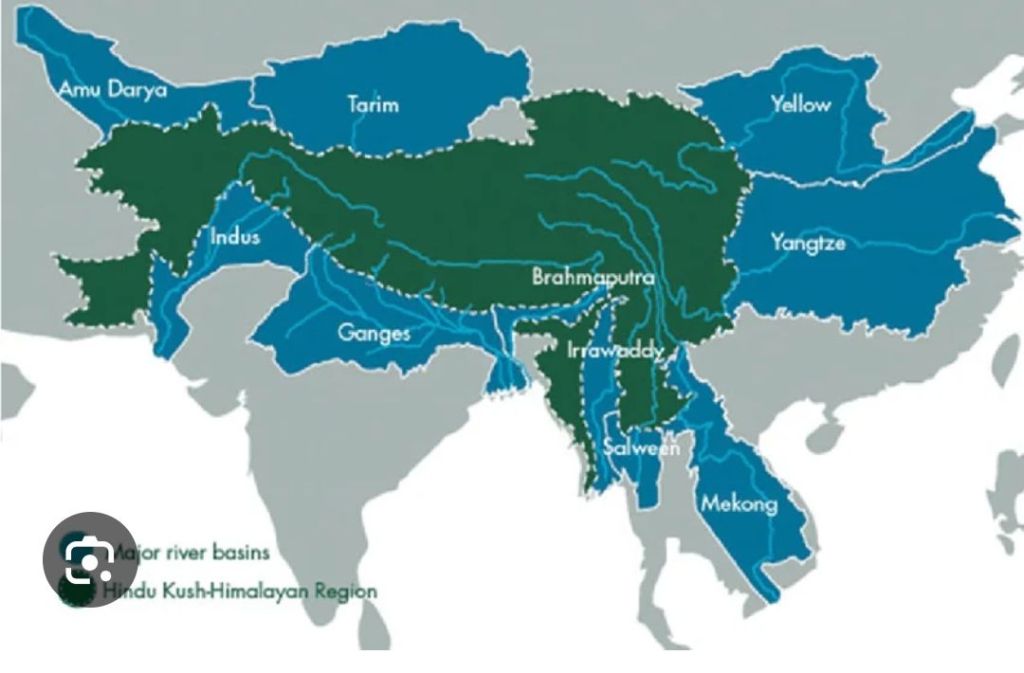
The Hindu Kush holds the largest volume of ice outside the poles. The Hindu Kush Himalayan (HKH) region is a vast mountain system spanning eight countries from Afghanistan to Myanmar, often called the “Third Pole” due to its massive ice reserves. It serves as Asia’s water tower supplying water to over 240 million people in the mountains and 1.65 billion downstream via ten major river systems (see map).
The region includes the Hindu Kush range in the west (Afghanistan/Pakistan) and the Himalayas in the east, bordering China, Nepal, India, and Bhutan. It holds the largest volume of ice and snow outside the Arctic and Antarctica and is considered a crucial region for regulating regional climates.
It holds 66731 glaciers across 55786 square kilometres. It is the source of at least ten major river systems supporting food, water, energy and livelihood security to billions. However, 78% of these glacier areas are situated between 4500 and 6000 metres above sea level and are exposed to elevation dependent warming – a phenomenon wherein temperature rises faster at higher altitude than at lower ones.
The region is highly vulnerable to climate change with glaciers melting rapidly, increasing the risk of floods, avalanches, and long-term water shortages. This region features diverse ecosystems, ranging from high-altitude deserts to tropical forests, supporting immense biodiversity. However, it also faces significant challenges, including unsustainable development and climate-induced disasters impacting the livelihoods of millions.
In this region rivers Ganga and Brahmaputra hold the largest glaciers. The region’s smaller glaciers are, however, shrinking faster creating risks of localized water shortage for high mountain communities and hazards like glacial lake outbursts and floods. A study shows that the glacier melt rate has doubled since 2000 in the Hindu Kush region.
Curbing the rapid glacier melt in the HKH region requires a number of measures like cutting black carbon emissions, reducing greenhouse gases, implementing regional scientific cooperation, managing glacial lake outburst floods (GLOFs), reducing localized air pollution, promoting sustainable land use and enhancing monitoring networks.
Regional pollution can be controlled by preventing open burning, brick kilns, and diesel engines.
Urgent adherence to the Paris Agreement to limit global temperature rise to 1.5°C is of paramount importance to prevent massive glacier loss.
Strengthening science-led collaboration to share data and coordinate adaptation across borders will facilitate a consolidated global action towards implementation and monitoring of sustainable and developmental measures in this region.
Other ways of curbing the rapid glacier melt are:
Researching localized techniques such as artificial snow/ice creation to protect vulnerable, smaller glaciers.
Avoiding environmental damage in sensitive high-altitude areas by strictly regulating construction, avoiding explosives in development and expanding forest cover.
Installing early warning systems and implementing structural measures to drain risky glacial lakes.
Expanding and maintaining long-term observational networks and on-field studies to track glacier health in real-time.
Engaging mountain communities in conservation and empowering local adaptation efforts.
(Information Source: Hindustan Times dated 21/03/2026 and ICIMOD – International Centre for Integrated Mountain Development)





So informative, gc. Hindu Kush Himalayan sounds interesting to discover.
LikeLiked by 1 person
Thank you Hazel. Glacier melt is really concern and cause for worry.
LikeLiked by 1 person
It rises the sea and might dissolve little islands, especially us.
LikeLiked by 1 person
Oh! Don’t get so scared..this post was just for spreading awareness.
LikeLiked by 1 person
All good, gc. No worries
LikeLiked by 1 person
Thanks Didi for valuable information 🙏 Happy Akshay Tritiya 🌹
LikeLiked by 1 person
Happy Akshay Tritiya to you too.
LikeLiked by 1 person
We are witnessing it,Geeta Ji.
Less snow in winter,less formation of glaciers,and pollution already adding to worries.
Plus Global Warming leading to early melting of glaciers.
An informative post,Geeta Ji
LikeLiked by 1 person
Thank you Nusrat. I knew you’d be able to relate to this post.
LikeLike
Happy Akshay Tritiya🌹
LikeLiked by 1 person
Same to you too Nusrat
LikeLike
Very informative post Geeta. Thanks for sharing.
LikeLiked by 1 person
Most fascinating information
LikeLiked by 1 person
Thank you very much Derrick ☺️
LikeLiked by 1 person
Lot of great information. Thanks for sharing.
LikeLiked by 1 person
A very relevant and informative post, Ma’am!
LikeLiked by 1 person
A very informative article GC! I think climate change and the weather systems and climate will be a hot topic for many years to come!
LikeLiked by 1 person
Absolutely. It’s important what we leave behind for the next generation.
LikeLike