
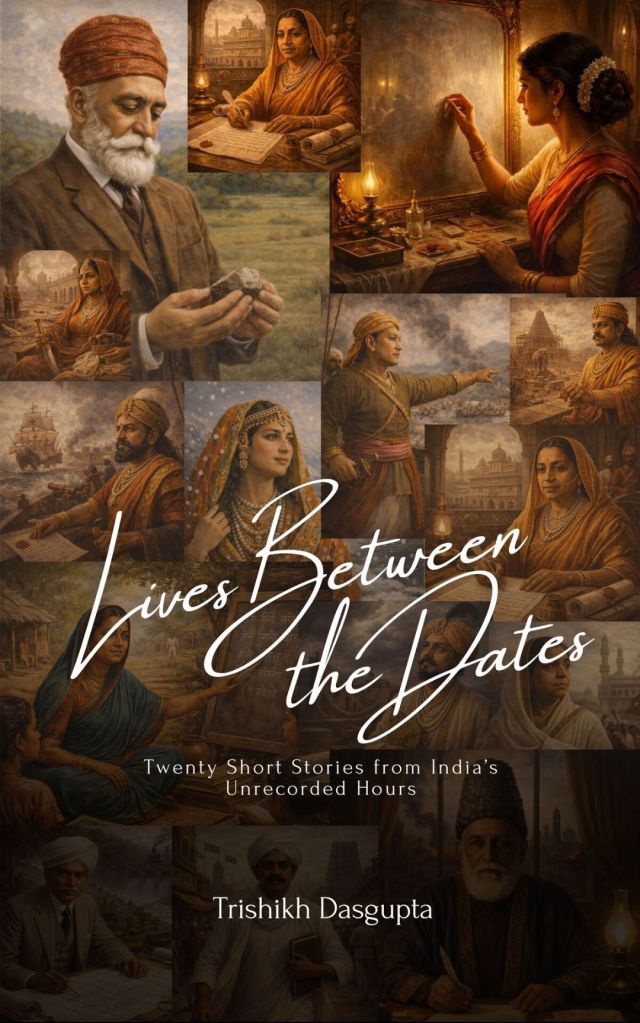
I have been following Trishikh Dasgupta’s short stories for many years on Storynook. Somewhere between reading his posts and interacting with him I had asked whether he contemplated getting published. So, when he finally did I had to grab a copy.
Lives Between The Dates is his third publication – a collection of short stories weaved around twenty historical figures spanning centuries and regions.
However, these stories do not follow the conventional retelling of historical sagas. These stories magnify moments which have evaded clinical documentation – moments of indecision, uncertainty, apprehension and deliberations.
“These were not memories that announced themselves as history. They were domestic, insistent, intimate. They belonged to courtyards, not chronicles.“
Moments which were “…like a held breath that could be released at any moment.“
We have a quietly observant labour activist and social reformer – Anusuya Sarabhai , a pensive word weaver – Sadat Hassan Manto , a precision passionate engineer – M Visvesvaraya, a quietly contemplative poetess and skilful orator – Sarojini Naidu, a reminiscent rebel leader – Begum Hazrat Mahal and such other towering history makers caught in their unchronicled hours of vacillation and self introspection.
“The difference between mercy and indulgence, she knew, lay not in feeling but in proportion. Too much and the structure weakened. Too little and it hardened into cruelty. Administration required a hand steady enough to find the narrow passage between.“
In brief Trishikh humanises history. He compels readers to acknowledge that those who made history could also have momentary self doubt and trepidations necessitating self review and reconciliation.
“She had learned to recognize this pause, the thin space before conviction hardened into motion.“
“…one listens to a truth that does not require agreement. Resistance, he understood, was sustained not by constant fury, but by the stubborn insistence on returning to work.“
“Ambition liked to dress itself as inevitability. Responsibility was quieter. It arrived with questions.“
Trishikh’s distinctive narrating style originates from his unmistakable command over the language, in-depth knowledge of history and a remarkable intuitive alliance with the terrain, in which the stories are set, elevating it into a living, breathing character.
“The land did not yet know what it was meant to become. It lay open and undecided, grass bending unevenly where the wind found reason to pass, red earth showing through in patches that refused neatness. A line of trees stood at a distance, their shade unoffered, their patience untested. “
“He thought of the river again, of how it taught patience by refusing it, of how it punished certainty with silence. Vulnerability, he realised, was not the opposite of readiness. It was another form of it.“
“The sea breathed in and out, unconcerned with flags, its surface carrying both promise and refusal in equal measure.“
“A woman bargained for grain. A child stomped his feet in a tantrum only to recover after being ignored. A temple bell marked an hour that did not ask to be commemorated. The city trusted its small mechanisms.“
“Guwahati understood anticipation. It had learned how to hold itself before the moment arrived.“
“Its temples were built not only of stone, but of pauses repeated until they became tradition.“
“Charcoal smoke carrying the promise of kebabs turned slowly, patiently, as if time itself were an ingredient.“
“A bird hopped once and decided against entering. The city moved on, unconcerned with this particular decision, trusting that it would be made.“
“Its temples were built not only of stone, but of pauses repeated until they became tradition.“
—-
This book is not only for history buffs but also for lovers of language and discerners of human dilemmas preceding commitment, accountability and trueness of intent and purpose.
“He thought of reputation, the word used so easily by men who preferred surfaces. Reputation could be repaired, adjusted, managed. Conscience was less accommodating. It kept its own ledger.“
“He imagined the alternative, the small failure that would never quite explain itself. The choice settled.“
“At the threshold, he paused and looked back once, at the desk, the lamp, the open window. The office had kept his confidence. He returned it by leaving nothing unresolved.”





How interesting! It sounds intriguing!
LikeLiked by 2 people
Thanks Carol Anne.
LikeLiked by 1 person
Me encanta! Alineado al momento presente que estoy viviendo. Te mando un saludo desde argentina y muchas bendiciones!
LikeLiked by 2 people
Dear Geeta, I read your piece slowly, almost the way one walks through an old corridor where every door holds a memory. Thank you for receiving the book with such openness, and for seeing not just the stories, but the silences between them.
When I began Lives Between the Dates, I was chasing something elusive, those unrecorded pauses where history breathes like an ordinary human being. Your words tell me that those moments found a listener, and that is perhaps the most a storyteller can hope for.
I am deeply grateful for the care, the attention, and the generosity with which you have engaged with the book. Reviews often speak about a work. Yours felt like a conversation with it.
Thank you for giving these stories another life on your page.
Trishikh
LikeLiked by 2 people
This is entirely my pleasure. Perhaps we can take this conversation a little further. I will get in touch with you on WhatsApp.
LikeLiked by 1 person
A delightful review. History should be humanised
LikeLiked by 3 people
Thank you…thank you…
LikeLiked by 2 people
I have read his posts and have always liked his stories.
Wonderful review Geeta ji.
LikeLiked by 2 people
Thank you so much. Yes, Trishikh is a popular blogger and his blog has wonderful stories.
LikeLiked by 1 person
Excellent review, Geeta.
LikeLiked by 2 people
Thank you once again Mary
LikeLiked by 2 people