
This is in response to Esther’s Weekly Word Prompt.
This week’s word : Board
***
The Signal
It changed to red.
He stopped the vehicle just a few inches from the zebra crossing. Impatiently.
This traffic signal was long. He was trying so much to avoid the forced stop. Praying silently that it would be “go-ahead-green” so that he could just pass by.
Today the Company’s Board of Directors Meeting was to be held.
He was getting late.
But nothing could be done now.
He looked around.
This locality was known to him having spent his entire childhood and the most part of youth here.
To the left the road turned into a gully.
He knew that gully so well.
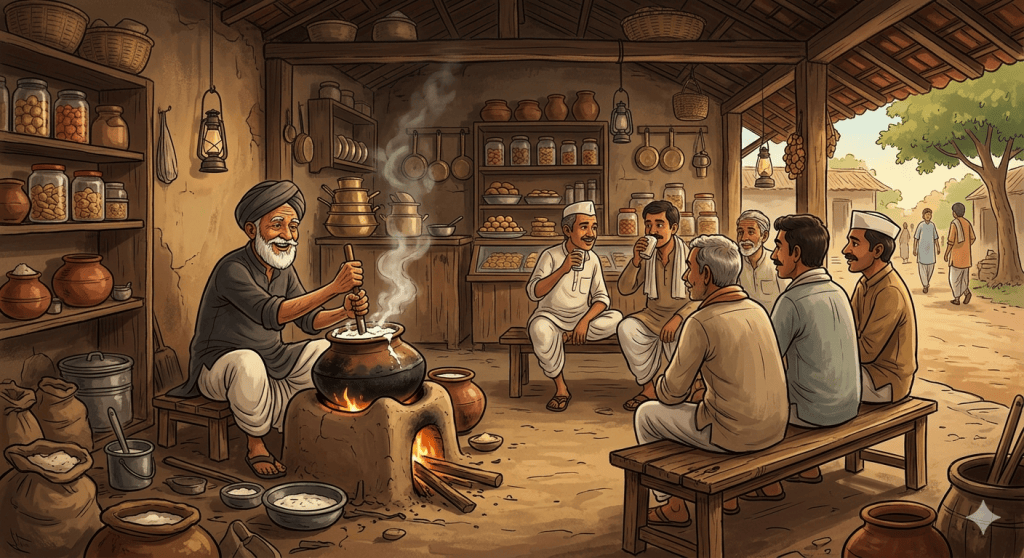
There was a mithai (sweet) shop in the corner right at the entrance where he and his friends savoured lassi for just a few paise per glass – a tall one made of steel shining in the sun.
In fact, there were two sweet shops next to each other owned by two brothers. But the one siding the gully did more business. The walls of the shop and the footpath on which it stood had blackened with soot, ash and lack of attention. However, the look of the shop did not matter much. What it sold did.
In front a few wooden benches would be occupied by bulky bodies in shalwar kameez, the scrawny in lungi and dhoti, the better placed in churidar kurta or pyjama or shirt and trouser – the regular customers – enjoying a cool drink before the start of the day or middle of work or in the evenings before going back home.
And that huge black kadhai (wok) in which simmered milk – its upper layer condensing slowly and thickening to a hard crust as the day progressed. It’s inviting freshness in the air! The wok was placed on a traditional earthen chulha (wood and coal stove) – temperature well adjusted. At times a ladel with a long handle would be dug in to give the milk a gentle swerve so as not to let it get burnt and the lower layers stuck at the bottom.
The curd was home made kept in an oval shaped utensil half covered. The lassi was handmade – a scoop of curd churned with ice and sugar in a stainless steel lota (pot) with a short, wooden baton, wet and slippery, in constant touch with milk and curd and malai. After every churn the man wiped the baton with a well worn towel and whirled the liquid from the lota to the glass and back a number of times to give the lassi a frothy texture. He loved to watch the whirl and the swirl – like pure white waves cascading alternately from a high crest to a low trough and so forth – the motion so well coordinated that not a single drop spilled out. Before serving, the mithaiwallah (sweet seller) would cut a small part of the malai (thick hard crust of milk) to top the lassi before placing the glass in the hands of the customers with a flourish.
In hot summer days the shopkeeper brandished a pankha (handheld small bamboo fan) like a wand to ward off the ubiquitous mosquitoes and flies hovering over the milk and mithais (sweets). Sometimes he covered half the milk wok too with a matching lid which opened and closed like a shutter. The sweets displayed on trays were covered with cloth covers. In winters the shop sold glasses of warm, malaidar (crusted) milk.
He suddenly realised that his mouth was watering and stomach growling. He had skipped his breakfast in a hurry to get to office on time.
On a spur of the moment he decided to step out and drink a glass of lassi with some hot, crunchy jalebis.
He manoeuvred his car slowly to the left and stopped right in front of the sweet shop.
The facade had changed. So had the owner – a young man with a dour face – the second or third generation most probably – the smiling, welcoming faces of his forefathers now replaced by furrowed brows and drooping lips.
On the outside a big neon signboard announced the presence of the “joint”. He couldn’t remember whether the one he remembered from his childhood days had a name. It was known by the quality of its products – the owner being the identifier – Bondey ki dukan (Bondey’s shop)!!
The interior now modernized was all shiny glass and aluminium. Tiled walls, artificially controlled temperature, refrigerated stuff, sweets and namkeens (tangy salty mixtures) attractively displayed in glass cases and formal, no-nonsense transactions. A digital weighing machine sat in the middle of the counter top for the benefit of both the seller and the buyer.
The iron kadhai, in which boiled the milk in the open, was gone. Gone was the whirly- swirly cascade of froth, the wooden bench, the informal air, the slurps forming creamy lines of moustaches on the upper lips, the tangy gossips, the loud guffaws, the exchange of coins, the jangle of the makeshift galla (where day’s earnings were stashed), the milk and curd smell mixed with hard earned sweat, the buzzing flies and the inadequate swish of the pankha.
He ordered a glass of lassi.
The man presented him a digitised bill with hurried efficiency before getting him his order.
He couldn’t even remember the number of times he had drank lassi from the shop without paying. The shopkeeper kept an account in the name of the family. Baba paid the money and later when in college he cleared his outstandings at the end of the month.
He looked at the slip of paper in his hand now – ₹150/- per glass! He was not surprised. With the passage of time, the rising cost of production and maintaining a shop with uniformed staff in a prime location the inflated rate was a given.
He paid and waited. The staff went to a freezer kept on the right hand side opened it and took out a glass which resembled a miniature earthen pot but it was not. This was an era ruled by plastic and it’s variants.
And the lassi was not freshly prepared in front of the customer. It was “pre-manufactured”.
Jalebis were only available early mornings or evenings. So he did without them.
He took the first sip. The watery liquid coursed down his throat.
It was too light.
Too thin.
Too sweet.
And no malai.
He grimaced, gulped down the rest and dashed out of the shop.
The signal had turned green.





From malai to machinery, that’s quite a journey. Beautifully written, and painfully relatable.
Earlier, lassi peene se moochh bhi ban jaati thi… aaj kal to woh joke bhi mushkil lagta hai😊.
I really miss that thick lassi, with gulab jal and a generous layer of malai on top.
LikeLiked by 2 people
Me too as I come from that era of nameless shops of community bonding.
LikeLiked by 1 person
We had lassi and ganne ka juice stalls right outside college. We were good kids, at least when it came to what we drank. 😄
LikeLiked by 1 person
Incidentally women did not occupy the benches of these shops. It was unthinkable in those times.
Yeah, these college joints were so famous
LikeLiked by 2 people
beautiful story depicting how life was, maybe still is in areas, times move on.
LikeLiked by 1 person
Times change the familiar into the unfamiliar. Nicely told story Geeta
LikeLiked by 1 person
Thank you very much Sadje. It is not only unfamiliarity but also a marker of quality, social mingling and the level of expectations set by precedence.
LikeLiked by 1 person
Very true Geeta.
LikeLiked by 1 person
A lovely time-lapse story.
LikeLiked by 1 person
Thank you Rupali
LikeLiked by 1 person
A pit stop to be avoided. You did well to get all that out of the prompt word.
LikeLiked by 1 person
Thank you so much Derrrick
LikeLiked by 1 person
A beautifully woven piece✨🤍more than just a mithai shop, it captures the warmth of people, memories, and a time where taste was felt, not manufactured. 🤍✨
LikeLiked by 1 person
You have said it Rajeshwari. It was felt not manufactured.
LikeLiked by 1 person
Geeta Ji,with a single stroke of pen you took us decades back to beautiful memories,to shops selling lassi,men sitting on benches ,gossips.
Back then, we had shops with wooden planks,the lassi walas kept curd in large copper vessels
We hadn’t much sweet shops in the town I lived in,the only sweet shop we had there was of a hindu man whom everyone called Lalaji.
LikeLiked by 1 person
See Nusrat… यादें ताजा होने के लिए सिर्फ एक किस्सा काफी है। मुझे भी यह लिखते हुए कई बचपन की यादें याद आईं। पर यह यादें दुखदाई भी है। जो अच्छी बातें थी गुजरें दिनों की वे वापस नहीं आ सकतीं। ऐसा नहीं कि अब सारी चीजें बुरी हैं फिर भी लोग एक दूसरे से दूर चले जा रहें हैं जो कि ठीक नहीं हैं।
LikeLike
सच में गीता जी,अब सारी चीज़ें बुरी भी नहीं पर वो मज़ा भी नहीं
हमारे यहां 90’s में इतने अच्छे हालत नहीं थे पर न जाने क्यों लॉग फिर भी खुश थे
In our language milkman is called ‘goor’
A joke from 90’s is that when a milkman was stopped by security forces and asked who he is
He innocently answered,’में गांव की गोरी हूं ‘The soldiers laughed and let him go.
So many good memories
LikeLiked by 1 person
Hee…Hee…How words get distorted to suit a purpose.
Varied time with their varied nostalgia
LikeLike
I do think it’s sad how times change. I remember so much more of a community feel. Very well told 😊
LikeLiked by 1 person
Thank you so much Esther. I guess we all suffer from Natsukashii a Japanese term for a warm, nostalgic longing for the past.
LikeLiked by 1 person
Hi 😊 I just wanted to share something with you…
I’ve nominated you for the Sunshine Blogger Award 🌻
I truly enjoy your writing and the way you express your thoughts — it feels real and stays with the reader.
It just felt right to pass this forward to you. 💛
If you’d like to take part, you can check my post here:
[https://nihshabdblog.wordpress.com/2026/04/01/mornings-with-my-boys-a-little-noise-a-lot-of-love-%e2%98%95%e2%9c%a8/]
No pressure at all — just wanted you to know you’re appreciated ✨
LikeLiked by 1 person
Thank you so much Rajeshwari.
I do not have much experience of these award.
I will check out your post.
Thank you so much.
Honoured, humbled and privileged.
But let me check out the post first
God bless.
LikeLiked by 1 person
Thank you so much 😊
And honestly, same here… this is my first time with something like this too.
I’m just figuring it out along the way, so no pressure at all — take your time to check the post.
It truly means a lot that you received it so kindly.
Grateful and sending you lots of good wishes too 💛✨
LikeLiked by 1 person
What I gather from your post dear Rajeshwari that I have to answer your questions and nominate other fellow bloggers for the award. However, what happens if the other bloggers I nominate do not agree to participate? Is there a stipulated number of bloggers that I have to nominate ? Do you still get to win the award if I fail in securing the participation of fellow bloggers at some point ? Your winning is very important. Please let me know.
LikeLiked by 1 person
Thank you so much for your thoughtfulness 🤍
There’s absolutely no pressure at all—participation is completely optional, both for you and for anyone you nominate. Even if someone doesn’t take part, it doesn’t affect anything.
There’s no strict number to follow either, and there’s no “winning” as such—it’s just a way to appreciate and support each other in the community 😊
Your kindness and intention mean a lot to me already.
LikeLiked by 1 person
Ok. I get it. I will do it for you.
LikeLiked by 1 person
No no, it’s not for me 😊 I’ve nominated you because you truly deserve it that’s what matters the most 🤍✨
LikeLiked by 1 person
Thanks to you. Indebted.
LikeLiked by 1 person