
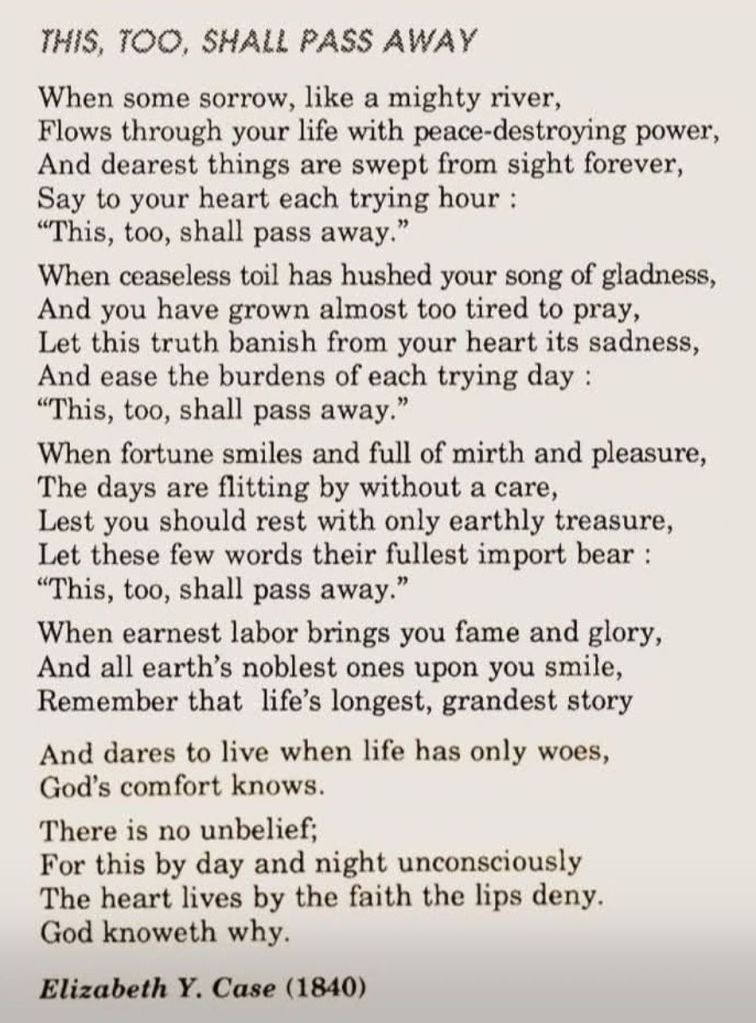
How do we navigate through pain and grief ? Do we remember this is just a passing phase? Are we aware of the ephemerality of happiness on sunny days? We are supposed to smile through tears believing that bad days are transient. Are we supposed to become morose thinking today we are laughing but tomorrow it may not be so ?
No.
We are not to break down in the hardest of times because the waves that recede do come back to the shore. And in our carefree days when everything seems hunky dory we are not to forget that joy is short spanned too.
I think the title of the poem This, Too, Shall Pass Away tells us to be alert and prepared for what’s next to come so that we have faith when things are not in shape and enjoy the happy phases of life as much as we can knowing that nothing stays as it is for too long.
This constant change is life and creation. Nature has seasons. Civilizations have growth and then decay. Societies are constantly in flux. Economies strengthen and fall. The curvaceous nature of everything around teaches us to be resilient, tenacious and flexible. And that is survival.
Sadness as well as happiness both, are gifts of God. We should embrace them as precious. Both teach us to live fully and meaningfully. If we have only either of the two life will be static and stagnant. Pain rolling into pleasure rolling back into pain rolling back into pleasure is such a unique process lending movement or gati to our existence. If this cyclic order is not there we are lost.
All inventions and discoveries have taken place from human wants and needs. The sense of want is heightened in the absence of what we feel we require – things that we lack. The sense of lacking makes us miserable which, in turn, propels us to look for solutions… inventions. Inventions make us comfortable and give us a sense of fulfillment. We acquire them and enjoy life till such time there is another upsurge of wants…another vacuum which makes us miserable again.
In short, in grief we grow. In joy we enjoy that growth. But human nature is restless. It does not know contentment. We have to acquire the skill to be content as we realise that there is no end to wanting and so no end to misery. Somewhere we have to stop and turn inward to find that true place which does not make us wander and gives sthiti or thahraav or anchor to our wanderlust.
In this entire process of breaking and making the mantra of moving on is this too shall pass away.
If the entire cosmos is in a continuum of in and out flux in time humans cannot remain rigid, inflexible and inadaptable.
The beauty of the poem lies in affirmatively reinforcing the most pragmatic philosophy of worthy living condensing it into a quick and easy to remember aphorism of life.
***
Elizabeth Y. Case (known also as Elizabeth York Case) was a 19th-century American poet. Her most notable work is a poem that retells the classic fable of a Persian King seeking a sentence that would remain true in all situations, concluding with the truism “This, too, shall pass away”.
While sometimes confused with other poets of the era (such as Elizabeth Barrett Browning or Theodore Tilton, who wrote a similar poem called “The King’s Ring” or “Even This Shall Pass Away”), Elizabeth Y. Case is credited in several 19th-century Anthologies and modern Best Poetry” Compilations for her eponymous version.

The poem This, Too, Shall Pass Away is courtesy Facebook
This article is part of Blogchatter’s #WtiteAPageADay Campaign





Beautifully written and easy to connect with because it touches the heart.
Pain and happiness feel like two parts of the same journey that we live through again and again, yet forget conveniently.
The reminder to hold on during storms and stay grateful during sunshine is easier said than done, but it remains a powerful truth.
LikeLiked by 1 person
I don’t know how I missed your comment.
My father used to say just like the earth is filled three fourth with water and one fourth with land so is our life filled with sorrow and happiness. Of course, the proportion of sorrow is more than happiness – three fourth sadness one fourth joy.
Yes, its difficult to remember and believe that this too shall pass away when in abject misery. In happiness we always feel we are entitled to never ending joy.
But the passing phases remain as indubitable facts.
LikeLiked by 1 person
Sadness and joy keep taking turns, and remembering that both will pass helps us stay humble in joy and hopeful in pain.
No issues, GC.
Not replying to another blogger can happen for many reasons. It is not a crime and never needs an explanation.
LikeLiked by 1 person
Good morning and thank you.
LikeLiked by 1 person
Good morning, GC.
Enjoy your Tuesday by posting 10 articles. 😃
LikeLiked by 1 person
And reading ten articles posted by you. 😆😆
LikeLiked by 1 person
Haha! let me limit 3 articles to start with gradually reaching 0 articles per day. 😂
LikeLiked by 1 person
They are enjoyable
LikeLiked by 1 person
Thank you, you are unusually kind. 🤣😂
LikeLiked by 1 person
I am usually very kind…
LikeLiked by 1 person
Kind of you, GC.
LikeLiked by 1 person
Geeta Ji,
I am quite delighted to read your detailed analysis of poem of Case. How many corporate retired execs have this much knowledge of literature ? Very few or almost none. I’m proud to have you 🌷🌷
LikeLiked by 1 person
Thank you Rajendraji. It’s only a matter of interest.
LikeLiked by 1 person
Yes true
LikeLiked by 1 person
This was a message I often gave my clients, without ever having seen this poem
LikeLiked by 1 person
Yes, Derrick this is an oft quoted message. Have a good day 😊
LikeLiked by 1 person
Life is a mixture of grief and joy. If this two didn’t exist, then it’s not life.🤭 Beautiful poem, gc
LikeLiked by 1 person
Thank you very much Hazel. You have summarised the essence of the poem beautifully
LikeLiked by 1 person
Thank you and my pleasure, gc. Enjoy your day!
LikeLiked by 1 person
Such a thoughtful and grounding reflection on life’s constant ebb and flow.
I loved how you showed both joy and grief as necessary, divine teachers.
“This, too, shall pass away” feels deeply meaningful here, not just comforting.
Your insight on restlessness and inner anchoring (sthiti) really stayed with me.
A beautiful, timeless piece—thank you for sharing. 🌿
LikeLiked by 2 people
Thank you Mahananda. Its readers like you who with their reflective interpretations elevate the worth of a post.
Sorry for the delayed response.
LikeLiked by 1 person
A precious poem and your reflection.
LikeLiked by 1 person
Thank you so much Rupali
LikeLiked by 1 person