
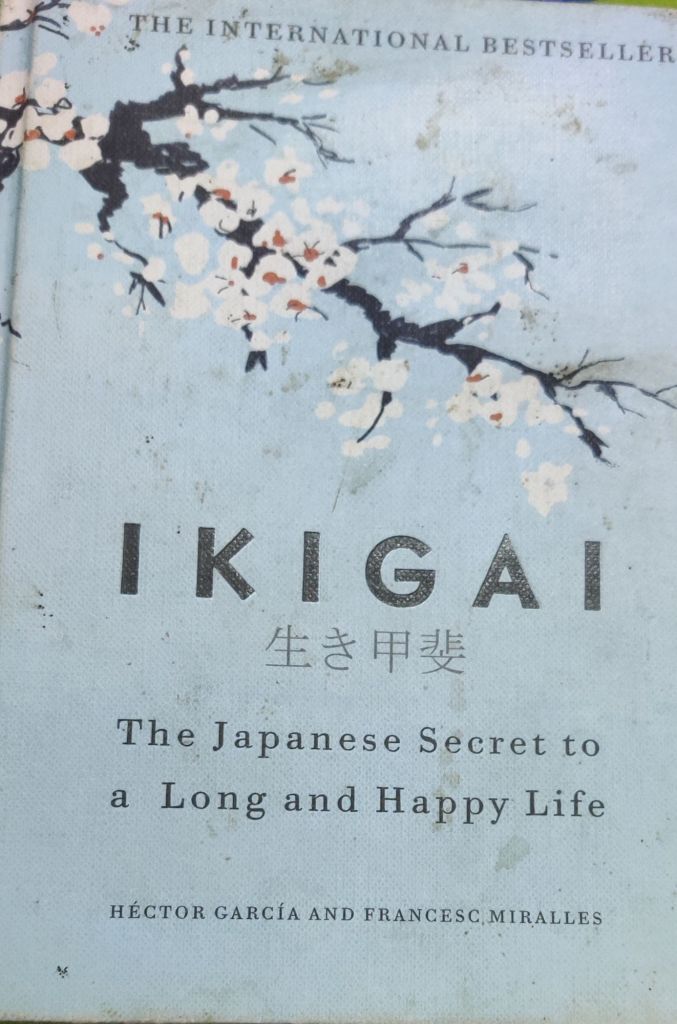
My reading graph has again dipped. I started reading two books at the same time but I finished Ikigai The Japanese Secret to a Long and Happy Life by Hector Garcia and Fransesc Miralles first.
If in the pic the book looks old there is a good reason for that. I got this book quite a few years back but couldn’t finish reading because of work pressure. But it was always in my TBR.
Recently in a conversation with my nephew a reference to this book came up. That made me pick it up and read this book again.
There are certain Blue Zones on earth where people live long, happy and healthy lives.
The net throws the following information about Blue Zones of the world:
“The Blue Zones are five regions with unusually high percentages of people living to 100 or beyond: Okinawa (Japan), Sardinia (Italy), Ikaria (Greece), Nicoya (Costa Rica), and Loma Linda (California, USA). These areas share common lifestyle traits, known as the Power 9, that promote longevity and lower rates of chronic disease and include a plant-based diet, consistent movement, a sense of purpose, strong social connections, and stress reduction techniques.“
The key to the longevity of the inhabitants of Okinawa, an island in the south of Japan, is healthful diet, simple living in the outdoors, green tea and the subtropical climate. In the North of Okinawa is a rural town called Ogimi with around three thousand inhabitants which boasts of the highest life expectancy in the world. Ogimi is nicknamed as the Village of Longevity.
Okinawa is also the Island of Longevity where shikuwasa – a lime like fruit packed with antioxidants – comes from. Could that be the secret of Ogimi’s high life expectancy? Or is it the purity of water in which moringa tea is brewed? Or is it Ikigai which drives the incredibly friendly populace of this island ?
Ikigai is a Japanese word. To put it simply, it means the reason for which one gets up in the morning. It is the purpose for which one lives. Every individual has his or her own ikigai.
There are various therapies, like Logotherapy developed by Dr. Frankl of Vienna Polyclinic Hospital and Morita Therapy, developed by the Zen Buddhist Shoma Morita of Japan through which an individual who has lost purpose and meaning in life can find his/her ikigai. Both therapies are distinctly different from psychoanalysis. These therapies do not intend to resolve inner conflicts. They just help you find your ikigai or purpose to live. Both therapies have a spiritual dimension to them.
Ikigai need not be a very strenuous exercise or an uphill task. Nor should it be so easy that one becomes too complacent about it. Ikigai should involve flow so that one can lose one’s sense of self and time in it (almost like meditation) to become one with the purpose. For example any creative activity in which you can immerse completely. Even following daily rituals (microflow) can be your ikigai provided you enjoy doing these.
In Japanese vocabulary there is no word for retirement because in Japan no one retires. They just continue doing what they love to do. They take years to perfect their skills and take pleasure in the journey of learning. As a race, the Japanese are hardworking and do not tire of doing the same work again and again over a long period of time. That is why perhaps ikigai comes naturally to them.
Ikigai is an intriguing concept and a fascinating read. The book urges the readers to look inside and identify their own ikigai. While reading the book I asked myself many times what my ikigai is. Is it reading ? Is it writing? Is it the homely chores? Or is it simply the walks in the park ? Ikigai can be anything from the mundane to what we are passionate about.
However, a distinction needs to be made between ikigai and life’s goal. Ikigai is the process or everyday drive to reach that goal but not the goal itself. Once one reaches the goal or attains the distant dream there may be a loss of interest to continue with the zeal. Ikigai essentially means continuity – what one is doing here and now. So if you are into music your riyaaz or daily practice could be your ikigai. But not the public performance you are preparing for. For a painter it’s the everyday filling in the colours on the canvas not the completed painting. Unless the musician continues to do riyaaz and the painter picks up another blank canvas to fill their ikigai is lost.
Its relevant to mention the lifestyle of the supercentenarians (those who live beyond 100 years) of Ogimi.
In Ogimi there are no trains. The inhabitants either walk or cycle.
They remain happily busy engaged in many activities but with a sense of calm.
They are early risers and early nighters.
They have a strong sense of community and active social life.
They have a low calorie diet with low salt (7 grams per day) and no sugar. Their diet consists of white rice, a variety of vegetables and fruits and fish (three times a week).
They practice hara hachi bu that is they stop eating when 80% of their stomach is full.
They do moderate exercises but do not pass time sitting for long hours: movement is essential to their lifestyle like spending time weeding in the garden, growing vegetables, visiting friends, dancing, being active in community work and gatherings etc.
Their prime source of beverage is green tea (five cups a day).
Last but not the least, the authors propagate mental, physical and emotional resilience in order to move forward or persevere with ikigai. Things that break under pressure are fragile while things that get better in adversities or under catastrophes are antifragile (a term coined by Nassim Nicholas Taleb). To discover and cherish beauty in imperfection or wabi sabi is another Japanese concept that creates a conducive atmosphere for practising ikigai – to understand, appreciate and accept the impermanence and ephemerality of life.
In brief the ten fundamentals of the residents of Ogimi are :
Stay active
Take it slow
Don’t fill your stomach
Be surrounded by good friends
Be in shape
Smile
Reconnect with Nature
Give thanks
Live in the moment
Follow your ikigai
I wholeheartedly recommend this book to those who wish to live a happy, healthy and long life and also to those who wish to be inspired to change their lifestyle for the better.





I recently read Ikigai also, Geeta, and I loved it.
LikeLiked by 1 person
Yes, it’s a very good read. More so, if we can imbibe the Ogimi style of living.
LikeLiked by 1 person
So interesting! I will look for the book, thank you!
I have always thought that everyone has that one thing, that they enjoy doing no matter what… even repetitively, without comparing oneself to others necessarily, so no external drive, and doing that thing to no exact purpose or aim… but just enjoying it, from within, purely and simply! So… no need for retirement, indeed, such a natural thing… like going on working in your garden or house, so lovely! 🙂
LikeLiked by 1 person
Yes, it is a very engrossing and rewarding process which motivates us to live with a purpose.
LikeLiked by 1 person
Most fascinating
LikeLiked by 1 person
Yes, it’s worth imbibing. Thank you so much Derrrick.
LikeLiked by 1 person
Seems to be a very useful book
LikeLiked by 1 person
Yes it is if you are interested in the subject.
LikeLiked by 1 person
I actually have no interest in living a long life. The shorter the better.
LikeLiked by 1 person
Its not for a longer life. But a happier and healthier one. End of life is not in our hands but the quality of life is.
LikeLiked by 1 person
That’s very true my friend. I agree that the time we spend on this earth, if it’s healthier and happier- it would be wonderful
LikeLiked by 1 person
I read this book during our stay in Copenhagen. I liked it.
LikeLiked by 1 person
Thanks a lot the captivating review! I should add it to my read list as well
LikeLiked by 1 person
Please do. This book is very useful if we imbibe the path of ikigai
LikeLike
[…] Ikigai […]
LikeLike