
I have a kind of friction with formats. You give me a format to work in I will after a while definitely veer out of it.
When I was learning Hindustani Classical Music I often broke the rules. Indian Classical Ragas are typically format based, however, with a lot of scope for innovation but within the format. Expertise lies in bringing out the beauty or personality of the raga innovatively playing with the notes within the stipulated format.
There are male ragas and female raginis. Obviously their personalities differ. Some are mild and malleable while others are strong and overbearing. Some are simple and straight and some are complex and tough. Each raga has a specified pair of notes on which the singer can halt during rendition – the vadi and the samavadi swars (notes). There is generally a difference of four or five notes between the vadi and the samavadi swar. Halting on the wrong note can alter or transform the raga completely.
There are notes excluded from the format of a raga which are known as vivadi swars as they can destroy the inherent nature of the raga. However, maestros have the expertise to apply these vivadi swars so cleverly that they more than enhance the mood of a raga.
And then there are varjit swars or notes which are completely prohibited from the matrix of a raga. It is relevant to mention that all ragas do not consist of all the seven notes. There are different permutations and combinations of notes – a minimum of five to maximum of seven – applicable in respective ragas.
Every raga has a stipulated time of singing. The twenty four hours of the day are divided into prahars. Every raga is sung in the prahar it is suited to. The samay chakra or time circle has ragas for dawn , morning, midday, afternoon, late noon, dusk, evening, night and late night. Then there are ragas which are seasonal – specific to rain , spring, autumn, so on and so forth.
Having said that Indian classical music is extremely scientific. As one proceeds to higher segments one realises it’s nothing but physics and mathematics. Not to say its effect on your physique, psyche and chemical constituents. It is said that raag darbari sung to perfection can cause a rise in blood pressure, raag malhar sung to exactitude can bring in rains, raag deepak by expert rendition has the capability to light a fire.
The effect of classical music on humans and animals is therapeutic. I remember my pet, Mr. Snow Boot, was unmanageable in his early years. He would romp about the house , bark wildly and create quite a chaos. The only way to quieten him down was to play classical music which would instantly calm him down and put him to sleep.
The best relaxant for an insomniac is the soothing strains of some mild classical melody. There are certain ragas which are sleep inducing. The vibration of a shepherd’s flute is said to have a wondrous effect on the growth of harvest. Classical music is an important part of Music Therapy for specially abled children.
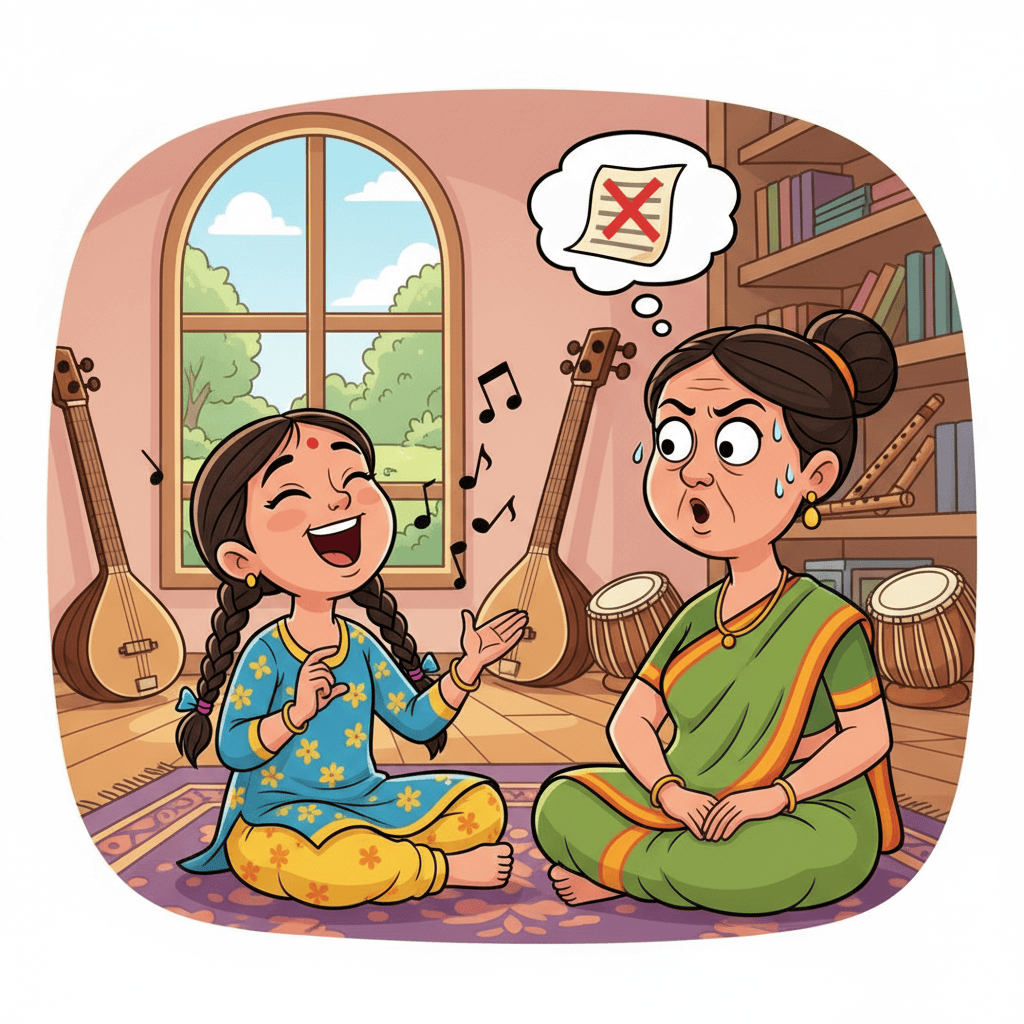
It is noteworthy that Hindustani Classical Music is learnt orally. The Guru or teacher sings and the shishya or student picks up by hearing. The notes are never written down or mugged up. A raga sung wrongly is nothing less than an affront to the guru him/herself. It is said that if you don’t respect a raga you are liable to incur it’s wrath. As a result, the singer will remain deprived of mastering it.
So when a mischievous student applies a flat nishad (seventh note) in a raga wherein the note itself is mandatorily exempt the Guru’s exasperation is natural. But what if transgression is inbuilt into the flagrant learner’s genetic code ? Simple, he or she never learns.
A mind which is inclined to experiment and tires easily of boredom breaks the boundaries and wanders away into wilderness with ease whether permitted or not. It has to ensure freedom as its fodder for creativity.
When it comes to writing, similarly, I rather say in ten different ways (till saturation sets in) on a given topic than subscribe to the copy – paste method.
So if you feel boxed more than often like me break open out of it without guilt or fear. Let in the unconventional, play with words and go astray with notes, mix the wrong colours and get lost in a maze of ideas unthought of as long as they spurt out like mountain springs.
You are safe. You are in your rhythm. You are yourself. In the long run that is what counts. Therein lies your own truth in vibrant hues. Don’t let it get clotted in the quagmire of stringent rules and stiff boundaries. Set yourself free.
So what if you fail to become the master of the game. At least you have played the game by your own rules.
😂😂😂😂

All pics AI generated





Yes, life is full of experimentation.
LikeLiked by 1 person
True otherwise it is boring.
LikeLiked by 1 person
Thank you, Geeta, for the interesting essay!
Joanna
LikeLiked by 1 person
Thank you Joanna for reading. You are always welcome.
LikeLike
An informative description which perhaps works for all classical music
LikeLiked by 1 person
Thank you Derrrick. I guess so but I don’t know much about western classical though I like symphonies.
LikeLiked by 1 person
The science and maths is the key, as you mention
LikeLiked by 1 person
Thank you so much Derrrick
LikeLiked by 1 person
Thank you so much for sharing your reflections on the scientific nature of music and the more or less felt need for formats.
LikeLiked by 1 person
Thank you very much Luisa
LikeLiked by 1 person
You’re more than welcome ❣️
LikeLiked by 1 person
“So what if you fail to become the master of the game. At least you have played the game by your own rules”– brilliant thoughts, Ma’am. I can again relate to you on this topic as I find it challenging to stay within a fixed format or expectation whether it comes to writing or life in general!
LikeLiked by 1 person
I guess this is a creative challenge to stay within the format and also the restlessness of creativity to move beyond the format. Both ways are manifestations of creativity.
LikeLike