
For me kynpham Singh Nongkynrih was the editor (along with Rima Nath) of the haiku anthology from India – Late Blooming Cherries – till I read a full article on him in Hindustan Times which described him as the voice of Meghalaya – one of the Seven Sisters of North Eastern India.
It made me realise how little I knew about the literary landscape of this multilingual and multicultural subcontinent.
I decided to find out more about him through his poetry.
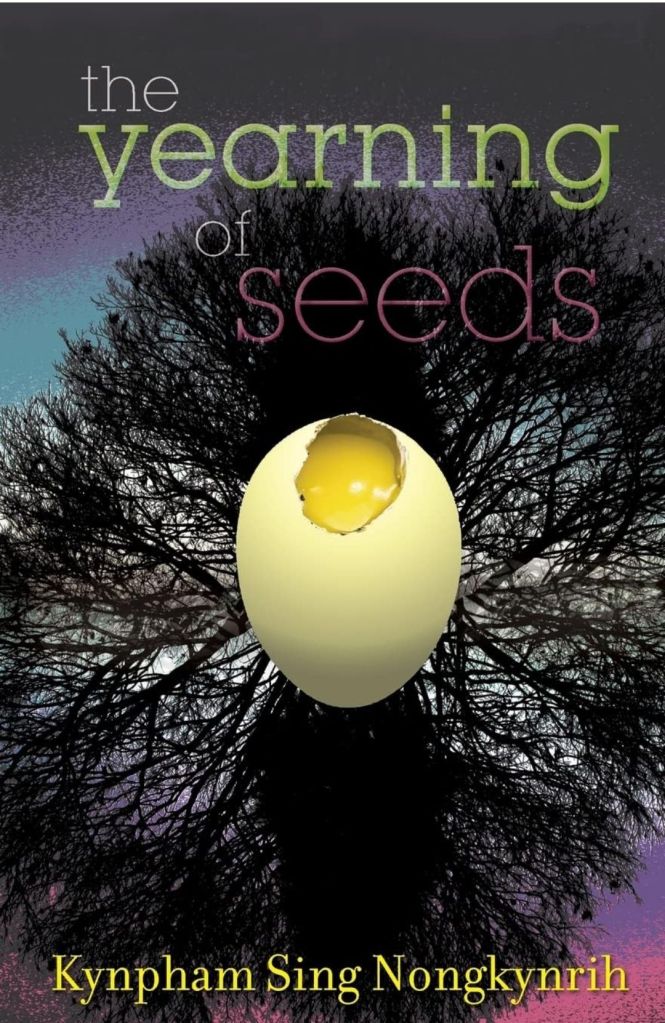
In his book of poetry, the yearning of seeds, Kynpham talks about the changing contours of the terrain, cultural erosion, insurgency, growing chaotic lives of the people and lack of political will to preserve and uphold the rich legacy of the region which he fears are responsible for the usurpation of personal identity.
The softness of his poetic expressions time and again gets subverted by harsh and ruthlessly brazen overtones indicative of his disappointment and frustration with the systemic and social flaws and failures. His verses are bold, blatant and unapologetically brutal making the reader wince.
Kynpham says his poetry is ‘anoetic’.
“…Something stirred inside me
I was racked by a sudden desolate yearning,
something fierce and restless, a gnawing, tormenting,
desire to reach out, to touch —
and I scrawled my first few lines,…”
When Kynpham says ,
“Let me sit astride a pachyderm and see saw
through the reeds in search of the rivet-skinned rhino.
I would like nothing more than to look it in the eye
and say, “Mine too is a vanishing tribe.”
the reader is struck by the sense of finality!
There is an overwhelming sense of alienation in his verses. Kynpham writes:
“Strange sounds are crowding this town.
Like the rooster, I too seem
to have become obsolete.”
On a war torn world, Kynpham’s words cut through:
“Let them tell their stories. Let them speak of the
bombardment of nations, the conflict
of races, the squabbles of neighbours.
…
…Let them tell why and from whom they have
fled.
My knowledge is little, my suffering trivial.
Ask them. Let them speak of good versus evil.”
The book ends with a bunch of haiku.
dense smoke from pine copse
man’s baleful fire hell bent
on quick destruction.
first spring rain–
the bus shelter
only half-finished.
forest fire watched
by millions; fire in my heart
witnessed by no one.
rain for days–
only soldier’s clothes flapping
on a sagging clothesline.
A little about the author
Kynpham Singh Nongkynrih is a Professor of Literature in North-Eastern Hill University, Shillong. He is a bilingual writer and writes poems, dramas and fictions in English and Khasi language. His awards include the first Veer Shankar Shah-Raghunath Shah National Award for Literature (Madhya Pradesh 2008) and the first North-East Poetry Award (Tripura 2004).





Very powerful material
LikeLiked by 2 people
Yes, Derrrick. Thank you so much 🙏
LikeLiked by 1 person
GC, Kynpham Singh Nongkynrih’s poetry is powerful, capturing the beauty and struggles of Meghalaya with striking honesty.
LikeLiked by 1 person
Yes, it does. Thank you Mr. Philo. Read something good with a strong cup of coffee to uplift your mood.
LikeLiked by 1 person
GC, appreciate it! A strong cup and a glimpse at life’s limits—morning sorted. 😀
LikeLiked by 1 person
Kynpham seems to be a talented poet! Enjoyed your post
LikeLiked by 1 person
Thanks Yvette so much. Yes, he is a powerful poet.
LikeLiked by 1 person
❤
LikeLiked by 1 person
This is a wonderful book review, Geeta.
LikeLiked by 1 person
Thank you very much Mary. I am glad you liked it.
LikeLiked by 1 person
[…] the yearning of seeds […]
LikeLike