
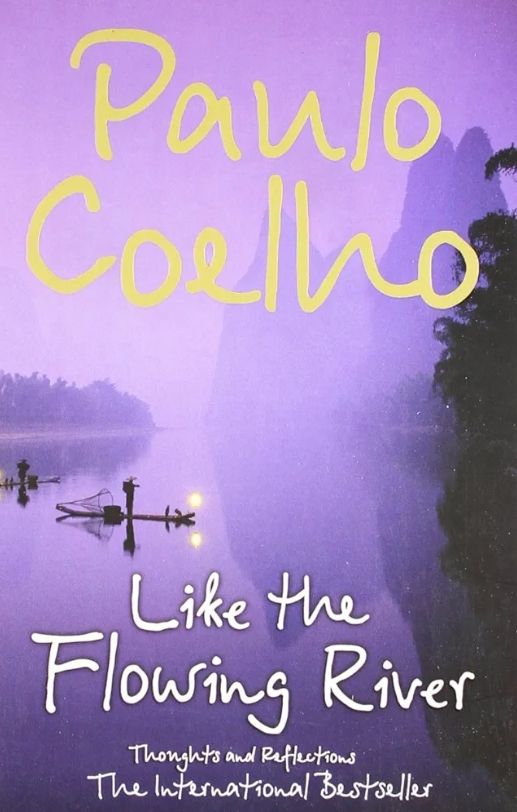
Quite like the flowing river this book flowed into my hand and then into my mind and now into my life. It may sound poetic but it is like that.
Like most avid readers the first book that I read of Coelho was The Alchemist. Frankly, I couldn’t understand much of it. Wanted to read it once again to get the essence but never could.
Life flew by. Many years later my sister got another Paolo Coelho – Like The Flowing River – from her school library. I started reading, was mesmerized but couldn’t finish.
Some years later, I got its Kindle version. Read through. Was not satisfied. Got a hard copy. Holding the book in my hand, turning the pages, re-reading I am as much taken by its unusualness as ever.
The book is a collection of anecdotal essays – long, short , sometimes just a para – tapering down to a musing, a learning, a teaching, a reflection , a realisation as much for the author as for the readers which remain for eternity.
In a shabby Tokyo bar, Coelho meets the impoverished wife of his favourite author, Henry Miller. She sings the song which brought them both together. Its mesmerizing.
When she says, “There was no point in squabbling over the inheritance: love was enough,”Coelho writes “Yes, in the light of that complete absence of bitterness or rancour, I think love really was enough.”
Prague 1981, Coelho buys a drawing from a young man by the roadside. He sees that the artist is not wearing gloves even in that freezing cold. They get into an animated conversation after a while realising that neither can speak each other’s language. They are communicating by gestures, facial expressions, smiles and a desire to share something.
Coelho writes, ” That simple desire to share something meant that we could enter the world of language without words, where everything is always clear, and there is no danger of being misinterpreted.”
Coelho says that every individual is the protagonist of his/her life. Everyone has their personal legend to fulfill and this is their reason for being in the world.
He further adds “Every human being should know two languages: the language of society and the language of signs. One serves to communicate with other people, the other serves to understand God’s messages.” For this, one should keep alive within the sacred flame of madness.
Coelho writes, “I think we should ask ourselves again: what are we capable of? And then, quite calmly, go off in search of our own immense potential.”
“Sometimes we encounter things on our path, but because our time has not yet come, they brush past us, without touching us, even though they were close enough for us to see them. I thank God for the awareness to understand…that everything that had to happen happened….”
“I cannot lose the one thing that keeps me alive: hope – that word treated with such irony by pseudointellectuals, who consider it a synonym of ‘deceit’. That word, so manipulated by governments, who make promises they know they will not keep, and thus inflict even more wounds on people’s hearts. That word that so often rises with us in the morning, gets sorely wounded as the day progresses, dies at nightfall, and is reborn with the new day.”
Coelho believes in “the alchemical idea that each of us contains the whole universe and that we are, therefore, responsible for its wellbeing.”
“Accustomed as we are to the mountains and the fields, we know that God is everywhere and that there is no need for us to go into a man-made building in order to find him. Often, during our long walks, we pray in silence, listening to the voice of nature, and understanding that the invisible world always manifests itself in the visible world.”
“I can only conclude that worse than hunger or thirst, worse than being unemployed, unhappy in love or defeated and in despair, far worse than any or all of those things, is feeling that no one, absolutely no one, cares about us.”
“However intelligent a man may be, he will soon lose his warmth and his flame if he distances himself from his fellow man.”
I have relied heavily on quotes and passages from Coelho’s essays to share what the book encompasses – expansive learning from personal experiences which allows epiphanic glimpses of universal truths.
A Little About The Author
Paulo Coelho was born in Rio in August 1947, the son of Pedro Queima Coelho de Souza, an engineer, and his wife Lygia, a homemaker. Early on Coelho dreamed to be a writer which was not viewed agreeably in his austere middle class household. Coelho was admitted to a mental institution twice by his father to make him get rid of his passion for literature. However , Coelho being a nonconformist and a seeker of the new, sought spiritual experiences travelling all over Latin America. Coelho rose to fame with his book The Alchemist. Today, Paulo Coelho’s books appear at the top of bestseller lists worldwide.





Thank you, Geeta, for your interesting writing devoted to Paulo Coelho work
If you can, please look up my post about him, his life, and his books in my the great books series. I think you will find it interesting, too.
Joanna
LikeLiked by 1 person
Oh! I did not know you have already written about him. I will surely read. I hope this post makes you happy after the last spooky one. I remembered you while writing out this post.
LikeLike
Thank you, Geeta, it is number 5. Just scroll down until you find it.
Joanna
LikeLiked by 1 person
Will do
LikeLike
Thank you, Geeta, you will not regret it!
Joanna
LikeLiked by 1 person
I am sure it will be an excellent read
LikeLike
It will be because it is about the extraordinary writer!
Joanna
LikeLiked by 1 person
I haven’t ever tried his writing. Thank you for this.
LikeLiked by 1 person
You are most welcome Esther
LikeLiked by 1 person
I love Paulo Cohello, his books are life changing in the best way possible. When you want something, all the universe conspires to give it to you 💕
LikeLiked by 2 people
Absolutely correct 💯
LikeLiked by 1 person
[…] Life Is A River […]
LikeLike
Intriguing
LikeLiked by 1 person
Thank you Derrrick
LikeLiked by 1 person
Thank you Geeta for sharing your thoughts about this book. I must get it.
LikeLiked by 1 person
Sadje I think you will like it.
LikeLiked by 1 person
Thanks 🙏🏼
LikeLiked by 1 person
Your review and bio are interesting, Geeta. I read The Alchemist, and it was wonderful. How crazy to commit someone as crazy for loving literature!
LikeLiked by 2 people
Thank you Mary for taking time out to read the post and comment
LikeLiked by 1 person
[…] Like the Flowing River […]
LikeLike