
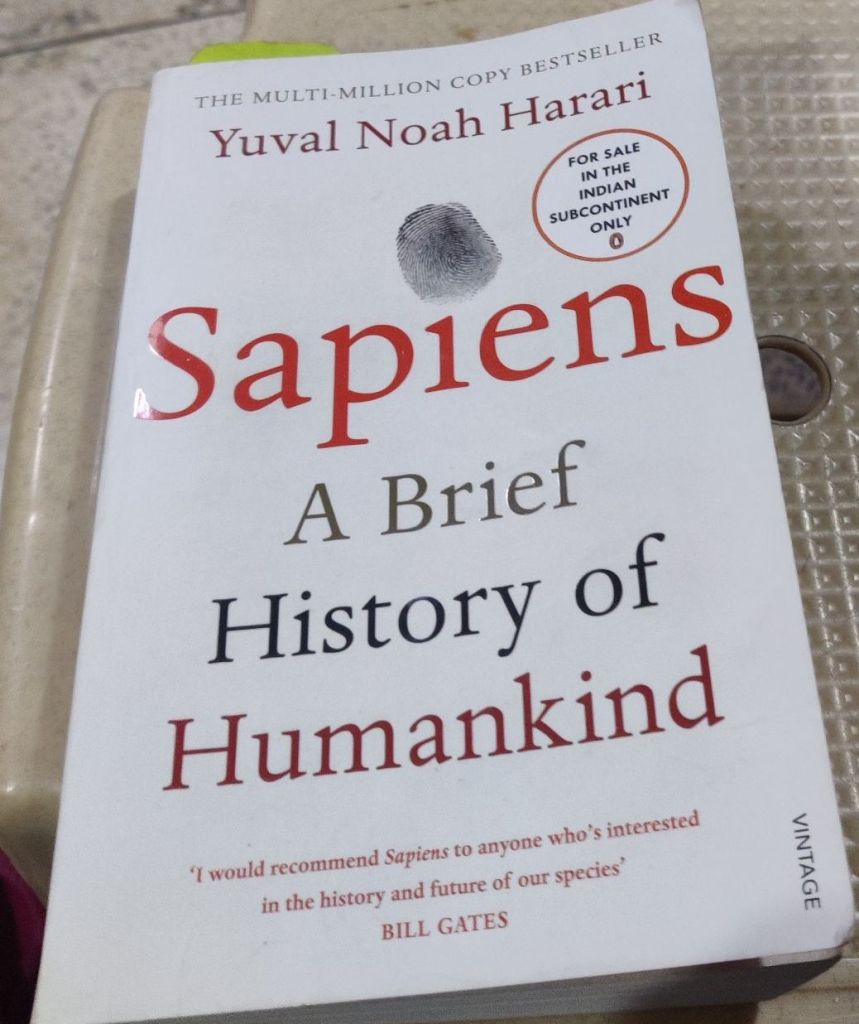
It’s massive. It’s a perspective shifter. It’s a myth buster. It’s a must read for all those who are interested to know how in such a short period of time Homo Sapiens came to rule over this planet earth. It’s a retelling of history but in a very different way.
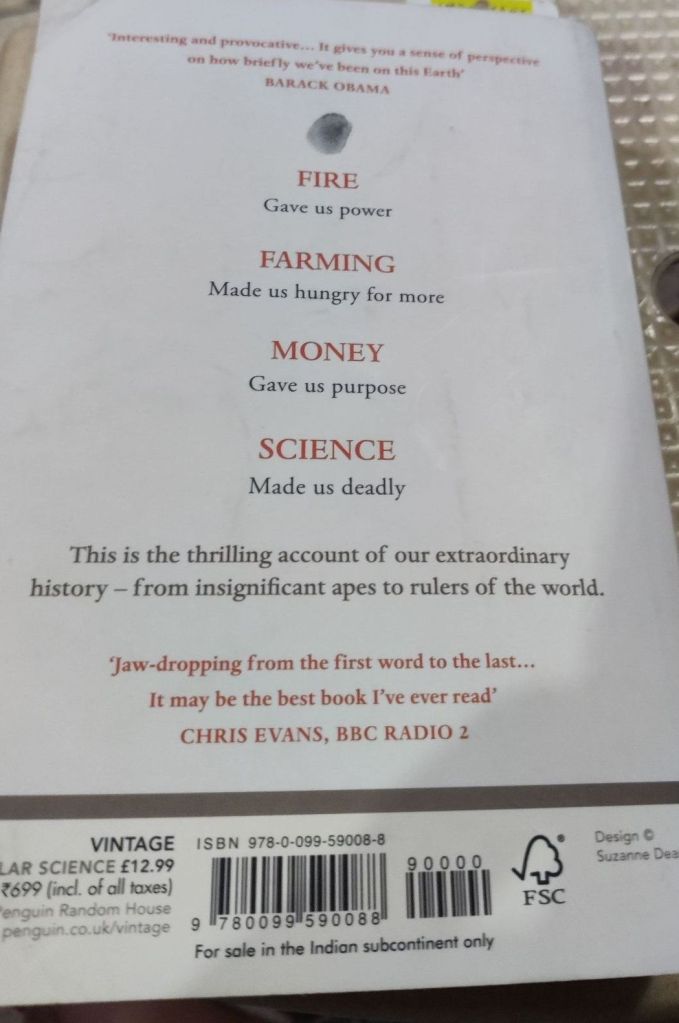
The blurb says “FIRE gave us power FARMING made us hungry for more MONEY gave us purpose SCIENCE made us deadly.”
For me to find the book interesting is not that I have suddenly developed an interest in history but because of the way it is retold.
Yuval Noah Harari’s mammoth work covers the entire period of human history from the genesis to its evolution through various phases till now (2014).
In school the subject “History” meant mugging up a whole lot of dates and events. It was boring because it failed to present our most important narrative in an interesting manner. The text books stated what and when events happened and the students were supposed to learn by heart and reproduce them exactly on the answer sheets.
Harari’s re-telling of the history of humankind is different in the sense that in very vivid language and an intense manner the book answers not only what and when but also why and how history happened. In doing so, it provides clarity and comprehensibility to our past. Merely knowing the historical landmarks do not suffice. Grasping why and how these happened shift perspective and facilitate understanding of the larger order of things.
To clarify why this book is a myth buster I will cite my own history book of 9th and 10th standards (more than four decades back). I do not know whether there is any change in the content now but I distinctly remember we were given to understand that the human species went through various phases of evolution from Paleolithic (early stone age man) to CroMagnon (early modern man known for art and tools). The Neanderthals were Homos who first took to agriculture leaving the nomadic life of their predecessors – the hunter-gatherers. Each phase of genetic evolution superseded the previous till the Homo Sapiens or the Wise Man evolved.
Harari, on the contrary says, no, various species of Homos or humans existed in different parts of the globe at the same time, e.g. Homo Neanderthalensis (Europe and Western Asia), Homo Erectus (East Asia), Homo Rudolfensis (East Africa) and many others along with Homo Sapiens but it’s the latter which overtook or conquered over the rest of the species and came to rule the Earth. How ? That is what Sapiens is all about.
It is very difficult to put in briefly what this enormous study brings forth. This “Brief History of Humankind” takes into account many other disciplines – Geography, Politics, Religion, Anthropology, Sciences, Art & Culture , Sociology, Economics and even the role of Comparative Study of Languages and Acturial Sciences to lay down a comprehensive documentation of creation, growth and progress of human civilization and rightly so because otherwise it would be an incomplete street view of our past , present and future.
Three revolutions shaped human history – Cognitive Revolution, Agricultural Revolution and Scientific Revolution. It’s the superior learning abilities and complex social structure that made humans the most powerful animal. Unfortunately, wherever Homo Sapiens set foot ecological degradation and extinction of other and variants of its own species followed.
Interestingly, the growth of Homo Sapiens was aided by language – a mode of informal communication – or gossip as Harari puts it. Language became a very effective instrument of transmitting information. Also, it was the ability to co-operate with large groups that gave Sapiens an edge over the others.
Harari says language evolved with gossip. Gossips facilitated creation of fiction or imagined realities or social constructs which in turn aided Sapiens to work in large groups towards a common goal.
As we all know, the Agricultural Revolution saw the primitive hunter gatherers settling down to domestic life. Harari says, contrary to the common belief that humans gradually learnt to gravitate towards an agrarian life, its the wheat that domesticated Sapiens. And before they knew Sapiens had opted for a more complex system of sustenance compared to their earlier lives of foragers.
A settled life required unifiers like religion and imagined order and written records (Sumerian) and systems that could be well regulated and standardized, e.g. the advent of money for transactional ease replacing the barter system. Harari says the worth of money did not lie in its intrinsic value but in the amount of trust that everyone reposed in it.
It is also interesting to note that the first written record in Sumerian Cuneiform script was all about trade transactions and collection of taxes and not about poetry and literature.
Industrial Revolution galvanized scientific experiments and inventions. Scientific Revolution boosted voyages and expeditions. The thirst to know coupled with scientific inventions led to exploration of the unknown. But these expeditions were not altruistic ventures triggered by knowledge seeking and embracing new cultures and peoples. These were motivated by profit. First encouraged by monarchs and then by merchants exploration led to conquests and conquests led to the establishment of Empires. Soon empire building became the most profitable enterprise exploiting the conquered land, its populace and its resources.
Harari says scientific experiments were not standalone academic ventures. They involved huge expenditure and needed funding. Those who funded obviously were the ultimate decider of the subject of scientific study. Needless to say the compass always tilted towards inventions which could generate profit.
Thus it was capitalism that pushed forward the project of empire building and scientific innovation.
With these mercenary ventures soon grew the complex systems of banking and advancing credit. As profit making became more and more hazardous individual financing gave way to joint stock companies and the institution of stock exchange. Harari meticulously explains why in contemporary times the credit score of a country is the most important factor in its international standing and economic growth and development.
Human history, according to Harari, is directional. It has moved towards the making of a unified global village and ecosphere.
After the two World Wars, the fear of nuclear annihilation compelled nations to cultivate peace which in turn benefitted trade. However, given the fact that science has empowered humans to the extent that they are able to control the environment to a large extent, discover alternate sources of energy, provide advanced medical support to the sick, make significant progress in health care thereby bettering the quality of human life, venture into space and even think of creating super humans in future but has it made them happy? He also warns of a future dominated by Biotechnological Revolution which can enable replacement of humans by a superior breed with more advanced cerebral and neural abilities. While history of happiness is a paradigm shift in the approach to the traditional discourse the most significant query raised by the author is that humans should now think what they want to want?
As I have said before Harari’s narrative is not about the milestones but the elaborate detailing of the course which propelled Homo Sapiens to reach there. In its approach the book is unique. However, Harari’s atheism renders a cynical tone to an otherwise gripping account. Sadly, Harari’s theological discussions exclude mention of Hinduism, the oldest religion of the world. The last chapter on History of Happiness necessitates an expansive and exclusive debate by dint of its very context. Harari’s picture of a futuristic world of cyborgs . computers with brain, organisms with extraordinary sensorial capabilites is rather a threatening and formidable end to a fascinating and scholarly treatise.
A little about the author: Yuval Noah Harari is a professor of History at the Hebrew University of Jerusalem. He is a popular science writer, military historian and intellectual. He has many bestselling books to his credit, His book Sapiens is based on his lectures to undergraduates of world history class.
I highly recommend this brilliant exposition of a brilliant mind to all my friends and readers who wish to know about this “thrilling account of our extraordinary history – from insignificant apes to rulers of the world.”





Sounds interesting. I have ordered.
LikeLiked by 1 person
Great. Let me know how you like it.
This book was my reading challenge of the year. I feel a great sense of achievement having read it.
LikeLiked by 1 person
I am reading silent spring these days but it is really heavy.
LikeLiked by 1 person
Sapiens is also heavyweight because of its content. I had to read certain portions twice to understand and assimilate what the author is saying. More so because some of his propositions were absolutely contrary to what I knew of history.
I therefore set a deadline to finish reading it – a challenge to myself but I did not make it too grinding either. Whenever I felt too heavy I moved away to something lighter and then came back to it again.
I guess that’s the way to read heavy stuff but in the end it was very enriching.
LikeLiked by 1 person
I think so too.
LikeLiked by 1 person
I’m not a bookworm, but your narration made me reconsider.
LikeLiked by 2 people
Oh! Thank you so much. I hope I have done justice to the book.
Different readers may have different take on the issue. Some may like the book. Some may not. But I am sure you cannot ignore Harari.
LikeLiked by 1 person
I know, you don’t recommend it just like that.
LikeLiked by 1 person
Thank you
LikeLiked by 1 person
Your review beautifully captures both the strengths and limitations of *Sapiens*. I appreciate how you highlighted Harari’s unique storytelling that goes beyond milestones to explore the deeper currents shaping human history. Your point about the absence of Hinduism in his theological discussion is thought-provoking—it’s a significant omission, considering its antiquity and influence. The portrayal of a potentially dystopian future with cyborgs and enhanced organisms certainly adds a chilling dimension to the narrative.
Your endorsement makes the book sound both intellectually stimulating and provocative. I’m genuinely intrigued and now even more eager to read *Sapiens* to experience this sweeping, challenging exploration of humanity’s past and possible future.
LikeLiked by 2 people
Thank you so much.
Hope you like the book.
LikeLiked by 1 person
Your captivating review has inspired me to grab a copy of the book! Thanks a lot for sharing!
LikeLiked by 1 person
Thank you for finding time from your precious schedule and reading
LikeLike
[…] Sapiens […]
LikeLike