
After watching the movie Jaane Jaan I was eager to understand the concept of loyalty in Japanese culture. How best to do so but to pick up the book on which the film is based.
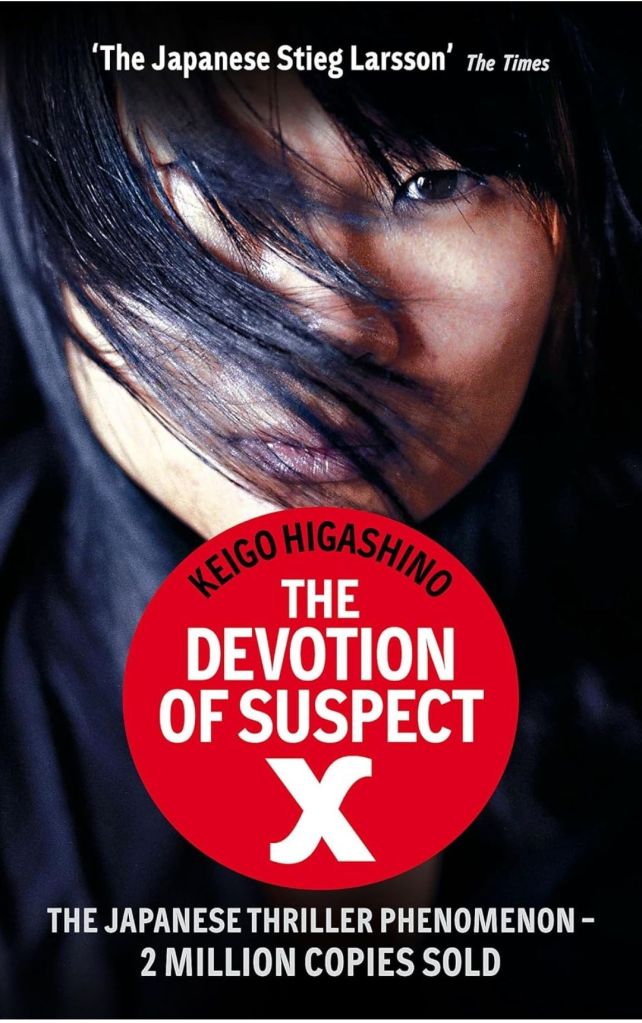
The Devotion Of Suspect X by Keigo Higashino challenges the very edifice of a crime thriller. Readers know who commits the murder and how. The actual killers have “imperfect alibi” which the investigating officers are hard put to prove as flimsy. The one who confesses to be the killer is nowhere near the radar of suspicion. It’s a war of wit between two geniuses. The one who knows the truth is pained to accept it. The one who is creating the myth of a truth is happy to give up his life for the one whom he silently adores. Do we call it a whodunnit ?
Those who have not seen the movie or read the book a brief on the narrative.
Yasuko Hanaoka is a middle aged, twice divorced mother living an uneventful life with her growing daughter, Misato. She works in Benten-tei, a shop known for its lunch boxes. One fateful day, her former husband, Shinji Togashi, a troublesome character, pays her a visit at the shop. He coaxes her to come back in his life as he is a changed man now. Yasuko is not convinced. Togashi follows her to her apartment threatening to not leave the mother and daughter in peace if they do not bow down to his wish. In panic Yasuko, aided by Misato, kills Togashi. But how to dispose off the body?
In comes Ishigami, a genius mathematician and Yasuko’s next door neighbour. He takes it upon himself not only to take care of the corpse but also assist Yasuko and Misato to avoid getting caught. He tutors them how to handle the cops, how to reply to their questioning and also sets up their alibi.
By and by the police comes knocking at Yasuko’s door. Investigation follows. The investigating officers, Kusanagi and his assistant, Kishitani, take the help of another genius physicist, Dr. Manabu Yukawa, to solve the case of the mysterious disappearance of Togashi now presumably dead.
Yukawa happens to be Ishigami’s college mate. In the course of investigation they meet after a long time. Yukawa is happy to see Ishigami who has not changed a bit. However, Yukawa is surprised to find that Ishigami is teaching in a nearby school whereas given his talent he should have been a University research scholar. Ishigami, on the other hand, is hesitant before Yukawa as he comes to know that Yukawa is friends with Detective Kusanagi and has developed a knack of helping the Police Department in solving complicated crimes.
The story, rather a cat and mouse game, revolves round Ishigami, Yasuko, Yukawa and Kusanagi till Ishigami confesses to be the killer. Kusanagi is not sure whether to believe his story. Yukawa guesses the truth that Ishigami is making a supreme sacrifice to save Yasuko. What can he do to turn the table so that Ishigami can be stopped from this madness of giving up on life. He takes the ultimate step, whether for better or worse, only time will tell.
Had I not been familiar with the ancient Japanese art form of haiku, I would have considered this thriller a half hearted novel. Keigo Higashino shows but does not tell – same as in the craft of haiku where much is left unsaid and open to reader’s imagination and interpretation.
As a reader, I assume :
Yasuko wants a peaceful life way removed from her past prime spent working in a hostess bar.
She is devoted to her daughter and like every mother will do anything to save her from evil.
Togashi has been a worthless, violent, exploitative husband before and even after divorce.
Ishigami is deeply in love with Yasuko knowing very well that his feelings will always be one sided.
He knows he has nothing in his favour which can earn him Yasuko’s affection.
He, therefore, takes up the role of a self appointed guardian to safeguard the one whom he loves to the point of devotion and his daughter whom he cares for merely because both give him a purpose to live.
Yasuko is grateful to Ishigami for what he has done for them. But he is just a fall back guy for her.
Perhaps she even takes him for granted knowing very well that she and her daughter are safe and secure under his tutelage.
Yukawa has an unquestionable admiration and unwavering loyalty towards his friend, Ishigami.
At the same time, he has a sense of accountability towards Kusanagi which heightens his dilemma.
He is pained at every step as the truth is revealed to him in the course of his deduction.
Perhaps he is partial towards Ishigami yet his righteousness prevents him from doing anything drastic or unjust.
When I look up to the characters :
I do not understand Yasuko.
Is she so cold hearted that she just does not think beyond survival ?
Her faith in Ishigami is irreproachable. She follows his instructions unquestioningly. Yet she does not falter or feel remorse when Ishigami surrenders to the police. Why?
Misato is left in the background. A girl in her formative years with an impressionable mind going through a nightmarish experience of killing her step father even if in the heat of the moment. What’s going on in her mind ? We don’t know till she is found bleeding by her teacher with scratch marks on her wrist. Does she survive ?
Ishigami, the focal point of the novel, is silence personified. He is expressionless fearing he will give away what he is guarding fiercely. At the same time, he stalks Yasuko when she is on a date. Is he jealous? Or is he unusually worried about her safety?
Yukawa’s loneliness is melancholic. He does not have a life beyond his laboratory. Perhaps he craves for Ishigami’s company – conjugal of two cerebral geniuses. But Ishigami’s reticence is unwelcoming. There is an undercurrent of insecurity and mistrust. Yukawa steps back. How alone he is !
Kusanagi earns Yukawa’s wrath. Why? Is it because he is pushing him further towards a detestable truth? His hands are tied. He has to deal with facts howsoever incredulous they may be.
In comparison to the book:
The cinematic adaptation (Jaane Jaan) caters to Indian sensibilities.
The storyline is unambiguous, firm and grim, not to say gripping and pivots around an “almost” love triangle. The characters are lesser in number and well sketched. Performances are undoubtedly outstanding as I have said before.
Kudos to Sujoy Ghosh, the Director, who has culled out the flesh of a narrative from a book which perpetuates and thrives on the grey mysticism inane to unrequited love, uncalled for devotion and stubborn loyalty.
Having said that criminalization of a beautiful mind blinded by love is also a horrifying reality which is craftily kept understated but indisputably and starkly weaved into the tale. How far is it justified it’s for the readers to decide.
The end comes abruptly like an astutely presented hypothesis backed by an indubitable theorem gone awry. The mathematician’s infallible logicality is refuted by the unpredictability of human frailty. As though divine intervention getting negated by an undetected, unthought of , overlooked miscalculation. The aftermath? Again left to reader’s imagination.
I have a personal hitch towards drawing parallel between Western and Asian authors. This comparison with Stieg Larsson ? Why? Can’t Asian authors have a standalone status ? On what grounds the benchmarking is made ? Is there a level playing field? I have not read Larsson. I don’t know. But comparisons, to me, are in general simply not done.
It appears, apart from Hindi, the book has been cinematically adapted in other languages as well – Chinese, Japanese, South Korean and Tamil. The book has received numerous awards and is regarded as the author’s best creation. However, this highly acclaimed novel is not an easy read.
Those interested may give it a try.
Movies, based on the book, are also available on Netflix.
I am unable to decide whether I should read more of Keigo Higashino. There is an X factor undoubtedly in his writing. But I suspect I have gone beyond gore and grime.
How about that ?





I rather like such stories where we know whodunnit but focus on the characters and the whys and wherefores. You have written an intriguing review
LikeLiked by 1 person
Yes, there can be many approaches to a thriller. However, those of us who are used to writers explaining in detail the thoughts and feelings of the characters in the narrative, this book can seem unusual as the author simply narrates the happenings. There is much which is not stated explicitly. The reader has to fill in the blanks. At least, that is what I felt while reading the book. A different writing style all together.
LikeLiked by 1 person
Your review encourages me to check this out.
LikeLiked by 1 person
Oh! That is extremely encouraging for me as a blogger. Conventionally speaking, I don’t embark on a deliberate review because I do not think I possess the competence to do so. But I always communicate what my thoughts and feelings were while reading a book or watching a movie/series. The book is available on Kindle too.
LikeLiked by 1 person