
Indian mythology includes queer culture as well.
Devdutt Pattanaik in his book “Shikhandi And Other Tales They Don’t Tell You” talks about it.
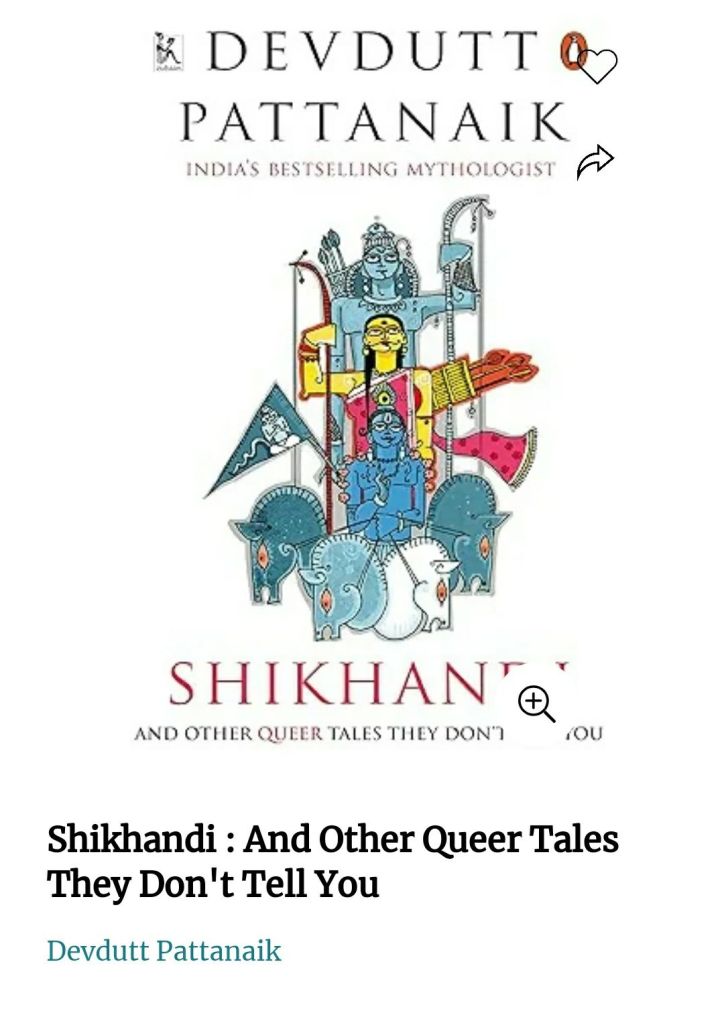
This is my second book by Devdutt Pattanaik (DP). The title of the book suggested interesting, lesser known stories from Indian mythology. Most importantly, I wanted to know more about Shikhandi who was strategically used in the epic war of Mahabharata against the Kauravas.
The aforementioned war was fought between Pandavas and Kauravas in Kurukshetra. Pandavas were the five sons of Pandu. Pandu was congenitally of weak constitution. Whereas, Kauravas, hundred in number, were the sons of Dhritarashtra who was blind by birth. Pandu and Dhritarashtra were brothers. So, the war was fought between brothers (Pandavas and Kauravas) for political ownership and inheritance.
However, DP’s book is not about this epic tale though there are references to it , specifically, when Pandavas mask their identities which may appear to be queer.
DP, in his book, cites around thirty instances from Indian mythology wherein queerness seems to have been embraced for some reason or the other.
To briefly mention a few:
Indra, the God of rains, is caught red handed with a sage’s wife. The infuriated sage castrates him. The Gods manage to restore his manhood.
As mentioned above, to remain incognito, the five Pandava brothers and their wife take up different roles in the palace of king Drupad. Arjuna (one of the brothers), the great warrior, enters the inner sanctum of the palace as an eunuch named Brihanalla, to teach the princesses the art of song and dance.
Shikhandi, born as Shikhandini, a girl, is brought up as a boy because King Drupad wanted a son. She is dressed like a boy, trained as a warrior, thinks like one and even married off to a princess. She borrows manhood from a Yaksha to fulfill her husbandly duties. Thus, Shikhandini becomes Shikhandi.
There are many other instances wherein Gods and Princes and sages turn into women from men by the curse of enraged victims and vice versa wherein women turn into men likewise. At times the conversion is enjoyed and at times not.
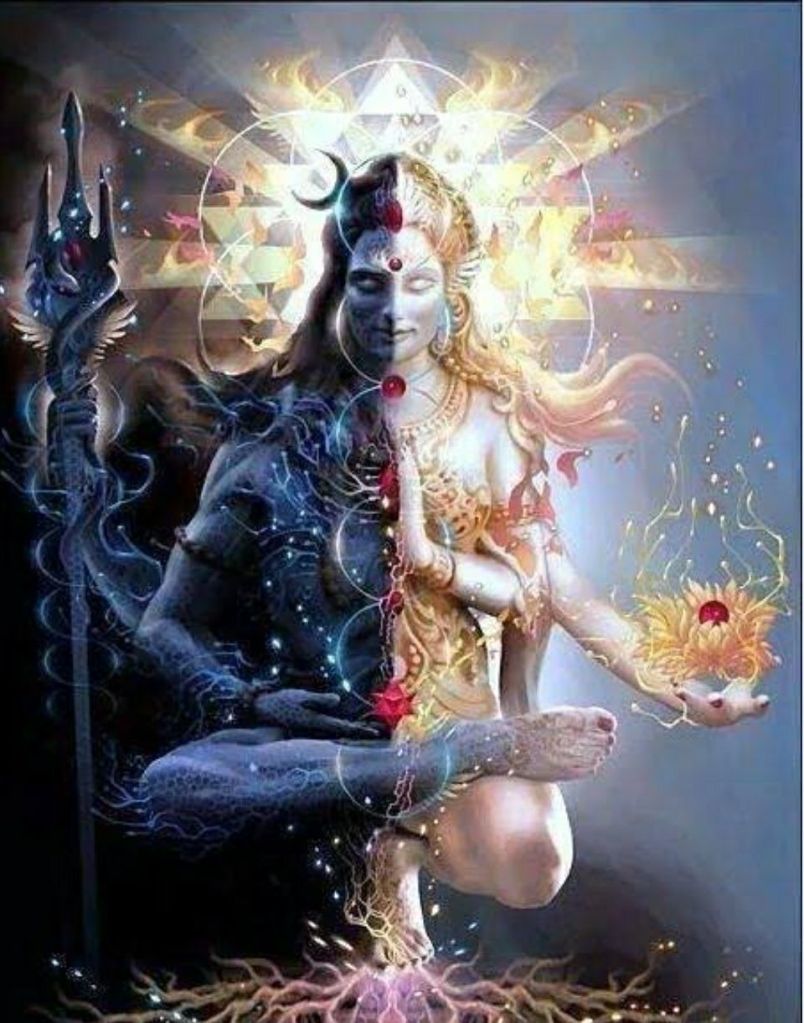
Lord Shiva is also called Ardhanarishwar as he embodies and manifests both male and female genders in his one body – one half man and one half woman – giving equal status to both.
Lord Krishna is happy to be dressed as a woman by the Gopikas. He plaits his hair, wears a nose pin and anklets and dances with Radha, his soulmate.
DP suggests there are elements of queerness in all these metamorphoses and manifestations.
However, as a reader, I believe all these instances are indicative of gender fluidity, role reversals, how comfortable one is in the other’s skin, rather, body and even gender neutrality.
While talking of genders, we invariably restrict roles, attire, behaviour and even approach in society. A man or a woman should act , dress, behave and think in a certain way which suits the stereotype as per established norms of society. But what if he or she does not? Is it fair to call him or her queer? Is it not queerness a figment or ramification of reactionary society?
Society does not accept what falls outside it’s formulaic matrices. What it does not comprehend fully is queerness or madness or a psychological malady. When society becomes non-acceptant , the out of the ordinary has to be performed or practised secretly. Secrecy breeds a friction between right and wrong. On this anvil of right and wrong society sits on judgement.
Unfortunately, DP does not dwell on the subject from this angle. He only sites examples of a culture of queerness pervading mythology. Ancient society, in comparison to the contemporary, was more liberal and open. Otherwise, Arjuna, the ultimate in machismo, could not have espoused the role of an eunuch for one whole year in the king’s palace and then accepted back in his true self after the period of Agyatavaas (staying/living incognito) was over.
There is an interesting incident during this period of Agyatavaas. All the five brothers and their wife, Draupadi, took up different roles in the King’s abode. Keechak, the queen’s brother, was attracted to Draupadi who masqueraded as the queen’s maid /companion. He made amorous advances towards her time and again which angered Draupadi but she kept a demure stance lest their true identities got disclosed. However, when her patience got tested to the limit, she approached Arjuna to take action against Keechak. Interestingly, Arjuna refused in fear of getting caught being Arjuna! It was the mighty Bhima, who enacting the role of a cook in the royal kitchen, lured Keechak dressed as a woman. Keechak thought it was Draupadi and fell into the trap and got killed.
Finally, as the period of staying incognito ended, all five brothers and Draupadi revealed their true identities and were welcomed by the King. The King even sided the Pandavas in their battle for political supremacy against the Kauravas. If the change of roles was unacceptable to the King he would have been infuriated and supported the Kauravas.
Beginning with a shaky premise, DP, in this book, demonstrates the role of queerness in mythology wherein at times it was used as an instrument of curse, and in others adopted out of vindictiveness, out of misconception and even out of lack of knowledge. Also, there are rare incidents of how it came to be embraced naturally in case of Shikhandi and Chitrangada, the warrior princess of Manipur.
DP does not analyse or distinguish these instances. He only gives the background of the conversion and how it can be questioned as queerness which is disappointing. A more detailed and critical evaluation of the instances would have lent greater depth to the subject and escalated the book to a notch up.
Yet, for those who are interested, the book can be read to gain a different perspective to the often heard or read stories of Indian mythology.
Give it a try…
Pics from Amazon and Pinterest





A detailed review. I am surfeit with mythology, however. Too many books on it nowadays.
LikeLiked by 1 person
True Sir.
LikeLike
I got this book. Let’s see when i read 😀. I like Devdutt Pattanaik’s writing.
LikeLiked by 1 person
writing.
LikeLike
Yes. I too like his writings. I was a little disappointed with this one though. But it was interesting to read and get his perspective on the issue.
LikeLike