
Interview someone — a friend, another blogger, your mother, the mailman — and write a post based on their responses.
Those who have not read my earlier posts on Over A Virtual Cup Of Coffee Series can read them here

Many years back I was introduced to haiku in an online journal. I was instantly hooked. I tried to write and share a few with poet friends, But those unfortunately did not fall within the ambit of haiku. I was advised to join the annual workshops in Pune conducted by the one and only, internationally acclaimed haiku poet, Kala Ramesh. I had the good fortune of workshopping with her years later in Delhi. Ashish was my co-workshopper, the only difference being, he has made haiku is life mantra and a mark as a haiku poet, whereas I am still trying to learn the ropes. A prolific haiku writer who has got published in well known journals, like Prune Juice, Frogpond, Modern Haiku, Ashish is also on the editorial team of HaikuKATHA. He lives with his wife and daughter in Manila, Philippines.
For quite sometime I was thinking of having a chat with Ashish over a cup of steaming hot coffee on this genre. Before we embark on a stimulating conversation a little bit about haiku.
Haiku is an ancient Japanese art form of writing poetry in minimum words. Simplicity and brevity are its hall mark. The thumb rule of haiku is : to show and not tell.
In that sense, haiku are vibrant visuals carrying the sensory experiences of the poet belying revealing truths. All haiku have their aha moment which is epiphanic pointedly unveiling the contras overlooked in the frenzy of day to day existence. It requires a Zen like observance and awareness to bring them forth.
Over to Ashish :
Me : Tell us about yourself. Your journey as a haikuist.
Ashish : I am an economist by profession, and a parent by choice. In 2015, I wrote a poem. and my friend commented that it was almost haiku. I had to look up what a haiku was but then I was smitten. I attended a workshop by Kala Ramesh in 2016 and have been writing ever since.
Me: How do you see haiku as a perspective changing form of poetry?
Ashish : What haiku has taught me is to slow down and be more mindful of all that is happening around me. There is wonder and immense beauty in even the simplest of things.
Me : Explain the wordlessness of haiku with a few examples.
Haiku is often called an unfinished poem because it is completed by the poet and the reader jointly. A good haiku leaves space for the reader to “enter” and understand the poem based on their own experience. Therefore the fewer words, more allusion and less definition, the better the poem. For e. g.,
harvest moon
two fallow farms
lie side by side
-Geetanjali Rajan
Me : The best haiku is the one which showcases more than one sensory perceptions. Give examples.
Ashish : Consider
sea mist
the scent of the night
it spent in the pines
-Michael McClintok
This poem combines the coolness of mist (touch) with the sense of smell.
gunshot
every pine needle
pointing at something
-Gregory Hopkins
This combines sound (gunshot) with sight (pointing needles).
Me : How do you underscore the silence or white space in your haiku? Give examples.
Ashish : Terseness and incompleteness I find are good ways of creating white space in haiku.
Consider for e. g.,
he leans on the gate going staying
-Marlene Mountain
One imagines two people appraising each other silently. The location is not specified, but in my mind its set somewhere in the deep, quiet countryside.
open grassland
a stray sheep on the horizon
almost a cloud
-Adjei Agyei-Baah
One can feel the deep quiet without the poet explicitly saying it.
Me : What was life before you took to haiku.
Ashish : Life was hectic and rushed, as I imagine it is for most of us. Haiku offers a quiet space in the midst of all this.
Me : How do you see haiku facilitating de-cluttering in life and resolving dilemmas within?
Ashish : As I said before, haiku offers a space to reflect and be mindful. That can help declutter and de-stress. In the midst of movement, it allows one to be still and just observe.
Me : How do you see haiku ten years hence with so many innovations taking place even in deviation of its classic parameters?
Ashish : Art of any kind is by definition creative, innovative – a constant testing of limits. I see haiku retaining it’s essential features – quietness, incompleteness and juxtaposing of images, but moving away from it’s current fixation on structures and rules.
Me : Where do you see yourself as a haiku poet a decade hence? What innovations you would prefer to bring in to make this ancient form of art more popular and acceptable to poetry lovers who are not into haiku at present?
Ashish : I have been trying to stop writing haiku for the past few years, and have failed. I see myself in very much the same boat. My driving passion is a need to express what I see and what I feel, in a s simple a way as I can. If this goes against an orthodox view of haiku, that’s OK with me. I feel that a poem which comes from the heart, which is not driven by a need to showcase one’s intelligence or cleverness, or to imitate others, is bound to be accessible to anyone.
Me : Who is your favourite haiku poet(s). A few haiku by them.
Ashish : Apart from the masters, Basho, Buson and Issa, among more current authors my favorite poets are Shloka Shanker, Geetanjali Rajan, Johannes Berg and Michael Dylan Welch to name just a few. Last but not least, Kala Ramesh, who introduced me to the form.
incomplete beings
you and i
complete the city
-Kala Ramesh
fitting my body into a yawn
-Shloka Shanker
in this world
we walk on the roof of hell,
gazing at flowers
-Issa translated by Richard Haas
Though a hurried interview but I guess Ashish has explained haiku as a genre in a very precise and compact manner.
Even in his crisp replies loads of depth and meaning are unraveled yet in brevity and simplicity. Again the hallmark of a masterful haiku poet.
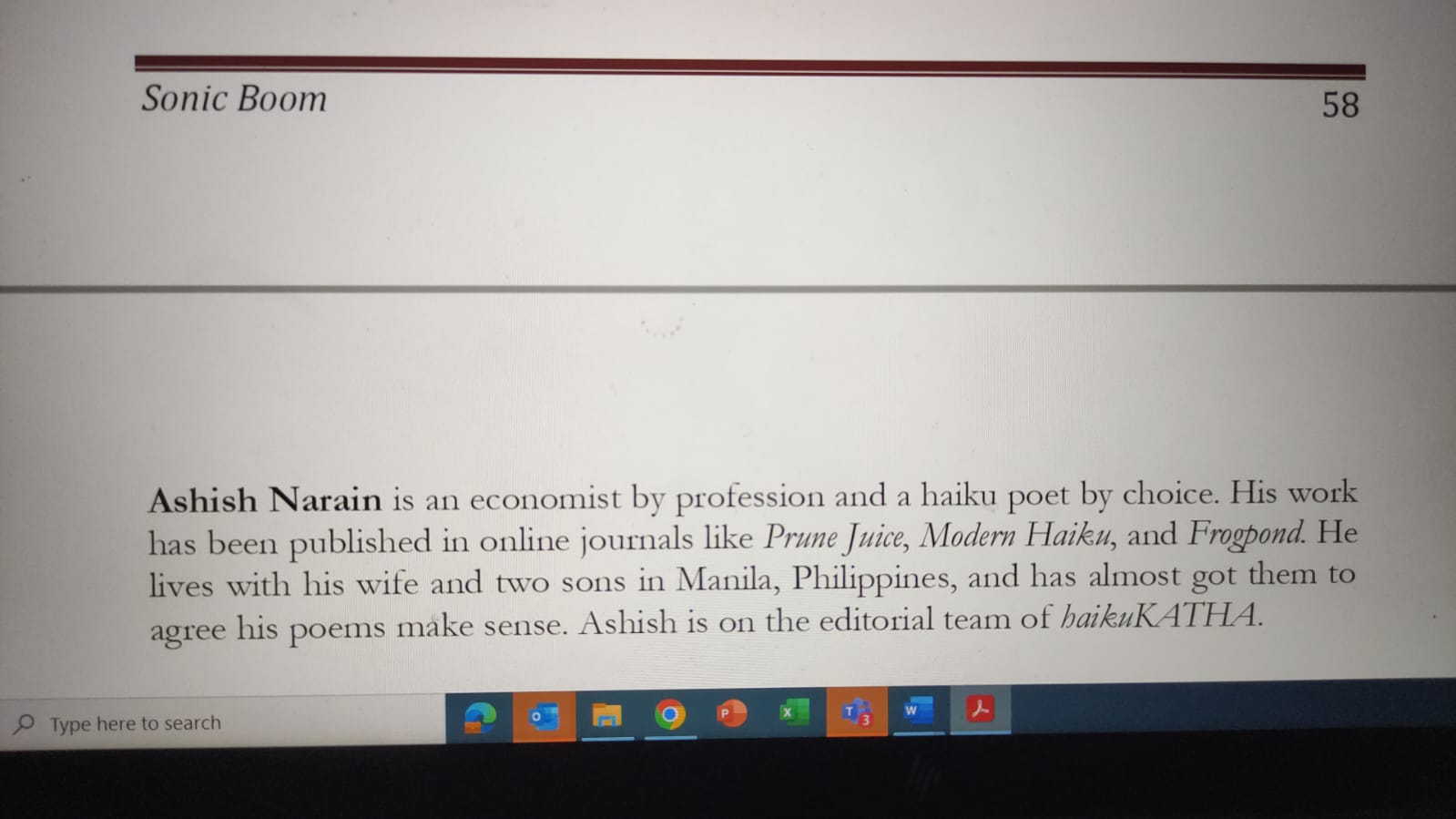
Before signing off a little bit about the author – an extract from a renowned haiku journal Sonic Boom





Fascinating and informative
LikeLiked by 2 people
Thank you very much Derrick
LikeLiked by 2 people
Dear Geeta, this felt less like an interview and more like a quiet, unhurried conversation that one doesn’t wish to end. The way you let Ashish Narain’s journey unfold, without intrusion, gives the piece a rare intimacy. There is a gentle honesty in both your questions and his reflections that lingers long after reading.
I especially appreciated how the narrative moves beyond achievements and into the spaces that shape a person, those in-between pauses where purpose is often found. Pieces like this remind us that stories are not always told loudly; sometimes, they arrive like a conversation over coffee, and stay like an aftertaste.
Thank you for creating and sharing this.
Trishikh
LikeLiked by 2 people
This is rather overwhelming. I take a bow.
LikeLiked by 1 person