
Again credit goes to my esteemed friend Rekha Rao of The Book Decoder fame that I came to know about the #ReadChristie2023 challenge wherein every month books by Agatha Christie will be suggested for reading based on a prompt. I know it is not possible for me to diligently finish the monthly challenge within deadline. But I have decided to pick up one of the suggested readings to go through at my own pace just to refresh my memory.
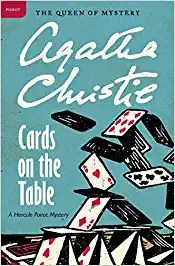
In the month of January 2023, one of the suggested readings was Cards On The Table. I picked this one up as I vaguely remember reading it earlier. However, a few months back I saw the film “based on the book”.
Mr. Shaitana (wonder whether etymologically the source of the name is the Hindi word Shaitan meaning the devil) throws a Party. There are eight guests – four sleuths and four suspects. Post dinner Shaitana purposely divides the invitees in two groups to play Bridge in two different rooms – The sleuths – Superintendent Battle of Scotland Yard, Colonel Race a well experienced Secret Service Agent, Hercule Poirot, the celebrity private detective and Mrs. Ariadne Oliver, the famous crime fiction writer and the suspects – Mrs. Lorrimer, a dignified widow and an expert Bridge player, Mr. Despard, an adventurous traveler, Dr. Roberts, a successful Doctor of rich patients and Ms. Anne Meredith, a young beautiful girl of humble background. Shaitana gets killed in the very room the suspects are playing cards. Now it is the sleuths who have to find out the culprit who did Shaitana in. Perhaps this is the ploy of Shaitana’s making.
All the four suspects have skeletons in their cupboards. But they have never been caught. The misdeeds committed by them are way beyond detection. There are no clues left to pursue. The only way to catch the culprit is to dig their past to establish a connect to Shaitana. Who is so desperate to kill him and why?
This time Poirot takes a very different route of deduction. The process of elimination is based on how the four players play their hands in the game. As I am not into Bridge it is difficult for me to figure out Poirot’s method. But it is the way hands are called and scores are kept reveal a lot about the character of the players.
Superintendent Battle does the spadework of raking the suspects’ past, jotting down meticulous notes and interrogating people who know them in the past. Mrs. Oliver is more dramatic in her ways. Colonel Race does a thorough verification on Despard’s antecedents. All four exchange notes but it is Poirot who employs his grey cells and imagination to nab the murderer at long last.
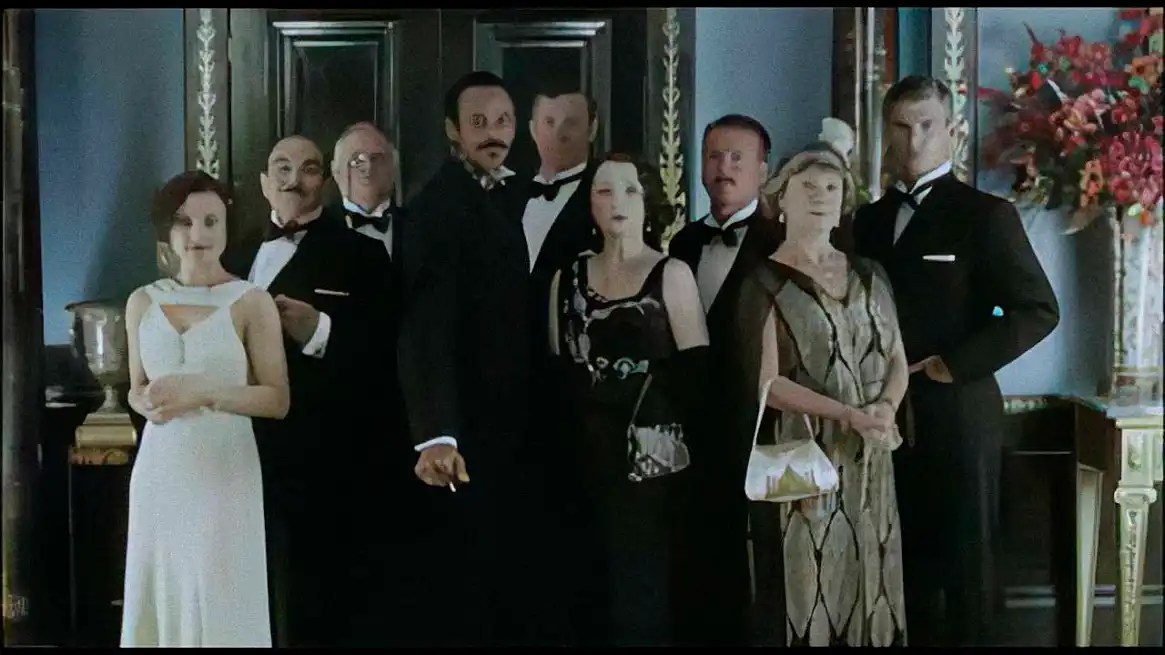
The film (TV adaptation), on the other hand, is a surprise as I watched it again after reading the book. Names of characters are changed. The narrative itself is considerably modified to plug in the gaps, perhaps intentionally, left in the book. Sir David Suchet, as Poirot dominates. All the other characters are just how they are in the book. Shaitana is as dark and devilish as in the book. But as Poirot remarks he is stupid too because he invites his end. Major Despard is as handsome and upfront as he is in the book. Mrs. Lorrimer is well bred personified. Anne Meredith is pretty and sweet and “innocent”. Dr. Roberts is the jovial medical practitioner. I was having difficulty in visualizing the character of Dr. Roberts while reading the book. The film gives it a face. Rhoda Dawe’s character has been given a different shade. Colonel Race is Colonel Hughes in the movie facilitating the investigation with his conventional wisdom. The redoubtable Superintendent Battle has been replaced by Superintendent Wheeler with , ahem, a flaw- angle to him. Mrs. Ariadne Oliver is as quirky as ever with her apple cores!
Christie has written this book in a different style. There are scores of assumptions as the past cannot be recreated. There are insinuations which are left to readers’ imagination or interpretation. In a very smart but crooked way the murderer is made to give in whereas it may not have been possible in a straightforward manner because every action of the present is related to the long gone past.
But Christie’s message is clear – the past haunts and returns where you least expect it.
I enjoyed reading the book as much as I enjoyed watching the movie. The altered narrative of the movie does not jar the impact of the book. The book is not overshadowed by the film which often happens in many other cases where the cinematic adaptation takes over the original writing. Both stay in their respective places without competing with each other. After watching the film one does feel “it could have happened that way” as the book is not as explicit as the film is. The way a reader connects the dots while reading the book comes alive in the film.
And that is the beauty of a classic. It lends to a plethora of , I would say, indications. That is why Christie is a class apart. She pointedly brings forth that history is not all black and white. Its a colour grey. Subtle. Undercover. One has to put two and two together to build up what is no more. That’s what we are always doing. Aren’t we?





A thorough review. Perhaps I’ll dig out my Christies
LikeLiked by 1 person
Thanks Derrick
LikeLiked by 1 person
It’s been a great pleasure to read this review of the book as well as its TV adaptation. None can match Christie when it comes to mysteries. And she is right in her message that the past haunts and returns where you least expect it.
LikeLiked by 1 person
Thanks a ton Mathur Sahab. Your appreciation always makes me so happy.
LikeLiked by 1 person