
I do not generally write a review of books written in languages other than English if I am not certain that there is a translated version available of the same. But this one has. So I thought I will give a glimpse of this “Tall Tale” which is a landmark in Bengali Children’s Literature. Rarely there is a review of children’s books. I personally feel there is also a dearth of such books which are just pure fun.
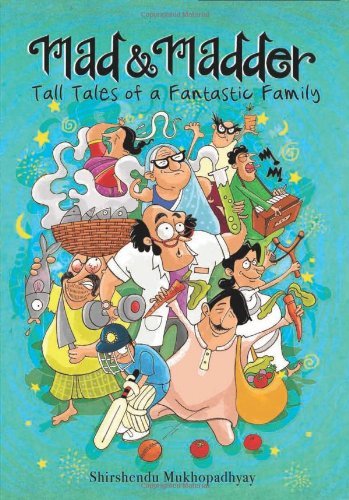
The original book is named Manojder Adbhut Bari which in English means Manoj’s Strange House. The book is originally written by legendary Bengali author Shri Shirshendu Mukhopadhyay and translated by Shri Abhijit Gupta.
Manoj, Saroj and Putul are siblings. Manoj has a rambling ancestral property which hosts a horde of crazy people like Dukkhohoron Babu, the tutor, who cannot teach unless he squats on his hinges. Satish Bharadwaj, the family priest, has two pet ghosts, Handu and Bhundu who are at present on vacation. Thakurjhee or Manoj’s aunt is obsessed with cleaning the house. Ganesh Ghoshal, the music teacher, who is chronic suicidal and tries out different ways to murder himself at least twice or thrice every month.
Manoj’s father Rakhohori Babu is a strict disciplinarian. His younger brother Haradhon Babu is a scientist specializing in creating hybrid plants and animals like Goriman which is a combination of monkey and man. Rakhohori Babu’s youngest brother, Bhajohori Babu, is an ace bargainer who has the unique ability of buying everything at half the rate available in the market. He is nicknamed Bajaru. But Bhajohori is also meek and easily cowered by his erstwhile school master who still treats him like a school kid.
But all hell breaks loose when Bhajohori stumbles upon a revolver and the lion in him is awakened. He decides to take revenge on all and sundry who have earlier mistreated him like the fish monger who hides good quality fish from him, the local moneylender who charges high interest rate from his clientele, Shardul Babu who buys everything at market rate without bargaining thereby hiking up the cost.
The revolver actually belongs to the Police Detective Barodacharan Babu who is as eccentric as others. He enters every premise of crime and detection by the backdoor (rather scaling the backyard wall, more precisely) and not through the front door. According to him, that is the sign of an ace detective.
Then there is a miserly king, Gobindo Narayan, who keeps on hording currency forgetting that even money loses its value if not used in time. His favourite past time is counting the mountain of notes stacked in a secret cellar. His only son, Kandarpa Narayan, got lost when he was very young. Detective Baradacharan is still looking out for him and believes that the clue to finding Kandarpa is somewhere to be found in Manoj’s strange house.
In the meantime, Bhajohori lands up amidst the local goons who loot at night and do odd jobs in the morning. The leader of the bandits is a young boy who looks and behaves differently. The goons captivate Bhajohori and decide to behead him because he tries to punish one of them (Kanai, the fishmonger) brandishing the revolver. However, the young leader has a unique plan. That night they are going to rob the king’s palace and Bhajohori is going to lead them. Bhajohori happily agrees under the effect of a glass of sharbat he is forcefully made to drink.
In the meanwhile, receiving a bunch of complaints from the localites about Bhajohori’s weird behaviour with a revolver, the Head Constable Nishi Babu lands up in Manoj’s house to arrest the errant Bhajohori. However, thakurjhee will not let the police force enter the premise with their muddy boots. Thus ensues a battle led by Manoj’s aunt armed with a wooden stick against the police who are soon defeated.
Amidst all this maddening chaos, will Baroda be able to find the king’s lost son? Will Bhajohori get caught by Nishi Babu? Will the dacoits be able to loot the king’s devalued wealth?
You have to read Mad & Madder to get answers to all these questions. I like reading children’s books. They are de-stressing and also steeped in ancient wisdom and values which adult fiction sometimes overlook. Also, these are books full of pure, unadulterated humour at times with an undercurrent of satire. You have to scoop out the deeper meanings while having hoots of laughter at the comical behaviour of all the characters who are in their own quirky ways highly relatable and even sometimes locatable around us.
I have read the book in original, i.e., in Bengali. So I cannot comment on the translated version. But translations are sometimes equally good and open the window to worthy literary works in other languages to the world.
I recommend this book to all parents who have little kids at home because laughter does not have any language or geographical barriers. They are just health boosters.





Fantastic review. I wish to read the book too. 😊😊❤❤❤
LikeLiked by 1 person
Thank you Aparna. I am sure you will enjoy it.
LikeLike
This looks like the ideal children’s book written with the imagination that is so often lacking in today’s examples. You do well to mention the importance of translation. In my bookshelves there is no distinction between books for children and those for adults
LikeLiked by 1 person
Thank you Derrick. It’s good to hear that you too like children’s books.
LikeLiked by 1 person
This seems worth a read for the fun of it.
LikeLiked by 1 person