

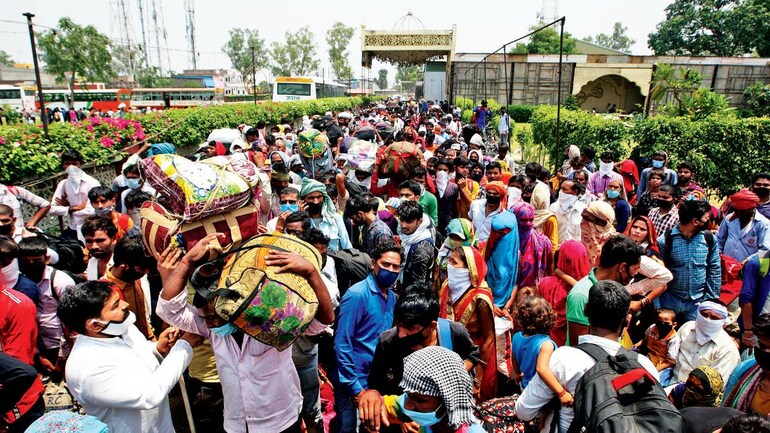
Even in the beginning of 2019 we did not know what lay in store for us by the end of the year and beginning of 2020. In March 2020, when the COVID-19 related pandemic resulted in total lockdown in the National Capital Region (at first on voluntary basis for a few hours and then indefinitely) followed by other states and cities one after the other, we did not know that we were witnessing history.
We phoned our housemaids not to come till it was allowed by the Administration. My mother’s night attendant, Manju, got stuck with us as no one was allowed to travel. Also, there was no means of transportation available on road. Heavy police patrolling continued everywhere. As our block is situated on one of the busy National Highways, it was unusual for the traffic-ridden road to bear a totally deserted look barring the patrollers and one or two private vehicles which were on-road due to some emergency. The only noise that tore the silence was the siren of the ambulances rushing past. The hooting never seemed to stop. It was frightening.
Manju continued to stay with us for two and a half months which was at that time a great relief. My mother is a bed ridden patient suffering from many chronic ailments and complex medical history. It would have been very difficult for me to manage her alone in those days of crisis. The only means of communication Manju had with her family was through mobile. However, her family was not too worried as they knew she was safe with us and had a source of income while many were rendered jobless.
Factories, shops, malls, mandis (wholesale markets), retail stores, medical clinics, therapy centers, schools, colleges, institutes, offices – all closed down – where men and women worked either on daily wages, fortnightly payments or monthly salary. Workers and their families living in rented tenements had to vacate the premises being unable to pay the rent. Many stayed in their work premises but when these shut down they were compelled to leave as they did not have money to sustain themselves for indefinite periods of curfew and lockdown. For once we were made aware of the plight of the daily wage earners who survived on what they earned working each day – the labourers, the construction workers, the dhaba (road side eateries) workers, the street food vendors, the vegetable and fruit sellers, the cart and rickshaw pullers, electric or battery rickshaw drivers, the bus/truck drivers, cleaners, helpers, cabbies and many others.
One evening I was walking my dog outside the Block on the service lane when I heard this flip-flop sound behind. Turning around I saw a middle aged couple walking quietly down the road. The man had a loaded bag on his shoulder and the woman carried a child. The sound of their chappals (foot wear) echoed on the asphalt. I wondered where they were off to not realizing that I was witnessing one of the many families fleeing the city – the historic exodus of migrant workers which hit global headlines.
Soon the TV Channels started telecasting about thousands and thousands of labourers migrating from the Capital to their home towns and villages. But they got stranded at the Bus Depots and Train Stations as no transport was allowed to ply. They waited for days together for some means of carriage without proper food and shelter. Subsequently, how these families traveled home on carts, tempos, tricycles, overloaded trucks and containers defying the norms of social distancing were telecast on every news channel. A teenage factory worker covered a distance of more than thousand kilometers on his bicycle to go to his village. He cycled during the day and rested at night. Strangers came to his aid. Gave him shelter to sleep and food to eat. He crossed jungles and rivers and several towns and villages before he arrived at his own village Police Station where he was quarantined for a fortnight. His only lament was that he never accosted any ghostly figure, he had heard of, while riding through forests after dusk!! His story was in the papers and everyone marveled at his grit and courage.
And then there were people who just walked miles after miles, penniless and empty stomach, carrying children on their backs, shoulders and laps. They had sore feet, were dehydrated and starved for days. But more important is that even after restoration of normalcy, these men and women have not come back to the Capital to this day. We colloquially refer our country as a ”jugaad” nation. ”Jugaad” is quite an untranslatable word which can be best described as fishing out or cooking up an unthinkable alternative or option where exists none. When nothing seems to be working we say, “Bhai! Ab kuchh jugaad lagao” which means “Bro! Now cook up some alternative.” So, we often wonder what “jugaad” these migrant workers must have deployed so as to obviate the neccessity of returning to the city to work anymore.
Thus, there is a dearth of handymen, house helps and such other workers whom we used to take for granted in the pre-COVID times and now feel the pinch of their absence. Such humungous crowd populated the city but did not belong here! It is an eye opener. There has also been a conspicuous change in the work pattern of those few who are based in the city and never left. House helps earlier working in four or five households now prefer to work in one or two where they have been working for long. Perhaps it makes them feel safer job-wise. Also, many families have untimely lost either the lady or the man of the house to COVID. These families also feel more comfortable with their old maids and house assistance.
In short, lives in the cities post COVID are not the same any longer.
More later…..
To be continued…/-





Since more posts (that is, the sequels to or parts of this one) are to come, I cannot comment anything but that it may turn out to be an extremely long story (comparable to the Mahabharat) if everything happened to the masses during this time period is jotted down. Besides, I am amused at the term ‘Social Distancing’ instead of ‘Physical Distancing’ (dunno which great man had coined it). A large number of people appears to have taken this term to their heart because social distance among individuals and groups is more visible to me post-Covid than earlier (your experience might have been a different one). I am eagerly awaiting the next post in this series.
LikeLiked by 2 people
I think they wanted to give a sophisticated guise to the word physical. That’s all. No I don’t think it will be too long. Only the ones which I found worth recording. You are always welcome.
LikeLiked by 2 people
[…] Those who have not read Part – I can read it here. […]
LikeLiked by 1 person
[…] Part – I can be read here […]
LikeLike
[…] Curse Of Corona Part I can be read here […]
LikeLike