

Recently I did a five day whatsapp course with author and book coach Sweta Samota. The topic of the course was “How To Become The Most Trusted Author” which actually meant “How To Become A Best Selling Author”. The course charge was nominal. The timings suited me. The first and fifth day were live one hour interactive session whereas the three days in between were recorded sessions for an hour each. Sweta is a good communicator and can hold her audience well. What she taught was not absolutely new – some were known and much (to my surprise) unknown. This was a preliminary course followed by a month’s online mentorship to write a best seller (?) which I did not join because of my tight schedule.
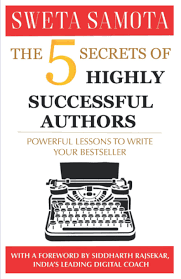
The course also included receiving her e-book on the subject as well as the paper back version which came a few days later. I have started reading the book and hope to finish it soon. Her writing has a flow and it does not take much effort to understand what she is driving at. The content of the course and the book is the same. So, reading the book is like refreshing what has already been conveyed during the course. However, my thoughts are a bit different on some of the issues, as usual.
Nonetheless, I will confess that I learnt a lot these five days. When I say a lot it means a lot about the business of writing books, or should I say, bestsellers – the trends, the modules, the modes of marketing and the various ways an author (a bestseller) mints money through one and many of his/her writings. In short, how they churn out more than one book out of the first book they write. This was news to me. How they accessorize their books so that apart from their writings they have parallel sources of earnings flowing from the main source, i.e., the book. How brands are created even in book writing. How franchises are made out of a series of books so on and so forth. In short, how an author becomes materially successful overnight, a name who is talked about and an opinion builder or influencer who is seen, heard and believed or followed by his/her fans in millions. All these and many more are not the outcome of his/her sole skillset of writing. Lots go into it – meticulous planning, market survey, floating the product and last but not the least keeping the product alive for a long, long time for the buyers in today’s age of barrage of information, every moment availability of new eye-ball grabbers and short retention span of readership.
When I first started writing (I began with poetry), one of my co-poets (virtual) advised me to be a disciplined writer and allot a few hours every day as writing time. (He also told me to read, read and read.) Practice makes one perfect. Honing your skill is very important. I have also heard that many great writers follow this schedule. Though they write out of passion and love (for writing), they have converted their passion and love into a daily routine – a habit without which they feel incomplete. This holds good not only for writers but for all who are into creative or any other kind of activities. Sweta also told us to devote at least an hour each day to write so that we are able to finish our books (that we intend to write) on time. Unfortunately, at this point of life I am unable to do so. That is why pre-fixing a deadline for my book and pre-selling it was a bad idea.
She also told us not to procrastinate. There are some authors who take a lifetime to write one book which may or may not be super hit. But if we start writing a book and leave it in between to restart/finish later the exercise never seems to happen and be over. with I agree. I also have some stories which are half done and I have not got time again to finish them. Also, we move on in life. So does our thought process and writing style. The way I had visualized and narrated the story I don’t know whether I will be able to pick up the threads and complete the narrative in the same flow. I realize my writing style has also undergone change with time. And today I am not that confident that I will be able to go back in time and write the way I had written it earlier. Which is again a pity because it was a very unusual style and would have done the story and myself (the writer) a whole lot of good (in terms of creative satisfaction) if I had finished writing the whole story at that time.
Sweta also told us not to do research while writing, specifically, in case of non-fiction as both require different sets of mental faculties. It is always beneficial to do the research first before beginning to write or later after the writing is complete. Same goes with editing. She said not to edit your work simultaneously while writing. I have this bad habit and will surely try to refrain from it.
I will now come to the points of difference that I have with the course coach :
Warming Up The Audience/Readers – Much before even starting to write the book, the authors nowadays, sell the idea of the book in the readers’ market. The book cover is designed through various apps available free of cost on play store/online and put up on the author’s social network sites with a brief about the purpose or main theme/content and a tentative deadline of the release of the book. The readers are asked to pre-order the book. The response of the readers provides a clue how the book will be received in the market. I believe well-known authors make huge sums through pre-order sale, even before writing the book, let alone, publishing.
As part of the course, we had to do this exercise (which I immediately regretted after doing). Many participants received positive response. I received a lot of best wishes and greetings and a few showed inclination of reading the book. No one pre-ordered (although it was on book-now-pay-later-basis). What do I make of it? Do I stop writing the book?
According to our coach, this exercise not only makes the reader curious about the author’s upcoming work but also lets the author gauge the reader’s mind about what sort of book he/she wants to read. I am fine with that.
I will not disagree that this is a good way of announcing your book. But perhaps this should be done only when the book is under print or the writer is half way through the book. Not like this! What if the writer is not able to keep to his/her deadline because of some genuine reason? How does he repay back the readers who are anxiously waiting for the book and even spent money ordering it?
Understanding Readers’ Psychology – Which actually means you write what readers want to read. As in a consumerist society like ours, commercial interest of all ventures become prime consideration, even in case of authoring a book, the same holds good. You have to see the market or your target audience nee readers. Generally, the trend is to lure the youth between the age of 18 and 35 years for everything that is new or trendsetting. Given our current system of education, which lays emphasis on technical and professional training, most of the current crop of young adults are non-readers. To lure non-readers into becoming readers, you have to write about subjects which grab their attention/interest or are easy for them to relate to. That gives me very limited scope and I may have to land up authoring mushy romances or motivational help books. I am not into either. So who is my reader? I want to write for all thinking people who will read, introspect and talk about my book. Sweta says, and I agree, that everyone cannot be my reader. I have to find my niche.
Using Simple Language: Today’s readers don’t want Shashi Tharoor-esq language, says Shweta. But I have also read today’s authors who just cannot hold my attention barring a few because of the language they use. Writing with simplicity and yet retaining the beauty of expression is a tough task. Tharoor has his own glamour. His mastery over English is unquestionable. I have not read him but I am sure I will like it. In stark contrast is my favourite author Ruskin Bond who speaks in simple language but is still able to create vibrant visuals. I am inspired and influenced by his writing. Neither simplicity nor beauty of expression can be sacrificed or compromised for each other.
Marketing The Product: Last but not the least is selling your commodity. In this case it is your book, your words, your thoughts, your writings, your freedom of speech and expression. Yet they are saleable. They are just products.
Sweta says self publishing is the best. I wholeheartedly agree. Big Publishing Houses are not bothered about first timers or lesser known writers. Though they accept unsolicited writings yet these just rot in the slush pile. To approach these Big Publications you have to route through Literary Agents. Again, these Literary Agents will take their own sweet time to read your book (if you are lucky enough) and decide whether you are publishable or not which implies that they will gauge your commercial viability and not writing capability. Therefore, it is best to go for self publishing.
Self publishing means self marketing also. Sweta says its best to invest in marketing – arrange book launches and readings, publicizing your book through various media so that people notice and take interest. I remember once Ruskin Bond had said (most probably when he was awarded the Padma Bhushan) that there are so many writers who keep on writing just for the sake of writing without aspiring for any honours or accolades. I think they are the true writers.
I have never heard Mr. Bond ever required a book launch. His rise was also not meteoric. But he waited. He struggled to meet both ends. Gradually the royalty cheques started coming in and became steady. Leading a quiet life in the hills of Mussoorie, he has devoted his entire life to writing short stories, novels, poems, essays, articles. He has also edited many books. He is publicity shy and has never tried any other means to make wealth apart from writing. His love for this country spills out of his books.
I’d rather follow him. I’d rather spend whatever is left of my life pouring out my thoughts. I’d feel lucky if somebody in some corner of the globe reads it, finds meaning in it, ponders over it and rereads till it ushers in some positive change in his/her outlook or life. That’s me. Perhaps I am outdated and may never make it. But its better to be me rather than somebody else.
With that thought…..
Au Revoire





Read gradually with a high level of patience and curiosity. I agree with your thoughts as well as the final word that it’s better to be me rather than somebody else. As for me, It’s difficult to buy the thoughts of your WhatsApp coach. The thing is that in today’s world, the selling supersedes everything else and that’s why whosoever is a master in marketing tactics and dealing professionally with the other relevant agencies is approached by others (the less successful ones or the success aspirants). Materialistic success is a highly overrated phenomena in any field. When Lata Mangeshkar passess away at the age of 92 years and a few months, countless tears are shed but it’s difficult to say how many tears were shed when Geeta Dutt had passed away at the age of barely 42 years. JO BIKTA HAI, WO HI CHALTA HAI. Therefore, a quality book may not become a bestseller but a bestseller is sure to be considered a work of quality. I cannot strive to find my target audiences or approach new audiences because I have always found satisfaction in being my own audience. Any commercial writer (or painter or musician or the like wise) has to make compromises for the purpose of selling his work because the sale proceeds bear the maximum importance and any unsold work may become a burden for him (if his commercial mind has completely taken over his creative mind). Nobody can teach how to write a bestseller but any writer of a bestseller can claim to become such a teacher. Success is achieved first, its reasons are devised subsequently for the purpose of justifying it (and fooling others, if needed). I endorse your point-of-view expressed in this post. Hope, this experience of yours (that is, undergoing this WhatsApp course) must have been a pleasant one.
LikeLiked by 1 person
It was initially. I enjoyed the talk. The seller has to be a good talker. The quizzes etc. But I lost interest once she started selling her mentorship. She is still at it. Can you believe it?
LikeLiked by 1 person
Hmmm. I understand. One more thing left to be covered in my earlier comment. Ruskin Bond is definitely a role model for the (genuine) authors. His quote (in your post) is the truth, the whole truth, and nothing but the truth. I remember saying him a few years back that the problem coming across by the world of literature is that now-a-days there are more authors than readers. I hope, you agree with him.
LikeLiked by 1 person
Absolutely
LikeLiked by 1 person