
This is not a conventional book review. It is about how the perspective of a reader changes with passage of time and growing age and experience. True, readers evolve as does the author.
There are certain books which are categorized as timeless. This quality of timelessness gives such books the tag of classics. It has always been my quest, while reading such classics, to identify the factors which lend them this attribute. Today, I shall talk about a genre which is unexpectedly included in this elite club of ageless read. Yet, it has made its niche, for which credit undoubtedly goes to the writer. I, as a reader, usually, am confused when it comes to the writer. More than often, the writer for me is a nebulous persona. His/her presence is explored in what he/she writes – style, perception, narration. It is through his/her writing that I ascertain the writer’s skill and thinking.
As I have mentioned above, the unusualness of the genre which I am talking about rarely has a repeat read value. Yes, I am talking about suspense thrillers, murder mysteries. How can these be read again and again if the reader is already aware of the climax? The whodunnit loses its charm then and there. But no, here I refer to the dame of murder mysteries, my all time favourite, Agatha Christie, who has busted this myth and her whodunnits/ howdunnits expose something fresh each time these are read even decades later.
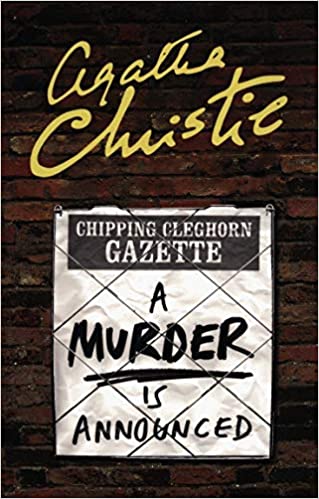
Recently, binge-watching Christie’s Poirot and Marple Series on SonyLiv rekindled an urge to read her again. In fact, I do clearly remember that I had started re-reading “Murder Is Announced” in a very leisurely fashion when the televised version of the same also came to my notice on the OTT platform. I quickly decided to read the book first and see how it has been dramatized. I was sorely disappointed by the latter but however, the binge-read revealed once again why Christie will always remain a classic.
It was early teens when I was introduced to Christie by my father who himself was as huge a fan of her (but would not admit) as I and my elder sister are till today. I remember he had nicknamed her “Ajotha Srishti” in Bengali jokingly referring to the myriad crime sequences the dame had plotted spanning eighty odd novels. I guess in those formative years I was more drawn towards the narrative than delving in detail into the characters and why they did what they did. Now I realize perhaps I was also subconsciously attracted towards her style of presenting the sequence of events as well which inspired my own writings much later.
When it comes to detective stories, the sleuths are always sketched in a larger than life fashion (Holmes included) They are a unique combo of brain and brawn. Their distinctive idiosyncrasies setting them apart from the rest of the mere mortals. But Christie’s dapper Poirot is no Greek God but his eccentricities bely his mind power. His penchant for symmetry and logic, disdain for the English and fascination for patent boots make him quaint and fastidious. But Christie pulls a trick here. Having settled amongst the English, earning the steadfast loyalty of an English friend and associate in the form of Captain Hastings and admiration of Chief Inspector Japp of the Scotland Yard who swears by his mastery in solving crimes “devastatingly quick” does not make him essentially English. He is a French speaking Belgian often in the eyes of suspicion himself of the British being a foreigner. Is this Christie’s subtle jab on Britain’s innate unacceptance of anything that is not English?
Her other creation, Ms. Marple is polar opposite. She is an elderly spinster retired to a quiet life in the country side. She loves to knit and observe people closely without their knowing and drawing parallels with her neighbours in the obscure village of St. Mary Meade. She is unassuming and gets quite flustered if asked to explain her thought process. But her wooly, muddled ways disguise an uncommon sharpness and shrewd insight into human nature. Her fragile exterior camouflages her real strength. She is nosy to some, unusually clever to others. The local police relies wholeheartedly on her judgment. She is not to be taken by her fluff of grey, clicking needles and innocently enquiring china blue eyes. She is a woman who loves to remain in the background but as Inspector Craddock puts it “is as dangerous as a rattlesnake”. Christie’s Marple is well ahead of her times empowered by an uncanny knack of unearthing the truth from the misleading heap of deceit and falsehood.
Between the two, I found Poirot more intriguing. But with age I see myself in Jane Marple.
The title “Murder Is Announced” indicates that the plot hatched to murder is pre-publicized (in the local Gazette of the village Chipping Cleghorn) and the date, time and venue announced (that of the country house of Ms. Letitia Blacklock, namely, Little Paddocks). The snoopy locals, in thirst of that rarely available excitement in life, dutifully flock in to witness the show so spitefully advertised.
But again, as I said in the very beginning, I am not interested to dwell upon the storyline or the process of deduction.
I always thought Christie was infallible. But this time, I found gaps in her narrative. Certain events forcefully imposed just to keep the readers glued. For example, the murderer arriving at the nick of time and overhearing her neighbours, Amy Murgatroyd and Ms. Hinchcliffe, reconstructing the crime. To the eavesdropper’s utter surprise, Amy had seen something which the others had not leading to her untimely death. A third murder, resulting out of a deliberate and too coincidental set up.
Its customary for the police to dig out the antecedents of the locals who were present at the scene of the crime. Every one of them has a past which they are assiduously hiding but only a few are revealed in the book. But at the same time, it made me conscious of the fact how important the past is for all of us. How we carry our baggage and how the load shapes our present and future. Christie made it more than clear.
Ms. Marple’s remark that earlier we knew our neighbours so well. But now (after post war migration) everyone is a stranger whose background has to be cross checked in order to be sure whether they really are who they say they are. It is an observation which still holds good. We reside amidst strangers. Our own identities are subject to speculation and documentation.
I have always marveled at Christie’s in depth understanding of human psychology. How she creates her characters – a bundle of contrasts and contradictions, conditioned by their half truths, vulnerable and at the same time vindictive. Ms. Marple’s remark that a weak and kindhearted person can also be very dangerous has left me thinking. How can these two very opposite traits reside in one single person?
Christie’s plots set against rural backdrops play with the basic alphabets of a language whose grammar is complex and not easily decipherable till the final closure when the face of the criminal is uncovered. In this process of unraveling the complicated matrix of crime, how the mind of the sleuth works is as systematically laid down as that of the culprit. Nothing is black and white -the shades of grey standing out in the misdeeds of the flawed characters.
During the course of deduction, many a times, the self-styled detectives have suspected the wrong ‘un and admitted their folly while explaining how they arrived at the truth. Many a times, funnily enough, Poirot has openly castigated himself for his mistakes. Ms. Marple, on the other hand, has a number of times confessed that the turn and complexity of events have left her confused and uncomprehending. Both are super-sleuths yet both are human, prone to be fallible.
In some of Christie’s novels, a quaint sense of personal justice has prevailed (e.g. Ten Little Niggers, Murder On The Orient Express). In the Murder Is Announced, it is how greed overtakes integrity and feeling of deprivation leads to moral degradation. In showing how the universal values that have sustained human civilization through eons get compromised by perceived injustice Christie has transcended time.
Christie has immortalized the villainous and the virtuous, both alike, by making them seem so real…so human. It is difficult to even hate the perpetrator of crime because Christie makes you understand why he/she did what he/she did. Christie’s elegance is understated. The violence that is weaved into the narration is so subtly presented that the reader is not overwhelmed by its magnitude. Yet, in a contemplative mood, going through the narration in one’s mind’s eye, the heinousness of the acts stands out. Christie underscores the degradation of humanity so gently and yet so powerfully, that even decades later, the impact is startlingly fresh.
Christie’s artistry lies in how a handful of complex characters serenade with an unusual grace through the maze of crooked narrative till the finale is reached when the ruthless wrongdoer is unmasked. Step by step the process of deduction bares the evil and as systematically the confounding layers of falsehood and deceit are peeled off, the ultimate revelation leaves the readers stupefied. However, on hindsight the built-up of the plot always seems simplistic and very basic. But it is only the dame who knows how to clothe the complex in simplicity.
And that is why Christie is timeless, ageless and enjoyable





Yes, a genuine author/authoress is a nebulous persona for any reader who is as sincere a reader as sincere is the author/authoress. My introduction to Dame Christie took place when I was a twenty-one years old youth and happened to read her novel ‘Peril at End House’ in the pleasant environment of a tea garden in Assam. I do agree that when the penning person is Dame Christie, even the mysteries carry a repeat value. I have read her novel ‘Hercule Poirot’s Christmas’ at least thrice and just a few months back, (before the movie on the novel came into the news), I read ‘Death on the Nile’ once again. Coincidentally, I happened to read ‘A Murder is Announced’ also some time back. Just like you, I have also aged with the Dame. Miss Marple’s remark that a weak and kindhearted person can also be very dangerous is correct. If I say more in this context, it will be too much to reveal. Miss Marple’s (and yours too) observation that everyone is a stranger whose background has to be cross-checked in order to be sure whether they really are who they say they are, is also agreeable. All the same, we are not rich enough to buy something like Pegasus (we might be under someone’s scanner though). Let me assert one thing regarding the works of Christie – she takes her own sweet time in building the premise which consumes a sizable part of the narrative before the mystery envelops the reader and therefore, the reader has to be very patient (to taste the fruit of that patience in the later pages of the book). In the context of Christie, I am thankful to you in more than one ways. Her masterpiece ‘The Murder of Roger Ackroyd’ was read by me upon your recommendation only. And this post of yours is no less than a gripping story.
LikeLiked by 1 person
Thanks Mathur Sahab for your esteemed presence and comment. You also influenced me to read Hindi pulp fiction through your reviews. All said and done Christie is a Christie is a Christie. The observations in the post are just observations and should not be taken to demean the classics she gifted us. I was reading her life story on Wikipedia. She wrote almost 65 Murder Mysteries in her life span in addition to other novels. She remained a Best Seller without attending any Course or employing a Book Coach. These Courses and coinages are mushrooms of today’s generation. A true prolific and proficient writer does not need any. You must watch the dramatizations based on her novels on OTT platform. I say based on her novels because there are deviations from the actual books in many. Sir David Suchet as Poirot is incomparable. After watching him, if you read a Christie with Poirot as the sleuth you will not be able to visualize anybody in that role. The dramatizations also give a flavour of the period and society she was writing in. Must watch. There are many Ms Marples but only one Poirot.
LikeLiked by 1 person
A very interesting post. I ,too, enjoy her books and have learnt a lot of life lessons from the astute Poirot but mainly from the mild but shrewdly observant Miss Marple. I read Agatha Christie’s autobiography recently, and am more impressed than ever at her writing prowess. One of my desires is to re-read all her books again.
LikeLiked by 1 person