
Those who wish to read the earlier posts can read them here :
Part I and Part II and Part III
Our haiku mentor, the one and only Kala Ramesh says,”Where there is craft, imagination ought to have a rightful claim.” Employing imagination is just not being fanciful, as it is derogatorily construed to be, it is an essential ingredient of human survival and evolution. A mind which does not make use of imagination is stagnant and powerless. Strong words yet true. It is pertinent, at the onset, to figure out whether imagination is merely a habit akin to some self-destructive addiction (“Oh! you know, he is always fancying things”), an indispensable requirement (no invention is possible without the adequate employment of imagination) or an enviable skill (which only a few gifted souls know the right measure to apply with and when and where in order to assess the implications of a course of action, circumvent major mishaps, anticipatory or otherwise, and chart out the most suitable path ahead amidst all odds – in short farsightedness)? For any kind of creative craft imagination is the byword. Since, life itself is the biggest creative handiwork of God, the entire cosmos manifests a greater and higher precinct of imagination that is humanly indecipherable leave alone scalable. Again, in order to sustain such a vast and complex matrix of the processes of creation, preservation and annihilation, what instruments are perceptibly and imperceptibly at work are again the outcomes of imagination, the level of enormity of which is, humanly impossible to perceive let alone gauge. In every sphere of life, be it education, profession, social cohabitation, economic prudence et all, imagination assumes much greater proportion and significance, not just to perpetuate and sustain the existing or proposed scheme of things but to comprehend the larger picture behind or beyond the myriad day to day, mundane and not so mundane, occurrences. Imagination, enhanced and backed by knowledge and intuition, empowers the mind to take the right decision at the right time, avert catastrophes if not obviate them altogether and forge ahead to build a comprehensive corpus of accumulated wisdom to the advantage of the posterity.
Be it any form or type of skill training, the rudiments of learning and unlearning need rest on imagination.
“How will you emote if you cannot possibly imagine what Cinderella must have gone through when she realized that she has lost her glass slippers at the stroke of midnight?” Was my question to the little ones, gathered for their Sunday session of acquiring drama skills, which I am certain made them think and wonder! And I am glad it did because when it boils down to the crux in haiku to assimilate the “vertical” nuances of a seemingly innocuous “horizontal” image, what one requires is a ladle scoop of I-M-A-G-I–N-A-T-I-O-N to experience epiphany through one’s sensory vision….what else?
My reason to emphasize this least-stated faculty of imagination will gain more clarity from the next story from haiku narrated below… a haiku in which the poet masterfully and generously crafts loads of it at the same time leaving nothing to it at all (here read it as imagination)….the picture is so sharp, precise, lucid yet impactful, resonating and spell binding all in one!! And that, my friends, is the beauty, power and x factor of haiku…easier analysed than mastered.
Many years ago when I used to stay in Kolkata, I would often stand on the balcony of my house, which was next to the railway tracks, and spend hours watching the trains pass by. Sometimes I would even sit on the platform and watch the trains coming and going. Those days Rajdhani Express was the fastest train of the country connecting Kolkata to Delhi. And did you know the train would pass by the very tracks next to my house on every alternate day.
I can’t tell you what fun it was to watch the Rajdhani pass by. I would wait for hours just to see it for a few seconds possibly as it swished past the tracks in a jiffy. The bogeys were coloured red and yellow. The windows would be all tightly shut. The dark glass of the windows would not allow a view of the inside. But its speed! Whew!! Maddening how it rushed from one station to the other to reach on time at the destination. And, mind you, it was always on time! Sometimes, as the train would hurry by the driver would blow the horn loud and clear. And even after the train had passed by, the horn could be heard from a distance for a very long time.
But one morn as I woke up I found the tracks could not be seen at all. A heavy cloak of fog had descended from the sky and enveloped the city. The houses, the roads, the traffic and also the railways tracks were all covered with fog like a giant hugging a child and nothing could be seen far and near!
I was very unhappy. Now I would not be able to see the Rajdhani swish by. Still I waited on the balcony at the time when Rajdhani was scheduled to pass by hoping after hopes that I would have just a mere glimpse of it.
And lo! I did. Faintly though…but yes, the body of the train was visible for a few tiny seconds before it vanished into the film of the thickening fog like a speeding cheetah….a cheetah with red and yellow stripes! And to make sure that I was not dreaming, the driver blew the horn which blared through the grey, smoky fog and kept on blaring till it became a distant echo.
Many years later when I read this haiku the memory and along with it the joy of watching the Rajdhani speeding on the tracks flooded back to me. The haiku was
dense fog
the train evaporates
into a distant horn
Kala Ramesh
Also written for : WordPress Daily Prompt : Express
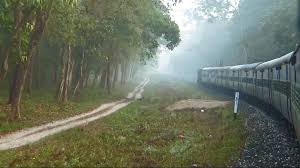
From Google





[…] Part I, II, III and IV […]
LikeLike