
Recently, I was invited by Vaishali Chakravarty of Actor Factor fame to interact with her students (age group : 9 to 12 years) and introduce haiku to them in terms of editing thoughts. Interesting! Though I had never thought of haiku in that perspective, yet, it made sense. This was my first interactive session with children of that age group and that too on haiku. And to be honest, I learnt much more than they might possibly have from me.
Coming back on track, it seemed a daunting task in the beginning. Making children understand the brevity and simplicity intrinsic to haiku was no small deed. The technique I adopted was focused on the story element so unintentionally presented by haiku. Yet, it was only a minuscule aspect of the genre. I selected ten most relatable haiku which would appeal to children of that age group and weaved a story around five of them which were rather extensions of the main theme of the haiku and five I left to them to react upon – my idea was to let them figure out the story in these, however, Vaishali suggested that they picture the story rather than write. So they drew the haiku which was perfectly in order and reinforced the visual vibrancy of the minimalist verses. Needless to say, it worked and how!
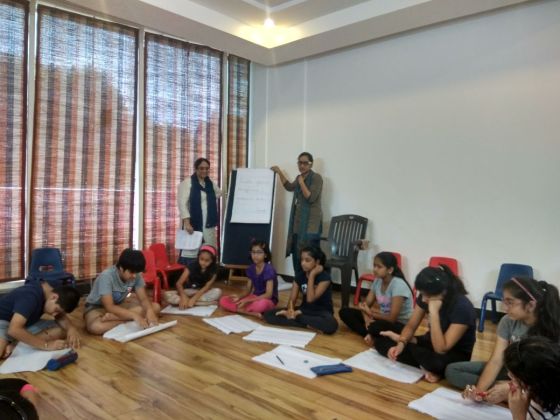
With Vaishali and the Children at Ambience School, Hauz Khas
Thanks to my very talented haiku mates of InHaiku Group, NCR Chapter, who lovingly allowed me to borrow their haiku for the session. I would be sharing post by post (five/six in series) the stories that I weaved around these haiku to convey to the pupils the art of tapering down thoughts to the bare essentials disregarding or discarding the unnecessary. Point to note : these stories should not be confused with or construed to be haibun. Haibuns are paras or stories embedded with haiku with strong element of the ingrained shift and link. Rather these stories, as I mentioned earlier, are kind of extension or elaboration of the haiku itself concentrating on the suggestive narrative of the ku (verse) .
So to begin with….
Grandma’s house has always been mysterious. An old, rambling building with lots of rooms, a huge courtyard and a winding verandah running parallel to the rooms. The ventilation of the house was poor as a result the rooms would remain dark even during day time. After nightfall, it would be dimly lit throwing shadows across the walls which loomed large.
While wandering around the premises I would find many rooms locked from outside. Heavy padlocks tied in thick chains rested on the doors like formidable sentries guarding hidden treasures. I was so curious about these rooms. “Why do these remain bolted day and night ?” I would often ask Ramu Kaka, who was as ancient as the house itself. He would remain silent most of the times or try to tell me some other story about the lame mongrel who had given six puppies in the backyard or Mimi, the kitten, who was grandma’s pet.
But it was Govind, Ramu Kaka’s son, who spilled the beans. “Those rooms are meant for the ones who cannot be seen,” he told me in hushed tones which sent a chill down my spine.
When it rained in the dead of the night, I would hear the croaking of the frog near the well in the courtyard or a jackal howling in the jungle a little away from the house. A door would suddenly open and then close. Shaded lights would be shown to strangers who entered the house quietly and left as quietly after. Govind said they carried pistols and guns, pamphlets and bombs. But they were not bandits. They fought for a cause. “What cause?” I asked. Govind would look down at me from his imposing height of four and a half feet and put his finger on his lips, “Shhhh!! They are fighting against the kings. They are rebels. They say it is we the people who should rule the country and not those who do not belong here,”
At this point, I would rack my brain hard to understand what Govind said. Confused, I would loiter in the untended garden at the back of the house. And during nights, when the clouds placed a blanket over the stars, I would eagerly wait for those nightly sounds – the frog croaking, the jackal howling, a door closing and shutting, unknown footfalls in the courtyard and sometimes a gunshot afar and then a heartrending cry tearing the sky and thereafter silence….a familiar sound which I had listened to earlier when mother was whisked away covered in a white sheet on a charpoy shouldered by four men in front of my father’s bleary eyes and once again when father had fallen into deep sleep six months later in the hospital.
Those nightly sounds of my childhood days came back to me when my friend wrote
a jackal howls…
ghost stories spook
my grandmother’s home
—Nandita Jain Mahajan





[…] I have said in my earlier post, I learnt much more from the children than they possibly did from me. The one thing that struck me […]
LikeLike
[…] Those who wish to read the earlier Posts I & II can read here and here […]
LikeLike
[…] who wish to read the earlier posts can read them here : Part I and Part […]
LikeLike
[…] Part I, II, III and IV […]
LikeLike