
 Nowadays I am walking, talking, eating, sleeping, living, breathing haiku. And you will be flooded with posts after posts on this mesmeric genre of unique poetry. Why? I shall disclose the reason by and by. But before that I must pay my respect to all those well- wishers of mine who showed the right direction when I was bumbling over haiku. Well, that does not mean I have mastered the art of “haiku-ing”. No, not at all…I have not because I guess haiku writing is an art which you cannot learn overnight. You have to ‘grow’ with it. More of that later…
At the outset, let me dedicate this post to Shri Amit Aggarwal of Safarnama fame who has been instrumental in exposing me to the world of Hindi haiku. Though, very technically speaking, haiku in Hindi, or any other vernacular language, for that matter, bear certain intrinsic differences from haiku written in English, in terms of expression, style, word craft etc. Notwithstanding, Hindi haiku is as engaging as its English counterpart basically because the subtler nuances of this form of writing remain the same (read form the base) whichever language one may adopt to put to word one’s epiphany moments. More so, if these haiku flow out of Dr. Sudha Gupta’s pen, the result is spell binding to say the least.
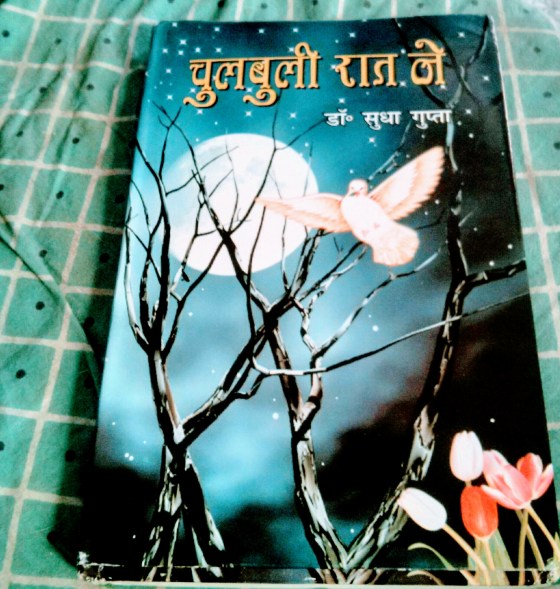
I am grateful to Amitji for generously gifting me a few of Dr. Gupta’s collection of haikus – “Lakdi Ka Sapna”, “Chulbuli Raat Ne” and a few more with the purpose to get me the “feel” of haiku in general, and Hindi haiku in particular.
Before I proceed further, let me once again confess that I am nobody to talk about, let alone evaluate, the works of a word mistress who surpassed herself with every haiku she created. Moreover, since Dr. Gupta writes in Hindi, it is more fitting to ‘speak’ about her anthologies in her mother tongue, i.e. Hindi, which I may try someday, seriously. But as of now, I just wish to ramble on ….because it is so difficult to contain oneself when one comes across precious and meaningful work of immense literary worth and not let the world know about it. Just that and nothing else…
Yesterday night I slept over Dr. Gupta’s “Chulbuli Raat Ne”. Again, there are certain books which you cannot stop or finish reading. You keep coming back to them, gravitated by their magnetic pull, bringing you closer to the abstractions of existence with every read. That is why I have not yet shelved the book.
What is it with haiku that makes one wistful? It is that undercurrent of futility, pathos and emptiness that makes you realize how you are wasting every bit of your living moment chasing myriad things and you never know whether these are meant for you!
And that brings me to the oft-quoted shloka of Bhagwad Geeta whose relevance, I suppose, shall never depreciate with time:
“Karmanye vaadhikaaraste maa faleshu kadachana
Maa karmafalheturbhurmaa te sangostvakarmani”
One must devote oneself to the joy of efforts detached from the results – the journey is much more significant than the destination! And why am I reminded of this invaluable verse? It is because haiku tells me to be aware of my awareness of every moment.. to be in the now… and shrug off the fear of tomorrow and remorse of yesterday!!! Therapeutic ??? Haiku does just that…
At the same time, it makes me stand and stare and assimilate the experiences of every fraction of time….and show the world how it is and not tell…Cathartic???
Now let’s not veer into generics. Coming back to “Chulbuli Raat Ne”, the elusiveness of haiku gets underscored as one page is turned into the other…I present a few gems below:
ghoomta raha
mausam ka pahiya
phir basant
whirls on
wheel of seasons
once again spring
khola jo dwar
nakamiyaan khadi thi
munh chidhaati
door unlatched
failures galore
grimace at me
yaadon ki loi
khutiin par tange-tange
keedey kutari
blanket of memories
hanging by the hook
moth-eaten
aah! durdaiv!
bhumika likho tum
main pat katha
aah! disaster!
preface you script
I the screen play
beshumaar wey
ghaltiyaan tumhaari
maafi hamaari
beyond count
your follies
my forgiveness
Aah! I did it but with a trepid heart as translation or transliteration both rob the original of its beauty and I am too ‘small’ to mess with such beatific creations. Honestly, I chose those which I could ‘tweak’ idea being to outreach Dr. Gupta’s work to the non-Hindi speaking readers too. But there are numerous others which are too beautiful, too delicate, too esoteric and too prfound to meddle with… I present a few of those here as well:
kokil taan
anjaane chhu deti
dukhti rag
sab ke paas
thaila bhar kisse hain
sukh dukh ke
hai naseeb!
boond-bhar neend bhi
naseeb nahin
koi upaay?
ateet ko bulaaun?
laut aa jaaye?
bada bindaas
murdon se baazi lagaa
soya shahar
panchhi na rotey
mausam ke khilaaf
sab sahte
kabhi na toota
sheet-grishm-varsha ka
chakra anootha
gullak phod
chulbuli raat ne
bikhere sikke
main durba bhali
ujaad, khandahar,
kahin bhi pali
main to jugnu
saans bhar ujaala
phailata phirun
ham-safar !
mere gun na giney
khot hii dikhey
When it comes to such writings, you cannot put a full stop and say that’s it. You read, you muse over, you cannot get over it and then you come back to it once again…and then again…and then again and again…
So, see you in my next post…..
Cheerio!!






I love Haiku too! Some years back I got Gulzar’s Triveni, a collection of superb Haiku and it was really interesting! These are lovely as well and some of them are real gems! 🙂
LikeLike
Then I think I must get the book for my book shelf. Thanks Ankita so much.
LikeLiked by 1 person
I’m deeply touched and humbled by your large hearted benevolence of mentioning me here and thanking you will not be a reciprocal gesture adequate enough for this benignity, Geeta ji.
I myself am a great fan of Dr. Sudha Gupta’s Hindi haiku per se. So much so that a fear keeps lurking at the back of my mind that a shadow of her writing might reflect in some of my creations…and that is the main reason that I leave mine with minor faults sometimes. I also deliberately avoid writing for weeks together after reading her so as to avert this possibility.
Your erudite post is a great write on (Hindi) haiku if were to judge, and the selection of quotes is wonderful too. If you kindly allow me I would like to give my input of my favorites for your upcoming post or just for your reference. (You might not have read them in the collections with you).
There is only one thing I wish to submit here with reference to and without disputing your observation, “..technically speaking, haiku in Hindi, or any other vernacular language, for that matter, bear certain intrinsic differences from haiku written in English, in terms of expression, style, word craft etc..” I have gathered from master poets and critics who know Japanese that even English haiku differs from the original Japanese Hokku (came to be known as haiku after Matsuo Basho) in terms of expression, style and word craft.
In my opinion, hence, although I’m nobody to opine authoritatively and am an insignificant learner myself, we must accept this fact as a limitation of languages and keep writing in whatever language helps us put our thought/feeling across most suitably…let us strive to keep the spirit alive behind the veil of words.
I look forward to reading the next part. Regards..!
LikeLike
Thanks for your effusive comment. Amitji I look forward to your inputs eagerly.
I have named this series of posts on Hooked To Haiku as Why Haiku. Be it Hindi or English the beauty and subtlety of haiku is never lost whatever be the limitation of language etc. When I said Hindi Haiku differs from English Haiku I did not intend it as a derogatory comment. It is as you said a limitation of language or expression or whatever. Both have their respective charm and style. And at times the limitation adds an extra dimension to the form. Also, haiku has been improvised over a period of time perhaps to make it more contemporary thereby sustaining its significance in modern times and times to come. Thus from conventional Japanese hokku , haiku has come a long way. When compared with the traditional ones, even modern English haiku substantially differ in expression, craft and style. Agreed. And that is what we call innovation. Isn’t it? While rewording Dr. Gupta’s haiku in English I felt the same limitation of language, believe me or not. Original shall always remain Original.
There is nothing wrong in being influenced by master wordsmiths. I am very much inspired and influenced by Gulzaar Sahab when it comes to Hindi poetry and more than often my reader points that out to me. So no fear if her shadow follows you…you owe it to her and she owes it to you…that is the reader-writer equation.
As I contemplate on the content of my subsequent posts on haiku, I realise I may have to dedicate the entire series to you as whatever meagre I have known about haiku is through books either sent or suggested by you.
So be there to read and once again thanks a lot for your guidance.:)
LikeLike
Thanks a whole lot Geeta ji for your kind understanding of my opinion and I so whole heartedly agree with and support what you have further said about haiku in your reply above.
A request to you at this juncture may not be out of place: A mention of my name in the opening post is an honour big enough for me to handle, kindly do not ‘dedicate’ the entire series to me so as to save me from embarrassment..I’m too small and insignificant for this..hope you will agree and oblige. I am neither a big writer nor have done any favours by way of my humble
suggestions/ideas/observations/opinions…this is the least we can do for each other as fellow writers.
Reading you is a delight and I find it appreciable when I find in your writing which I know is missing in mine..
The next part(s) are eagerly awaited.
LikeLike
Being too modest, I must say. But I will keep your views in mind.
LikeLike