
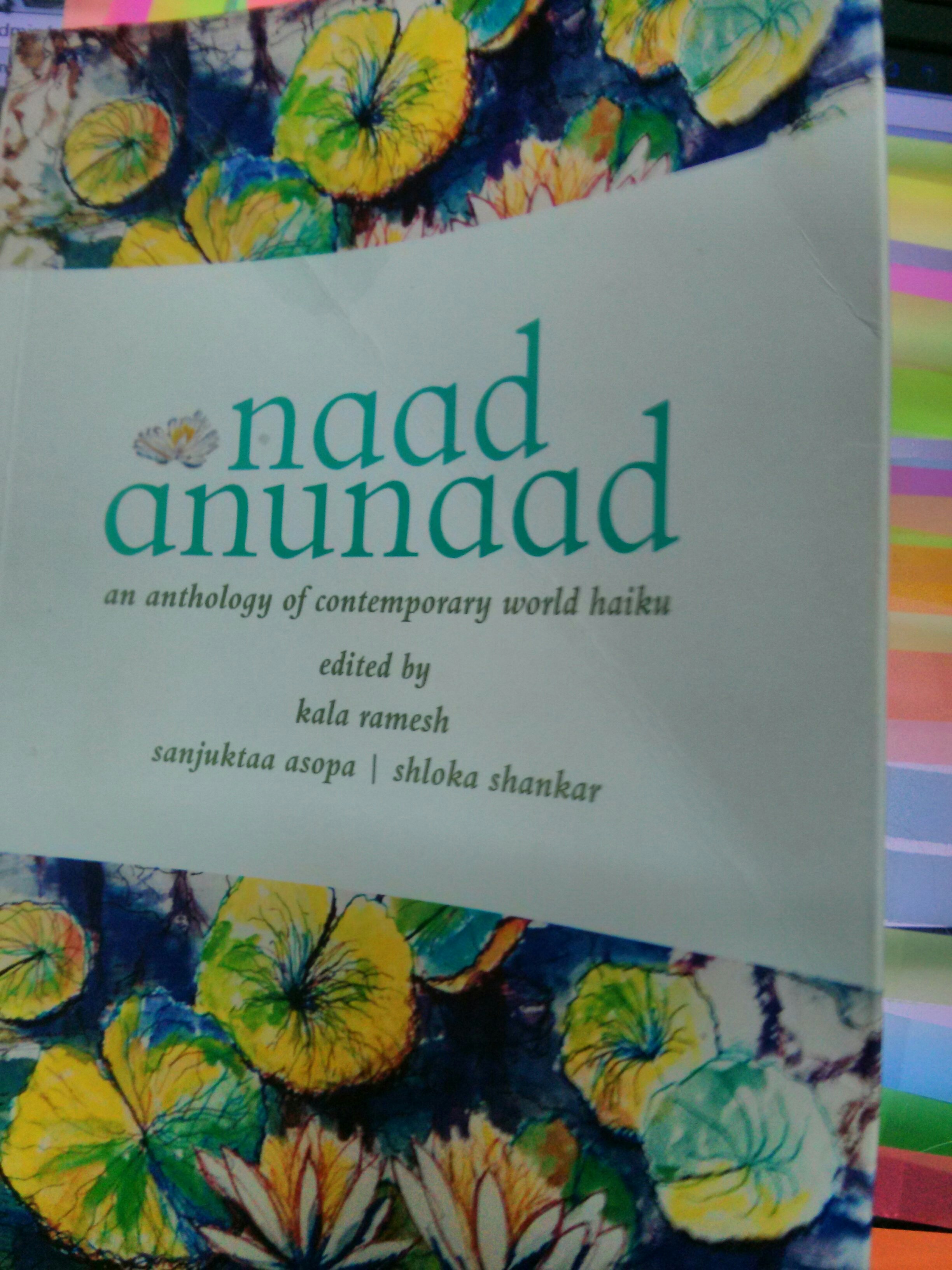
(Haiku is simple to read but difficult to write. I was introduced and immediately attracted to this form a couple of years back. Though whenever I tried to write one the stalwarts bluntly told me that it was anything else but haiku. To get a fair idea of what haiku is all about I kept on bothering the best known haijins of this country, lucky that I came across them and they so indulgently gave in to my innumerable queries and countless questions. As it is an experiential form of poetry one has to be initiated into the world of haiku in a gradual and guided manner. However, my hiccups over haiku came to a sudden halt as I came across a few books on the subject. I am thankful to those who directed me to these treasure troves. One such priceless find is ‘Naad Anunaad’ about which this post is all about)
I was wondering whether it was proper to write about a book which I was in the middle of. But then there are certain books which you can never finish reading and keep referring back because of their Biblical proportion in terms of their encompass, the enormity of content and what they teach you without attempting to do so. And then there are those wave-like feelings which rise within you when you come across creations of exquisite beauty! Yes, this was my experience when I was going through “Naad Anunaad”, a collection of 746 contemporary world haiku penned by 231 writers from 26 different countries, edited by the internationally acclaimed haiku poetess, Kala Ramesh assisted by Sanjukta Asopa, a well-known journalist and haiku poet and Shloka Shankar, a freelance, writer, poet and visual artist from Bangalore.
This triveni of haiku exponents have created a tome-like referral (not in terms of size but again content) for all haiku learners and lovers across the world.
The book begins thus: “In Sanskrit, the primordial sound in the cosmos, referred to metaphorically as AUM, is known as naad, and its resonance as anunaad.…..In silences between notes, between words, between lines, the emotion that arises is known as Rasa – the aesthetic essence – which gives poetry, music or dance, a much greater sense of depth and resonance.” This is also that defines the ethos of the book itself.
“Haiku are word paintings. In film jargon, we could refer to them as shots frozen in time.” The images absorbed by our indriyas (five senses) are momentary, therefore, ephemeral. Haiku intend to immortalize these trickles of time. These Japanese form of short verses conventionally adhere to the 5-7-5 syllabic meter. However, the word limit is not an encumbrance but an enhancer. Come to think of it, how can you imprison a moment of exquisite beauty within the bounds of verbosity? Words fail when you confront the beauty of truth. The minimalism in haiku, thus, belies the resonance of epiphany therein.
I dip my feet
in a river the river
joins the sea
- Kala Ramesh
falling blossoms
the breath between what was
and what will be
-Kala Ramesh
The resonance of haiku is a derivative of what remains unsaid between the words said. These silences between the words and between the lines and between the images lend endless scope for personalized interpretation as well as introspection.
the ocean in a raindrop inside my womb a heart
-Kala Ramesh
after the rain
in each hanging droplet
the world upside down
-Kahinath Karmakar
deafening rain_______
to think it has no sound
of its own
-Kashinath Karmakar
Needless to say, its zen-like quality which compels an awareness of the moment, haiku are therefore never in the past tense. And how can one visualize the larger picture if one is not deeply entrenched in the very now ______
rippling laughter
face to face with myself
on water
-Minal Sarosh
For me, haiku is nostalgia personified. The beauty of resonance is in its ringing pathos. The form eloquently brings forth what was, what is and what will not be….. and that is the reason why perhaps one can never get over a haiku…it deftly holds on to the wispiness inherent in the cosmos…..a wondrous feat in terms of word capture, to say the least…
autumn morning____
my shadow now
has a slight hunch
-Kumarendra Mallick
autumn wind
the slant in the handwriting
of my former self
-Polona Oblak
It is difficult to address the idea of abstraction in haiku as its dominant visual impact apparently overshadows the subliminal terrain which philosophises the futility of life.
between the sky
and the spin of the earth
this falling leaf
-Laryalee (Larry) Fraser
The esoteric splendour of haiku is in the interplay of sharp contrasts. The contradictions of Nature and the paradoxes of life delicately balanced on the fulcrum of unfailing precision and undiluted crispness.
this puddle
what my paper boat knows
of the sea
-Sanjukta Asopa
the gravedigger staring
into space
then back at the grave
-Rebecca Lilly
As once the internationally acclaimed haiku poet Ramesh Anand had veered my attention on the ‘wow’ factor essential to a haiku, fact remains, that it is the most inexplicable and at the same time the most adorable ingredient of this form which with ease flummoxes as well as fascinates a reader to no end. This undiminishing awe is what epitomizes the perfection of a haiku.
temple ruins….
an eroded Buddha
still in meditation
-Ramesh K
The minimalism in haiku lends it an abruptness which is engaging as it is intriguing. It is also this element that draws the reader into a collaboration with the writer to impute perhaps greater meaning to an open-ended summation. And therein lies the charisma of haiku.
galaxy…
just a lily-pond
will do
-Sanjukta Asopa
gossip column
only the ink remains
unsmeared
-Carol Raisfield
breakfast together
silence about things
that matter
-Carol Raisfield
this world
is a dewdrop world
yes…but…
-Kobayashi Issa
Translated by David G Lanoue
starry night
what’s left of my life
is enough
-Ron C. Moss
However, in its incompleteness is there a complete story…
dad’s house
I unbutton a shirt
that no longer fits
-John Mcmanus
Nonetheless, there is a timelessness about haiku and every time you read the same one you are never tired of it. I have already gone through the book twice perhaps thrice yet every now and then I come across a haiku which has a newer meaning, a fresher presentation and a novel touch which I had not discerned before. And I know a decade hence when I again pick up this book I shall find similar engrossing haiku which will again mesmerize me with their contemporaneity and relevance.
yard sale
the empty fish bowl
still wet
-Peter Newton
Haiku is suggestive – it shows and does not tell.. The form though rigid has an ingrained flexibility thereby leaving huge scope for innovation…There are some exquisite one-liners here for all to relish and muse over…
iampackedelevatoreverybuttonpushed
a man in a crowd in a man
-John Stevenson
At the cost of lengthening the post, I cannot resist giving here a few catchy and thought provoking haiku…the various rasas depicted in their symbolic best…
There’s an odd underlying pathos in haiku which is at times hard to fathom yet extremely palpable pulling the chords of the heart with a maestro’s touch –
city park bench
sitting briefly beside me
the midday sun
-Samar Ghose
salt free diet
somehow I knew it would
come to this
-Samar Ghose
Humour –
Wa i ti ng fo r the ne xt SNE EZE
-Shloka Shankar
Satire –
orthopaedic clinic
a three-legged chair
outside the entrance
-Johannes Manjrekar
traffic argument
the camel’s sneer
is impartial
-Johannes Manjrekar
Nostalgia –
garage sale—
the flowered couch on which
I became a woman
-Carol Raisfeld
Haiku is multilayered lending varied interpretive scope to its readers.
Relatable –
year’s end—
only the sound of mouse clicks
from every desk
-Kashinath Karmakar
cricket fever
the CEO talks batting order
with the peon
-Quamrul Hassan
Evergreen romance –
sharing an umbrella
your wet left shoulder
my right one
-Angelee Deodhar
Picturesque –
window moon
an imperfect circle
in a perfect square
-Kashinath Karmakar
And here’s a yummy one –
New Year’s Day
the centre of the chocolate
not what I expected
-Carolyn Hall
In order to pick these haiku from a big bunch of beautiful ones I had to flag the pages of the book and now it looks like this..
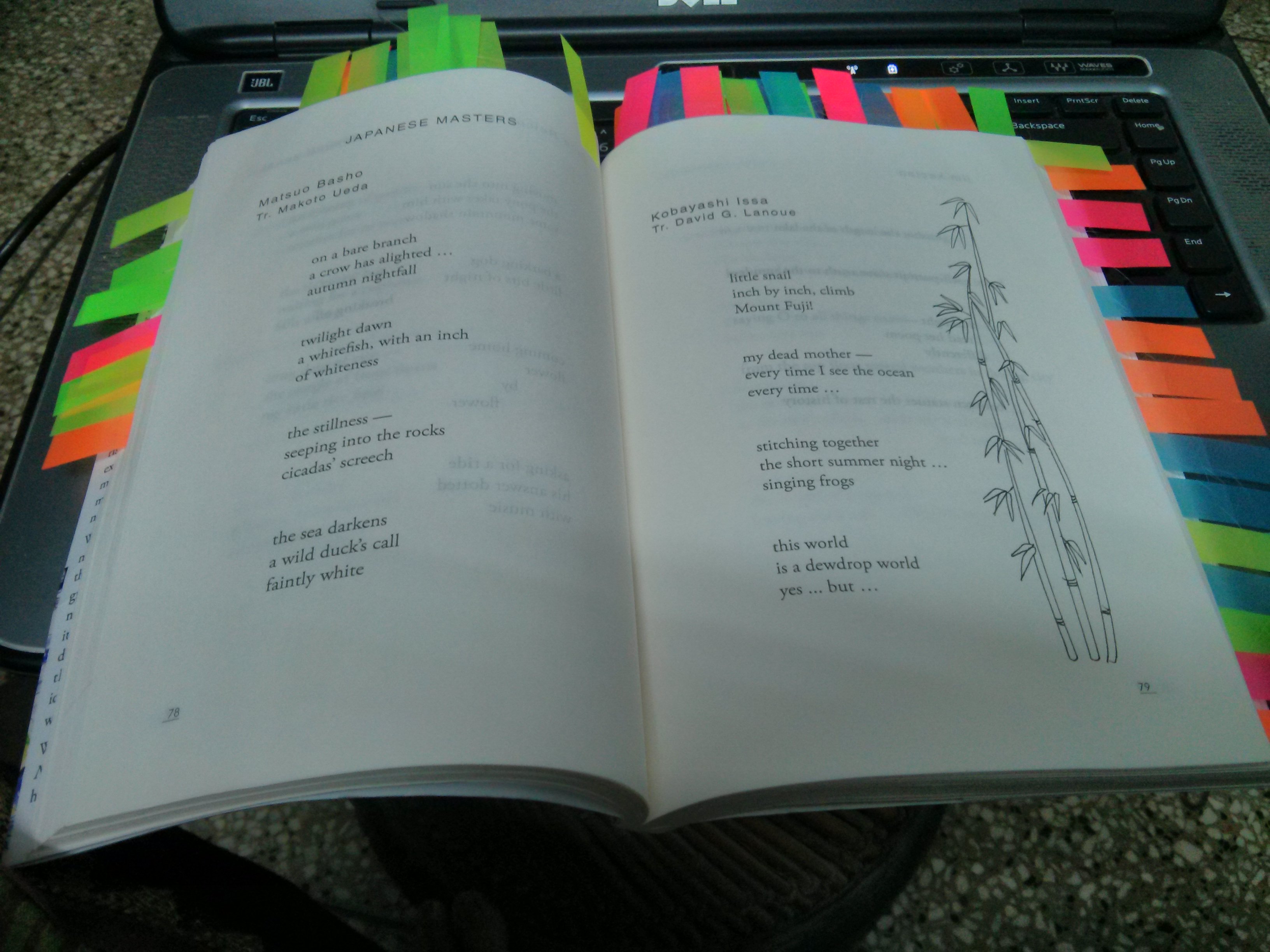
I am sure with the next reading the number of flags will grow and so will the colours….which implies not one reading is enough. You need to savour each and every verse longingly in order to soak in the undercurrents beneath the strings of simple words.
Haiku is really a word picture. By spacing of the letters and the alphabets the abstraction of idea finds vibrant imagery.
speeding along the awning’s edge
raiiiiiiiiiiiiiiiiiiiiiiiiiiiiiiiiiiiiiiiiiiiiiiiiiiiiiiiiiiiiiiiiiiin
-Anita Virgil
As Kala says haiku has changed forms over the years and the anthology does not only include traditional haiku but also modern haiku (gendai), senryu, border-line haiku and the new ku without grouping them under various categories in order to retain the rasa.
Kala hopes that Naad Anunaad ‘will draw a new generation of readers and authors into the kind of intimacy with nature that our grandmothers enjoyed…..Nature here does not mean just the hills, rivers and forests – it includes cities and the life we live, our day-to-day activities, taking in stride the agonies, failures, successes and idiosyncrasies intertwined with the natural world.’
Thank you Kala for giving us such a literary treat.





Superb!!!!
LikeLiked by 2 people
Thanks dear
LikeLiked by 1 person
Thanks for a lovely review of the anthology, Naad Anunaad, Geetashree.
_/\_
LikeLiked by 1 person
Thanks to you for such a beautiful book.
LikeLiked by 1 person
A beautiful review .. Congrats
LikeLiked by 2 people
Thanks Sir
LikeLike
Simply awesome!
LikeLiked by 1 person
Thanks Alok
LikeLiked by 1 person
A scholarly write…shows your deep interest and understanding. Loved it:)
Great quotes too! Thank you:)
LikeLiked by 1 person
Thank you. More on this shall follow soon. As I have written in the post, I am indebted to a few, which includes you as well, for this evolving interest in this form.
LikeLike
Excellent review Geeta – this book goes on my list! Haiku was my first venture and attempt at writing – it is a beautiful art and my personal favorite form of poetry even though I am not at all good at it. Loved your choice of haiku – thanks for introducing me to this priceless gem 🙂
LikeLiked by 1 person
It is priceless. Glad you like it.
LikeLiked by 1 person
🙂
LikeLike
Hi Geetashree,
Thanks for publishing my haiku here.Please note there is a typo in the haiku below-
deafening rain_______
to think of it has no sound
of its own
The “of” in the second line should not be there.
deafening rain–
to think it has no sound
of its own
Hope you will rectify it.
Regards,
Kashinath
LikeLike