A Promise To Keep


I guess I may be the only exception who did not watch  Dhurandhar (The Expert), a 2025 Hindi film,  which broke multiple records  and reportedly grossed a revenue of Rs. 1000/- Crore worldwide. Why ? Because I know what a spy thriller will be all about in the context of two neighbouring countries that have nurtured a quaint love hate relation since their births.

But I watched Main Vaapas Aaunga (I Will Come Back) on Netflix. Against the backdrop of a Partition ravaged Punjab is the story of the budding romance between Keenu and Jiya belonging to two different communities – romance which is under the constant threat of being nipped at the bud by the blood thirsty communal rioters. To assuage Jiya’s fear that she may have to be estranged from her lover anytime soon Keenu makes a promise that even if circumstances force him to leave the land where he belongs he will soon come back to reclaim not only his sweetheart but also the life he has known.

Keenu keeps his promise and returns after six years to find that his dream of being reunited with Jiya can never transpire into reality. He returns heartbroken, rebuilds his life from scratch in a country where he feels alienated and secretly keeps pining for Jiya. In his ripe old age, in the throes of fast encroaching dementia, post repeated strokes, he keeps mumbling about a curse on his family and an unfinished job that he has to finish.

Main Vaapas Aaunga effectively relives the anarchy and trauma of the Partition. More importantly it showcases how political decisions upend the lives of the common people. The belongingness one has towards one’s roots cannot be altered overnight by the drawing of a man made line (The Radcliffe Line) which may determine the geographical boundaries of two countries but cannot be driven through people’s hearts.

Keenu’s “flashbulb memories” on deathbed compellingly reinforce the futility of all the havoc that terror and war mongers wreak. The movie ends on a kaleidoscopic sweep of all the recent terrorist attacks, human exodus across borders and survival of human spirit in refugee camps world over delivering once again the pressing  need of converging collective will towards building rather than breaking – an imperative that a narrative founded on excessively gory and violence ridden saga of espionage may never have been able to put across.

Trivia I : “The Partition of India in August 1947 split British India into two independent countries, India and Pakistan (which later split into Pakistan and Bangladesh) causing a massive humanitarian crisis, mass migration, leading to displacement of 12 to 20 million people and an estimated death toll between 200,000 and 2 million due to widespread communal violence. Millions of Hindus and Sikhs moved toward India, while millions of Muslims crossed into West and East Pakistan. Riots, massacres, and brutal attacks targeted refugee trains and walking columns (kafilas). Tens of thousands of women faced abduction, assault, and forced separation or conversion. Delhi, Punjab, and West Bengal are a few cities/states that struggled for decades to house and integrate millions of destitutes.  Resultant generational trauma, border fencing, and strained diplomatic relations continue to affect South Asian politics.” (Wikipedia)

Trivia II : Sir Cyril Radcliffe, a lawyer by profession, had never set foot in India prior to his arrival on July 8, 1947. He was chosen to chair the boundary commissions specifically for his complete lack of prior connection to the subcontinent. He drew the Radcliffe Line using maps and census data, left almost immediately after finishing, and never returned. He arrived on 8th July 1947 and was given a brief window of roughly five weeks to divide the provinces of Punjab and Bengal. He left India shortly after completing the boundary award and never visited the region again. (Wikipedia)
The Thing About Old Age


I have been, of late, thinking quite a lot about how “being old” is to be defined. Is it just by age? But age, at the expense of sounding cliched, is just a number. There are people around me who have been defying age in their day to day working, living and thinking. Or is it to be understood by the fitness quotient? I guess that too is a debatable parameter considering the advancements in medical sciences. 

My mother was operated for breast cancer in her eighties. The surgery was successful. The credit of her post surgery rehabilitation goes as much  to the doctors as to her own will to live. She breathed her last in her 92nd year. Throughout those last ten to twelve years she valiantly fought against chronic infections gradually taking over her body along with profound dementia.

Society has a way of shunning the old. If you are infirm more so. “They are old…they will not understand” is something that I often here. Is it when you lose relevance that you actually become old ? I also fear outlasting my utility – to others as well as to my own self.

My elder sister says human connection is very important. True. So is community bonding. In the book “Ikigai” Francesc Miralles and Hector Garcia say that being a robustly interactive part of a community helps people live a happier, healthier and longer life.

I don’t aspire to be a centenarian. But when I see my contemporaries are living a more active life I try harder to combat my disabilities. Sometimes I am successful…. sometimes I am not. Age catches up when we lose purpose, give up on hope, submit to fate.

Yet in spite of my efforts to lead a better life, physically as well as mentally , I worry whether I really belong any longer. Am I acceptable to the millennials? Am I comprehensible to the GenZ? Will the Gen Alpha be accomodative of me?

I think these nomenclatures have distanced people more. It’s like they are from a different planet and I have survived the Ice Age. I wish we were a little more inclusive, perceptive and willing to understand each other – it’s both ways. I guess that’s how we can be more agile. Understanding each other’s viewpoints. Keeping abreast of what’s new. Keep on learning. Communicating effectively. Not the way we used to but the way the present generation is able to grasp.

I guess the whole issue is our tendency to live in the past. Compare it with the present and feeling morose that things are not happening the way it used to be. That’s killing if you think deeply. Time is linear. It will never make a U turn. Living in a time warp makes one less and less adaptive. My elder sister has resolved to learn something new each progressing year. She is making herself useful to her family. That’s the way you escape redundancy. Her spiritual leaning helps in many ways.

Where am I in this whole paraphernalia of living in tandem with time?

Still introspecting…

Doors


This is in response to Sadje’s Weekly Photo Prompts on #Whatdoyousee.

The other day in the Poetry Club I read out these lines:

“There are many doors which have not opened to me.

There are many doors I have passed by and did not knock on.

There are many doors I have entered but have come out of –  changed forever.

There are many doors I have entered and did not want to come out at all.

Somewhere between these locked and unlocked doors I am stuck till now looking for a way out.”

Followed by  thunderous applause.

Many came up to me and said I should get my poems published.

A few even requested me to repeat the lines for them to jot down.

“I’d again read it at leisure…” One of them said.

So gratifying.

So humbling.

So encouraging.

Next was my husband’s turn.

Yes both of us are members of this Club. In fact, I forced him to join in. He is so tongue tied in public. Clumsy. Vague. Always short of words.

Every weekend the Club gave us a prompt word to speak on. It could be anything – poem, speech, passage from a book, personal anecdote, short story etc.

This week the prompt was : Door.

Everybody looked expectantly at him. He blushed. Mumbled a bit. And then cleared his throat and said, ” A joke…”

As soon as you say ” a joke” faces usually light up. The atmosphere changes and bristles with anticipated hilarity.

He stuttered a bit and then got into a flow:

“Once upon a time there was a ghost. A polite ghost. He ambled into a restaurant and knocked on the restroom door before entering.”

A few giggled at this.

My husband unnecessarily straightened his shirt collar which was already straight. He did that whenever he felt confident. He continued with his new found confidence.

“He entered the restroom but never came out. You know why?”

He paused dramatically and looked around the audience who appeared to be clueless.

A few more seconds…

Then somebody asked quietly, “Why?”

My husband grinned and replied,

“Because he suffered from chronic constipation.”

Of course, I was the first to laugh.

The others followed reluctantly.

#Wdsy

Just A Few Lines


yellowing leaf

how silently can we

say goodbye

***

unlatching the door

once again back to

my own self

***

bin bag

the other side

of me

***

the falling

of a dead leaf

even the breeze

does not lend it

a cadence

***

falling leaf

the silence

after you

Two of these haiku were first published in  mindspeak-vanderloost.blogspot.com

On Stage


In school I avidly took part in stage plays representing my House (no. 5 for extra curriculars). While the other students were attending classes I got special permission for rehearsals.

Eventually our school started taking part in inter school drama competitions outside the school premise. And of course I was there in the lead roles. Tragically, they were all male leads about which I have already written. 😢

The stage always posed many unthought of challenges however well rehearsed I was. Once in an inter House drama competition I was to enact the role of a blind sage. I had long monologues to be delivered with eyes closed. Additionally, I was to wear a wig, beard and wooden slip-ons which were tied to my feet with strings as I was not habitual of wearing them.

As it was a dance drama before my entry little girls were to perform a group dance with flowers. My teachers had told me to be careful not to step on the petals strewn all over which  made the stage slippery.

While delivering the heavy weight emotional dialogues I got carried away. Mid dialogue I suddenly remembered to check the floor. All this time I had kept my eyes closed. I pretended to blink like a blind man and opened my eyes just a wee bit in between to see where all the petals were scattered. But as soon as I did so I realised I was looking straight into the eyes of one of the judges sitting close to the stage. I quickly shut my eyes back and continued as though I had not seen him. But I guess he had. Our play was adjudged the second best and not the first though all the participants and teachers had put in their hundred percent into it. 😭

In another instance, I was in the role of a king wearing an opulent headgear made of cardboard. As I moved my head a little while saying my lines I realised it was loosely tied and could fall off anytime. So all the while on stage I had to keep my head precariously tilted to one side so as to keep the headgear in its place. But my teachers and fellow participants said I looked very regal. 😂

As part of our upbringing, Bengali kids were supposed to know how to recite poems written by Tagore , sing Tagore songs and enact in Tagore’s plays and dance dramas. In the annual Durga Puja Festival we kids were called to participate in these dance dramas. I was very poor in dancing and always bungled my steps. 😂

Till the Board exams I was seriously involved with the stage but soon realised that it was hampering my studies. After the Xth Board I , therefore, consciously excluded myself from these extra curricular activities.

However, these on-stage experiences made me realise that on stage, as in life, no amount of memorization and rehearsals could substitute improvisation, which usually self taught, proved to be more handy and effective on all occasions. 😆

Working Around A Feast


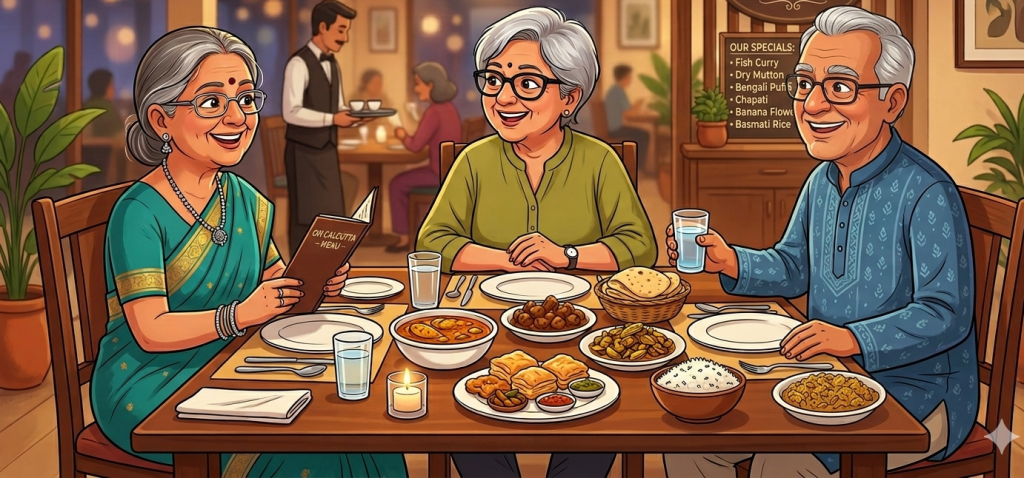
Usually when work based outings are planned eating out comes as a natural choice because of convenience, time constraints, distance from residence etc. But in our family of foodies it is the other way around. We plan a feast first and then decide what important work can be undertaken around the food  joint which we have selected for the day. 😂😂😂😂

For a long time we (me and my elder sister) were hankering after Luchi (Fried Puffs) and Aloor Dom (Potato Curry) – a typical Bengali combo. Generally, it is had for breakfast but we wanted to have it for lunch. Blame it on the rains which make us salivate for rich, spicy khana.

So, the day before yesterday we planned an outing accordingly. We had to go to the southern part of the city as all the Bengali restaurants are situated there.

After finishing our work which was obviously near the location of the eatery we headed straight towards the main attraction. It was a small restaurant for families , friends and work colleagues out for an informal meal.

We ordered Luchi and Aaloor Dum or Dum Aloo of the North  along with Chholar Dal, i.e., Channe Ki Dal (Bengal Gram lentil) as it is called in Hindi. But the dishes we ordered were made in the typical Bengali style which is way different from the North Indian style of cooking. Along with it was Mochaar Cutlet or Banana Flower Cutlet – an absolute Bengali delicacy. B-I-L had Bhetki Maachher Kalia or Bhetki Fish Curry and Rotis. We ended with Mishti Doi or sweet curd, again a Bengali speciality.

The potato curry that goes very well with the puffs – (made up of all purpose floor) – is rich, flavourful with well fried golden brown baby potatoes/big potatoes chopped to size. The chholar dal is thick with a subtle coconut flavour. Both these preparations  have a slight sweet taste which is essential to the dishes. But the sweetness is balanced with other spices like the Bengali garam masala in the potato curry which enhances its taste tenfold. The chholar dal is garnished with roasted cumin and fennel seeds and green cardamoms. At home we put kishmish in it too.

The bhetki (Sea Bass or Baramundi) fish curry or Kalia essentially has onion, garlic and ginger paste as the main ingredient in the gravy. The fish is deep fried till it is crisp and red and the masalas are also well fried till the oil separates from them. The gravy is thick and of a rich dark red or blackish brown colour. Didi said it tasted better with rice the next afternoon at lunch (we had got it packed as well). Since, I am a sparse non veg eater I abstained from having it.

We bought a lot of Bengali sweets on our way home which included Rasho Kodombo made out of jaggery, Malai Toast, Kacha Golla and even Orissa’s famous Chhanna Poda.

Though we were  feeling very full but our taste buds were quite satisfied. I skipped dinner. So did Didi. As of now we feel like two smugly happy cats till of course the next outing is planned.

Till then….

😊😊😊😊

Again A Bunch – Haiku, Tanka And Haiga


Why do I like haiku? Because it tells a story –  not the conventional one with a beginning, a middle and an end –  but somewhere from the middle abrupt and not explained fully.

So that each time you read the same lines you get to unlatch a new door , loosen the drapes a bit or perhaps draw the curtains away from the window panes and let sunlight stream in.

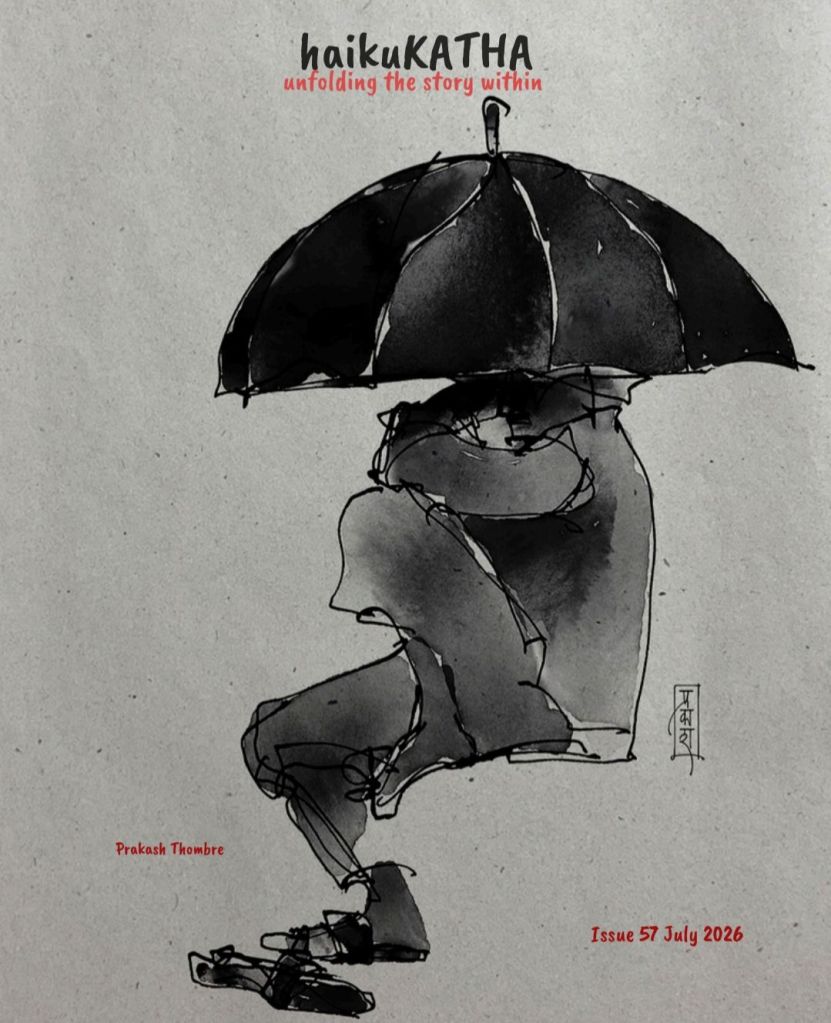
Here are a few more fresh and fragrant from HaikuKATHA Volume 57 : July 2026.

Read through  and I will tell you why I chose them.

the bell
that rings
the bell …
mother’s flashbulb memory
Gandhi ji’s Hey Ram

                                kala Ramesh

The one word that drew my attention to this tanka is “flashbulb” reminding me so much of the flash light of the erstwhile cameras. Like a sudden illumination. When I associate the word with memory I am  instantly alerted of the winter years …. the fading twilight zones… the receding of tides…the waves pushing back into the sea.

The L-3 “Gandhi ji’s Hey Ram” comes as a jab – a below-the-belt punch. Sudden. Unexpected. Sharp. Such a shift!! At the same time such a subtle allusion to that eternal receding into the cosmic blackhole!!

***

did he wonder
why I always sent
a valentines card
two male penguins in the zoo
raising a chick

                                    Alfred Booth


word by word
you dissect the lab report
with Google
how I wish we grew old
without these threats

                                    Alfred Booth

Both these tanka seem in continuation of each other.

Both are so wistful….pensive….The silence in between heavy with those unpeeled layers of “what could have been”s… and “if only”s…

***

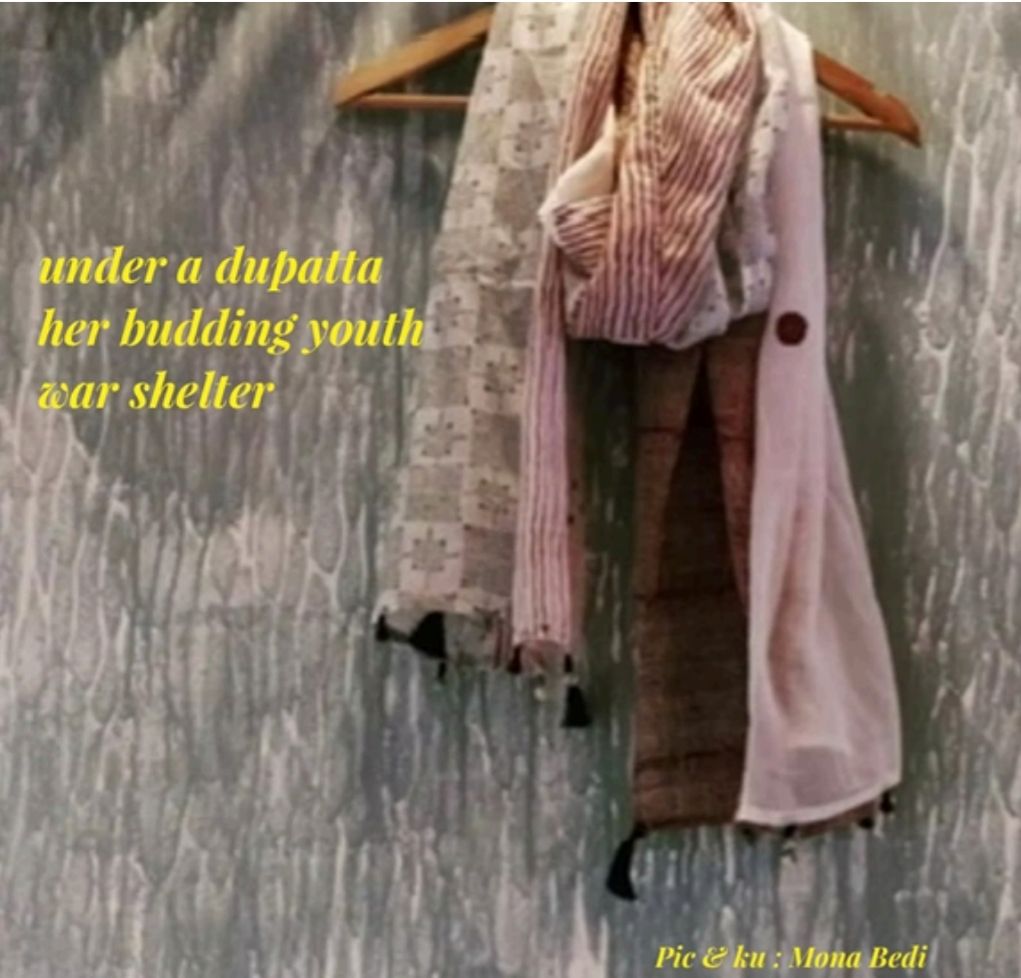
Need I say anything on this haiga by Mona Bedi ?

No…there is no didactics here.

Only that haunting realisation of the utter futility of man made devastation so boldly underlined.

***

summer cloud —
all the excuses
             

                     – Fatma Zohra Habis

This two-line haiku speaks of craft.

Usually excuses are associated with life half lived…. of remorseful remembrance.

But summer is just the prime of youth full of promises and boldness…

always too late
there is no way
to make it linger
the life of a flower
already in full bloom

                           – Fatma Zohra Habis

I see this tanka in continuation with the two-line haiku.

Almost a guilt runs through these lines – a guilt of not able to sustain all that is blooming and beautiful around us.

***

a box
full of handmade
Mother’s Day cards …
now how do I
save these text

            –   Baisali Chatterjee Dutt

night after night
i pour myself
into the darkness
through song —
daybreak takes my voice away

               –      Baisali Chatterjee Dutt


sleeplessness again …
which means
another night
replaying
my life’s greatest misses

                      –  Baisali Chatterjee Dutt

In all these three tanka there is an unmistakable indulgence towards permanence (cards, songs, opportunities) which sharply contrasts with the temporariness of all that is living, breathing, growing around us.

***

HaikuKATHA is a well curated monthly journal of haiku, tanka, haiga, tanka prose, gembuns etc.

You can read the other submissions here.

Or click the link below 👇

https://www.trivenihaikai.in/post/haikukatha-issue-57

Take your pick from the post or from the journal and let me know in the comment section.

Peace


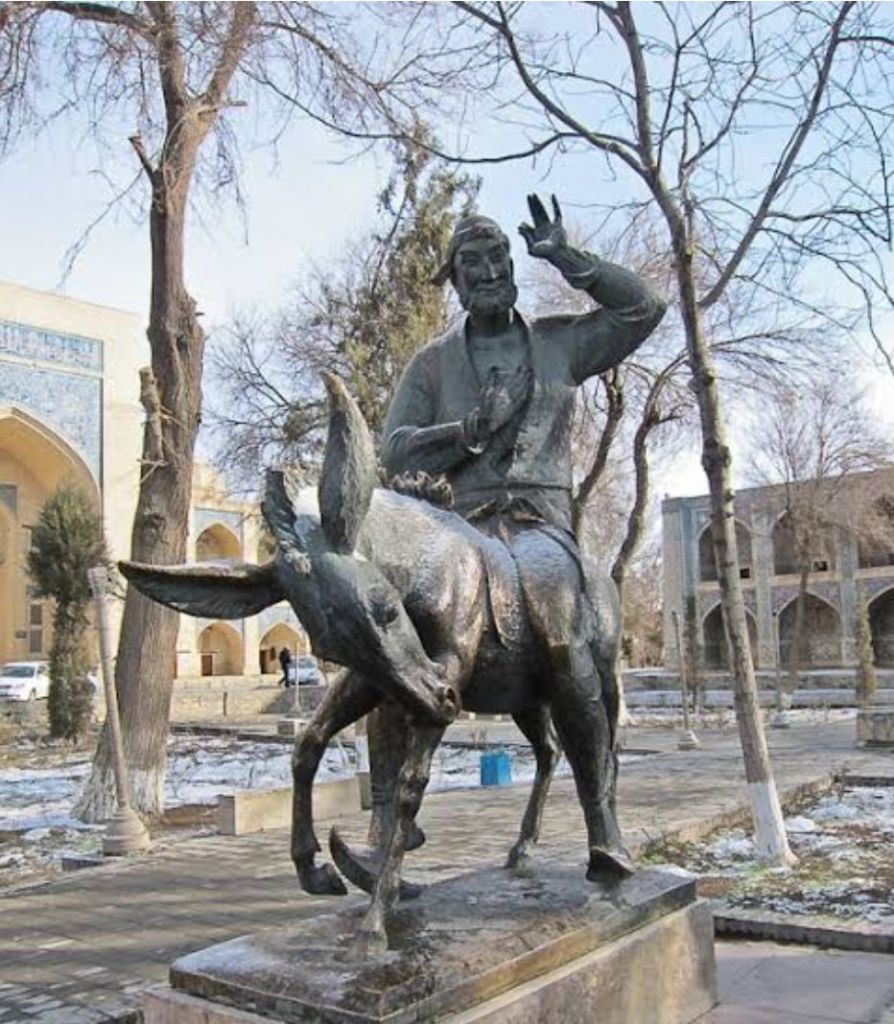
One day a man with a cloth bundle arrived where Mulla Nasruddin was sitting. He looked like a traveller and sat across Mulla placing the bundle on the ground and asked a simple question:

Where is peace?

Mulla did not answer. All of a sudden he snatched the man’s bundle and started running. The man, at first taken aback, ran after him because the bundle contained all he had.

He chased Mulla through many streets and gullies. After a long race Mulla came back to where he was sitting. The man, huffing and puffing, came back too. But before he could ask or say anything further Mulla replied:

Here is peace.

***

This short story can be interpreted as many ways as the readers want.

My Takeaways:

One is not needed to chase peace. It is within one’s own self. It has to be just realised.

One does not need too many personal possessions to attain peace. It can be attained with as little as possible.

Being peaceful does not mean being careless about your own self. One has to take care of what one already has without hungering for more and more.

***

Wiki says:

“Mulla Nasruddin was a real historical person, but over the centuries he turned into a legendary folk character.

Historical records and a tombstone in Akşehir, Turkey, suggest he lived during the 13th century (around 1208–1285 AD) as a Sufi philosopher and witty satirist.

Archives from 13th-century Seljuk Turkey mention a real Nasreddin Hodja who lived in Sivrihisar and Akşehir.

As stories spread across the Silk Road into Greece, the Arab world, Iran, Central Asia, and India, people attached hundreds of humorous jokes and wisdom tales to his name.

He represents a cultural archetype—a clever person who acts foolish to expose human hypocrisy, pride, and absurdity.”

Do let me know your thoughts on the story in the comment section.

PS: This post stands revised in line with a conversation with dear blogger, Hazel of Seven Sisters fame. I am so privileged to have such thoughtful readers.

Image Courtesy X.com

The Test


In response to Esther’s Weekly Word Prompt.

This Week’s Prompt: Test

https://estherchilton.co.uk/2026/08/05/writing-prompts-125/

Writing Prompts

The Test

It was his first after struggling for twelve long years.

A make-it or break-it opportunity.

The Director said he had it in him.

This was a test of his lifetime and he had to pass with flying colours.

Just one dialogue and a minute’s appearance on stage before a live audience pulsating with excitement.

He had mugged up the line to the extent that he could repeat it even in deep sleep.

Which went like this :

“Your highness ! I opened the lid of the wok to find the mutton was gone!”

What a powerful , profound punch pivotal to the play!!!!

But …. Ooooh!!! These butterflies in the pit of the stomach and the trembling in the legs.

Somebody gave him a push from the back and he stumbled on stage landing straight at the feet of the king seated regally on his grand throne.

A second’s hesitation. Then a quick recovery.

He lifted his head dramatically.

“Your Highness!” His voice quivered a bit.

But again he cleared his throat as though it were a part of the act.

(He was a natural, wasn’t he?)

And repeated with all his bottled up emotions,

“Your highness ! I opened the lid of the mutton to find the wok was gone!”

A deathly silence….

Followed by roars of laughter, cat calls and whistles..

Something hard fell on the stage

….smelly….rotten…

Then the curtains were dropped hastily

Unexpectedly

And a scream mixed with a few garbled ejaculations …. Unprintable.

That was from the Director…

Ufff!

He had failed again…

***

PS : This was my father’s favourite story which we asked him to repeat often. He loved to deliver the line “Your highness ! I opened the lid of the mutton to find the wok was gone!” with a lot of dramatic humour!!!!