Distraction Not Allowed


What do you listen to while you work?

One thing that I am not good at is multi-tasking. But it does not mean I am good at other things. I have always been average in every task I perform. Which is kind of very relaxing because nobody expects too much out of an average person. Even if you fail its okay and accepted without any qualms. But if you are an outstanding student, worker, householder etc. the expectation level goes higher and higher and you have to be on your toes to prove yourself or break your own records from time to time.

Now coming to the prompt. Being an average person means you can only do one work at a time. If I listen to music I cannot complete the work in hand. That is why I never put on the stereo while driving. I fear I’ll get lost. Not that I drive much. I don’t like driving either. Concentrating on the road for long is not what I can do well.

You see I have a wandering mind. Music makes it wander more. Therefore, it’s best for me to focus wholeheartedly on the job which requires employment of grey cells . Since, an average person has slightly rusted grey cells it’s wiser not to pressure them.

As children, we used to hear the radio all the time. Binaca Geet Mala which later became Cibaca Geet Mala, Chhaya Geet, Yuv Vani, various other musical programs on Vividh Bharati. We also listened to sponsored programs like Inspector Eagle. Hawa Mahal, which aired audio plays, was also a program to look forward to. On certain days Didi(elder sister) put on the channel which aired English music. At that time songs were played on public choice or demand. Now it’s as per the RJ’s preference who may or may not have good ear for melody.  Nowadays to make a song hit it is played and replayed. I guess, in those days too the method was the same. The only difference being they took so and so names from such and such places who wanted to listen to that particular song. Now who knew whether those people really requested for those songs ? More importantly did those people actually exist? The names of the places became famous with the song as those were oft repeated. Jhumritalaiya was one such place situated somewhere back of the beyond from where avid listeners requested to play certain songs.  Once sis dropped a postcard to AIR (All India Radio) requesting for our favourite songs to be played. We kept on waiting for our names to be announced. Sadly, it never happened. I guess we were more interested to hear our names on the radio than the song itself 😀😀.

My sis said music helped her solve mathematical problems with ease. I always used to get distracted with music though. But I thought she was right because she was my big sister. Sis was a great influencer when I was a child. Whatever she said was the ultimate. I believed her without questioning.  I remember drawing and painting while listening to music. Daydreaming took over studying with or without music.

In later years I have found that music can facilitate finishing boring jobs faster like dusting, cleaning etc. I sometimes play music and hum along while cooking. However, more interesting is to talk to the cats, dogs, birds and bees at the kitchen window. I have a secret conviction that I understand their language and they mine. So we carry on a great conversation without making out what we are talking about. Wish it could be the same with humans. It would save all the bickerings and differences of opinions.

What say you ?
Comfort In Distress


What’s your go-to comfort food?

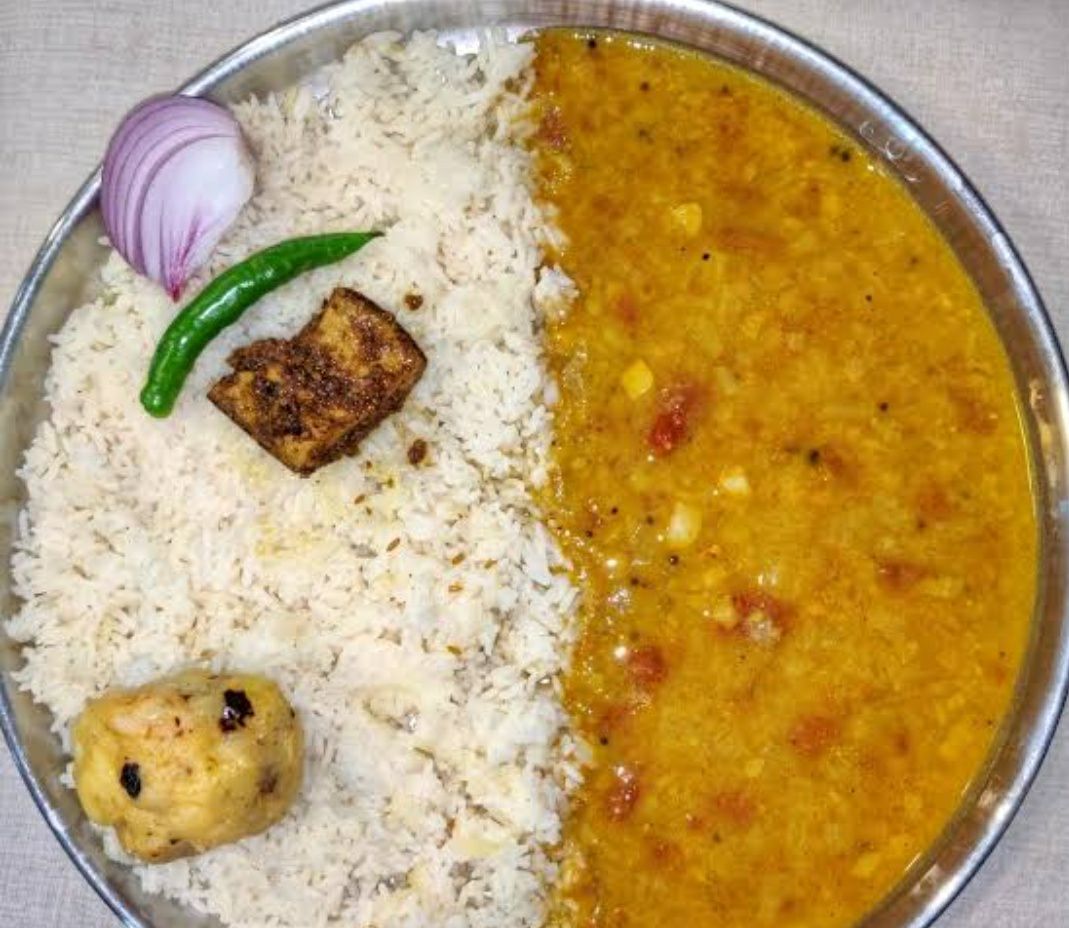
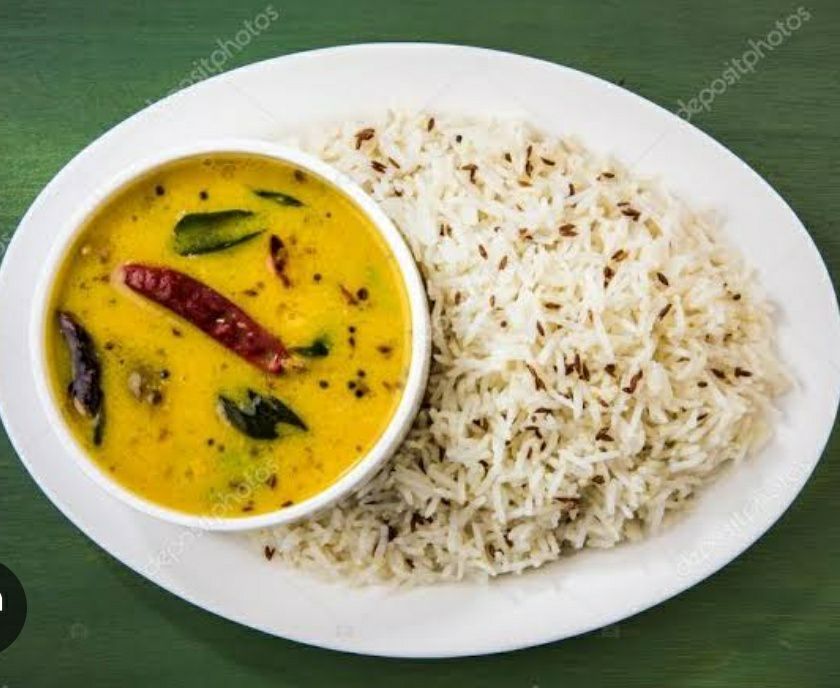
Daal-Chawal  of course!

It’s not only my comfort food it is also comfortable to make as it require least amount of ingredients and time.

When in stress eat Daal-Chawal

When not in stress make Daal-Chawal

When tired go for Daal-Chawal

When under the weather the only food that gives peace is Daal-Chawal

When bored and out of ideas the easiest is to serve  Daal-Chawal

In every season what gives solace is Daal-Chawal

In every mood the only enhancer and rejoicer is Daal-Chawal

Daal is nothing but split pulses or lentils. It can be just boiled with turmeric powder and salt as per taste. One can also make it spicy by adding a few more ingredients like chopped onion , ginger garlic paste, diced tomatoes , a pinch of coriander powder and garnish it with cumin seeds in clarified butter. Sometimes vegetables can also be put in lentils to make it more filling. Chawal is boiled rice. I  de-starch it as well. It takes minimum time to prepare and contains all the proteins, carbohydrates, vitamins and minerals for a healthy lunch/dinner to fill your tummy and energize your body and mind. If you make it a one pot dish it becomes khichdi which is again very simple to make and delicious to eat..

Bengalis are foodies. You ask any Bengali what his/her favourite dish is the answer  will either be fish or meat. However, I am the exception who cannot do without Daal-Chawal. It’s a basic food for rich as well as poor. This is a dish which even if you overeat will not make you sick.

In summers, light versions of Daal is preferred like Dhuli Mung, Laal Masoor, Toor Daal, Dhuli Urad etc. Whereas in winters this plain and simple Daal can become a gorgeous treat when made rich with heavier version of whole pulses or lentils like Maa ki Daal, Whole Mung Daal, Chane ki Daal with Tadka, Rajma, Chhole etc. Indian cuisine can be very rich and spicy as well as bland and insipid as you want it. We have from June to October very humid weather every year in this part of the country when appetite leaves you and most of the time one feels dull and de-energized because of the heat and sweat. It is best to have patliwali Arhar ki Daal-Chawal during this time which is light on stomach. At times, to change the taste Arhar ki Daal can be transformed into tangy Sambhar with lots of vegetables and tamarind paste garnished with mustard seeds, whole red chillies and curry leaves.

For most in North India Daal-Chawal is a go to food. For me best lunch (I seldom have dinner nowadays) is Daal-Chawal with a dry sabzi or vegetable at the most. Choice of vegetables in summers is very less. So different versions of Daal is very satisfying. One of my favourite ways of making Daal is with raw mango!!! It’s what I look forward to in summers.

As it can be seen I can go on and on and on.

So let me put a full stop here.

Traa-Laa-Laa

Enjoy eating your comfort food.

Why I Like K And P Dramas


K means Korean
And
P means Pakistani

By now it’s quite apparent that I am hooked to Pakistani and more recently Korean dramas. As always I try to figure out why I like them.

I have enlisted the following factors which make these dramas superbly watchable :

Limited episodes

Strong theme

Interesting story line

Nuanced direction (especially Pakistani dramas)

Handling of complex issues without getting ugly or overboard

Attractive presentation

Upholding of  rich culture, ancient wisdom and timeless values (e.g. respect to elders, gratitude, decluttering of life, closeness to Nature, community bonding etc.)

Relatable characterization

Realistic vision

High entertainment and audience engagement

Outstanding performances

Absence of  body show

Transmission of powerful message without being didactic

I guess, being Asian, the approach towards life and environment are quite similar across borders. Way society reacts to issues is also the same. Whereas Pakistani dramas, like Indian dramas, have a tilt towards religion and rituals as an indisputable source of solace and strength in times of adversities, Korean dramas veer focus on being close to Nature, relinquishing competitive existence, finding adequacy and self-sufficiency in simple and basic things of life and an overall drift from materially successful living to higher and more abstract forms of soul satisfaction.

The other thing that I appreciate in these dramas  is the  way relationships are shown to develop. Taking time to Know each other, enjoying the togetherness, from liking to loving to promising to be for each other forever, it is a gradual merging of two souls made for each other. In comparison, in Western series and movies there is a hurriedness to get into a physical relationship which is as short lived as disillusioning.  The reason to be out of a relation is also sometimes very flimsy reflecting impatience,  selfishness and a reluctance towards mutual adjustment.

This has far reaching consequences as today’s generation imbibe  what they see in these series, movies and dramas. They gulp down without munching. Too much emphasis on individual liberty,  lack of vision, patience and efforts to grow old together with the one in relation  and the families, sky rocketing career ambitions, disregarding the long term sustainability of relationships through personal sacrifices are some of the reasons of increasing number of break-ups in relationships and consequent divorces.

Cinema, theatre, books (all other expressions of art)  are mirrors of society. They reflect the image of contemporary society as much as they deliver message of how to improve and correct the maladies leading to aberrations and degeneration. 

Whereas we have learnt many good and bad from the West we from the East have to give what we consider best to empower humankind through creative narratives and other means of self expression.

Security Versus Adventure


Are you seeking security or adventure?

This is an intriguing prompt. So let me answer it.

Both, senses of security and adventure, are age related. In youth one is curious. Curiosity leads to seeking knowledge. Search for knowledge can be arduous as well as adventurous.

With age one becomes cautious. The sense of security or the lack of it heightens as we grow old. However, there may be exceptions to the rule. A person can be adventurous by nature embarking on journeys that a cautious  person may never undertake irrespective of age. In contrast, a cautious person will seldom go for adrenaline pumping adventure even in young age.

My first big job, as a trainee, was in a well known public sector company in Kolkata. The corporate office of the firm was situated in BBD Bagh, in  the then Central Calcutta. Close by was the Police Head Quarters, Laal Bazaar – the historic red building. Behind Laal Bazaar was the infamous China Town housing the Chinese, Tibetans and other immigrants of various nationalities who by their looks were in general identified and classified as “Chinkies”.

This was a labyranthine neighborhood rumoured to be the hub of all kinds of dark activities – from smuggling to drug peddling to prostitution – you name it the town prided in it. It was  rumoured that even the  cops  did not dare to enter into that formidably fortified  locale even in broad daylight.

One of the trainees, in the office, a khasi girl  was married to a mysterious Tibetan who lived in this notorious locality. There were many other girls from the same region working with us. Khasis, being a minority, had great bonding. My bestie was also Khasi. The girl, living in China Town, was absenting from office due to ill health. It was my bestie’s wish to go see her. It did not take much effort to  tag me along.

The visit was uneventful. The girl lived in some kind of a chawl whose entry and exit were as confusing as that of the locality itself. We hardly spent much time with her. The locals, however, did not look as shady as I had imagined them to be.

It was again a chance visit to a well trodden “red light gully” one evening. Pedestrians and taxi drivers took a short cut through this alley to avoid traffic. From underaged to old to infirm , women of all shapes and sizes  in rows after rows, stood expressionless, waiting patiently for  ‘clients’. It was just a matter of survival. Nothing else.

After a certain hour of the day girls of good families were not supposed to be seen in many streets of  Calcutta. Though I happened to walk these streets I could not fathom the reason why.

I stayed with my paternal aunt and her husband in Calcutta for sometime. Being childless, they expected  me to perform those duties which otherwise their unborn sons and daughters were to do. Uncle (aunt’s husband) was chronically ill due to  bad habits and  health issues. Lot many times, the family physician had to be called for  emergency visits. The doctor, in turn was highly asthmatic and therefore did not have a roaring practice. But he was a good fellow, sincere physician and sympathetic towards aunt and uncle.

One evening I had to rush off to him. By cycle rickshaw it took half an hour to and from the doctor’s residence. The roads wore a deserted look as it was quite late. Doctor’s house was a little  away from the main road behind a vacant and uncared plot of land which had almost turned into a jungle with tall grasses and undergrowths. There was no street light nor any pathway inbetween. One had to walk across the unkempt patch of land to reach the doctor’s doorway.

I had kept the rickshaw waiting. Finally, we paddled towards destination. Midway the doctor hemmed and hawed  and then warned me not to be scared  if any stranger tried to stop us midway. It so happened that some hooligans were after the doctor to vacate the house he was residing in backed by the local politician and builder who hankered after the twin plots of land – the one on which his house was built  and the other vacant one. Having refused to succumb to the onerous demand, Doctor had been receiving threats from many quarters. He declined home visits after nightfall as it called for avoidable trouble. Although, nothing untoward happened, it was a high  risk taken in exigency. I was in my twenties. The goondas would never have spared me if they had chosen to attack the doctor that night.

Now when I look back, the seemingly adventurous incidents make me wonder.

I was never the one to throw caution to the wind. More so in my later years. Then what prompted me to be so reckless? Was it the outcome of utter boredom and a craving to try out something fashionably new and daunting? Or was it mere and extreme curiosity that did not let me think twice ?

I still wonder…

Nose Pin


Too many experiments with life and with oneself may not always be  desirable

I do not remember at what point in life I became interested in nose pins. Nose pins are traditionally worn by women of certain communities as signs of being married. It’s an important part of wedding attire of many communities, especially, in rural areas.  Though not compulsory, girls get their noses pierced at an early age in line with family custom. But definitely it’s a beautiful ethnic ware.

Noone in our family wears a nose pin. So getting my nose pierced never happened. It was very late, I guess in my late twenties, when I became more and more aware of my fondness for this adornment but it was too late for piercing. The pain to be endured in the process deterred me from going ahead. But I would often talk about  it whenever I visited jewellery shops. The counter girls, in turn,  encouraged me to wear one assuring that the piercing would be painless and done in minutes.. But I could never muster enough courage…

In India, girls get their earlobes and nose pierced at a very young age when the skin is soft and thin. As one grows older the piercing becomes more and more painful because of thickening of the lobes and nasal walls. In certain communities the piercing is a ceremonial process. I do not know how the piercing is done now. When we were small  the process was long drawn and dreadful.

Our neighborhood doctor’s widowed sister was the go to person for such minor invasive procedures. She was a nurse. Many stories revolved around how she got widowed and came to live with her brother. Those aside, she was a gruff woman hardened by life. The two-staged earlobes piercing  was done by her. At first the lobes were pierced with sterilized needles and a black thread was tied through  the holes till they became fit for holding a thin pair of earrings, preferably of gold, as gold did not cause sceptic. In certain cases, instead of the black thread  miniscule neem sticks were shoved inside the tiny holes  till it was time to wear the ring. To avoid  puss formation  turmeric and mustard oil paste was applied regularly on the earlobes which turned a hideous yellow in colour signifying that the girl had attained the age and undergone the piercing process. There was no fixed age for piercing. It depended on how eager the child was to wear the jewellery and how particular the mother was to get her child through the pain. Subsequently, the thin earrings would get replaced by thicker versions or studs (tops as called colloquially) as per the financial strength of the earning parent.

In my case, as it happens so often, the hole turned out to be crooked. A child is supposed to sit still during the piercing. I must have squirmed a bit crying out in pain. So the needle inadvertently cut through a nerve or vein, I do not exactly remember which. As a result, one lobe had to be re-pierced. In short, it was a nightmare ! But mother said it had to be done.

Nowadays, multiple piercing of ears and nose are in vogue. For me once was enough as it made me go through the ordeal twice , no thrice. Once the holes got blocked due to dust as I had ” kept them open” for long (which meant not wearing the earrings).

After having endured all the trauma associated with piercing, I never went without earrings. Till now I cannot wear very heavy  ones or artificial stuffs as my ears cannot hold them for long and  develop allergic reactions to metals. Understandably, the dread of piercing, which will always remain fresh in my mind, prevented me from getting my nose pierced though I craved for a diamond nose pin all along.

However, last week I had to visit the jewellers. In our country, every region has their respective, conventional and distinct patterns of jewellery. Therefore, every community prefers their own jewellers. Goldsmiths in Bengal turn out intricate and beautiful patterns with lesser amount of gold while in the Northern, Southern and Western parts of the country, the emphasis is on weight (of gold) in jewellery. Our jeweller has his shop thirty kilometres away from my residence in the Southern part of the city. The commuting time is one to two hours depending on traffic.

This time I went alone. It took me less than half an hour to finish my dealings. The shop owner is a good salesman too. On my mentioning of a nose pin, as is now almost customary of me, he quickly took out his collection for display and insisted that the piercing would get done in a jiffy without any pain. Half an hour later, a tiny cluster of diamonds was shining on the left side of my nose. Four decades of fear evaporated like vapour. I was surprised by myself. How could I !!!

I was told to return after two days to get it set permanently. In view of the distance I scheduled the second visit  after a fortnight. Way home I felt supremely self conscious. It seemed every commuter was staring at me. That tiny piece felt like a large outgrowth on the face. I am not crazy about fashion and least bothered about overhauling my physical appearance. I valued nose pins for their ethnicity and grandeur. They were a symbol of aristocracy and tradition.

My house help noticed first and marveled at how it suited me. So did a few others in the neighborhood. Noone knew in my family that I had got my nose pierced on an impulse. I hid in the bathroom when my sister came down.

It’s pretty humid now. Working in the kitchen my specs often slides down. Once it got caught with the newly acquired  pin unsettling it. Somehow I managed to put it back. However, the catastrophe occured on the third night.  I must have rubbed my nose in sleep when the pin popped out refusing to set back. I rushed  to my jeweller’s in the afternoon. However, no matter how much they tried the pin was adamant not to go back the preferred route. By that time the fervour of experimentation had left me. I gave up on  the pin.

So much so tor a short-lived adventure which taught me not to hanker after what was not meant for me. Thank God I never posted news of  my new found possession online. Otherwise by this time I would have been the butt of many cruel jokes circulating amongst family.

It is a common belief that souls with unfulfilled desires roam restlessly even after leaving the mortal body. As I wish to go straight to heaven without the repeated anguish of rebirths my one nagging  wish to wear a nose pin has been fulfilled by God even if it is for two  days. Now my soul will not frequent the earth’s atmosphere or the solar system, whichever,  thirsting after a glittering rock on the side of the nose. It is said that it takes time for the soul to realise that it does not have a body  any longer after death. Now, it’s free from that agonising realisation as well.

All’s well that ends well.

On that satisfying note I sign off.

Post script : The pic is from Amazon.

Romance


What’s your definition of romantic?

Usually,  the word romance is perceived in relation to boy-girl or man-woman relationship. However, romance has a broader connotation. It is an approach towards life, surrounds and  people. Romance is all encompassing and is not restricted by any boundaries – mental or physical.

A die-hard romantic has an emotional connect to everything. It can be Nature, it can be a work of art, it can be music, it can be a book of poems or it can be towards fellow beings. A romantic heart is a soft, feeling and sensitive heart.

A romantic is a dreamer too. A romantic dreams of a better and beautiful world. A romantic’s imagination can get tickled by things which may seem mundane and ignorable to others. It can be sunlight dancing on leaves  evoking a sense of wondrous joy. It can be strain of a long forgotten tune invoking euphoria or  tearful nostalgia.

A romantic holds memories dear. Being wistful, even without a cause,  is in-built in a romantic’s DNA. Even a cool breeze carrying the fragrance of unknown blooms can make romantics reminiscentive.

The ultimate is when a romantic falls in love. There’s a beautiful song in Hindi which says  “one who is in love has a smile to the eyes and a playful gleam spread over the eyelashes.”

Romantic’s heart flutters even while reading a passage from a book,  eyes moisten while immersing in a poesy of poems, an unseasonal poignance enveloping the heart while listening to the lyrics of a song.

In short, it can be anything and everything which makes  a romantic heart do hip hop. A romantic is  incorrigible! Incurable! There is no place for  logic or rationale in  a romantic’s  judgement or thought because a romantic is essentially an emotional being.

A romantic goes by his heart and may take a step on an impulse deemed foolish by others. But  a true blue romantic has  reasonings and sensibilities which are different and quite apart from the rest. For a romantic intrinsic human worth is the most significant and valuable. .

Romantics are generally judged as  impractical in their perspectives and decisions. They’re not the go-getters. They are the ones who’d rather savour life in all its sweetness. On a rainy day a romantic may spend the entire day sprawled in the balcony gazing at the dark clouds, humming with the beats of the rain, breathing deeply the petrichor arising out of that first droplet of rain kissing the earth and getting goosebumps over the susseration of rain soaked leaves. While the ambitious counterpart may find no time  to even  look outside the window.

The best about romantics are that they don’t suppress their feelings. They live by them. All creative personalities are romantic at heart and they know how to mould their feelings into exquisite objects of art.

We have a lot to learn from a romantic being not only how to enjoy and appreciate a myriad of mundanities of life but also to find beauty and joy in the littlest of moments. Romance is truly zen like.

I have often wondered whether romance has a deeper and stronger relation with being spiritual. I guess the connect to one’s core is also a higher form of romance escalating one beyond and above this material world.

That is the ultimate in romance. Isn’t it?


Embracing Queerness


Indian mythology includes queer culture as well.
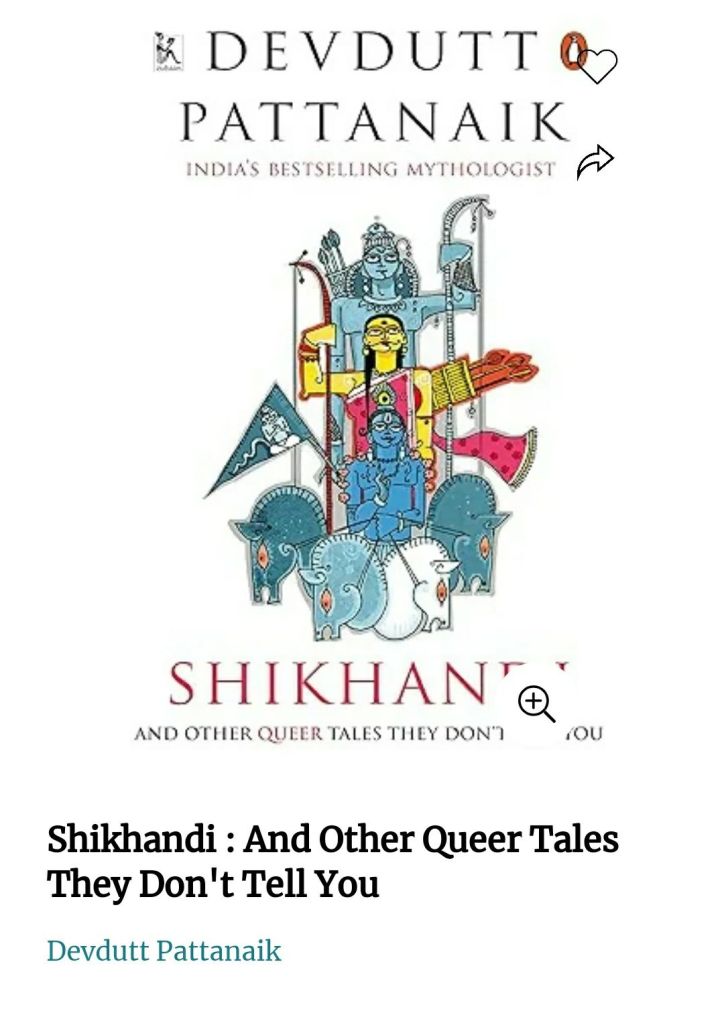
Devdutt Pattanaik in his book “Shikhandi And Other Tales They Don’t Tell You” talks about it.

This is my second book by Devdutt Pattanaik (DP). The title of the book suggested interesting, lesser known stories from Indian mythology. Most importantly, I wanted to know more about Shikhandi who was strategically used in the epic war of Mahabharata against the Kauravas.

The aforementioned war  was fought between Pandavas and Kauravas in Kurukshetra. Pandavas were the five sons of Pandu.  Pandu was congenitally of weak constitution. Whereas,  Kauravas, hundred in number, were the sons of Dhritarashtra who was blind by birth.  Pandu and Dhritarashtra were brothers. So, the war was fought between brothers (Pandavas and Kauravas) for political ownership and  inheritance.

However, DP’s book is not about this epic tale though there are references to it , specifically, when  Pandavas mask their  identities  which may appear to be queer.

DP, in his book, cites around thirty instances from Indian mythology wherein queerness seems to have been embraced for some reason or the other.

To briefly mention a few:

Indra, the God of rains, is caught red handed with a sage’s wife. The infuriated sage castrates him. The Gods manage to restore his manhood.

As mentioned above, to remain incognito, the five Pandava brothers and their wife take up different roles in the palace of king Drupad. Arjuna (one of the brothers), the great warrior, enters the inner sanctum of the palace as an eunuch named Brihanalla, to teach the princesses the art of song and dance.

Shikhandi, born as Shikhandini, a girl, is brought up as a boy because King Drupad wanted a son. She is dressed like a boy, trained as a warrior, thinks like one and even married off to a princess. She borrows manhood from a Yaksha to fulfill her husbandly duties. Thus, Shikhandini becomes Shikhandi.

There are many other instances wherein Gods and Princes and sages  turn into women  from men by the curse of enraged victims and vice versa wherein women turn into men likewise. At times the conversion is enjoyed and at times not.

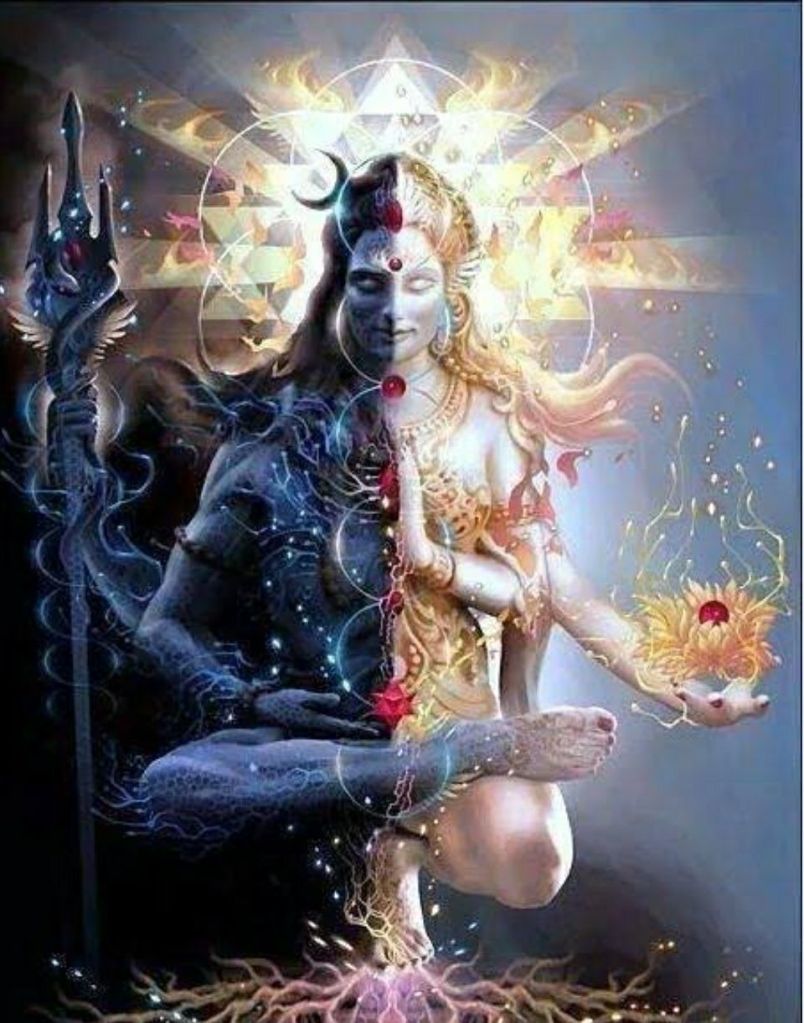
Lord Shiva is also called Ardhanarishwar as he embodies and manifests both male and female genders in his one body – one half man and one half woman – giving equal status to both.

Lord Krishna is happy to be dressed as a woman by the Gopikas. He plaits his hair, wears a nose pin and anklets and dances with Radha, his soulmate.

DP suggests there are elements of queerness in all these metamorphoses and manifestations.

However, as a reader, I believe all these instances are indicative of gender fluidity, role reversals, how comfortable one is in the other’s skin, rather, body and  even gender neutrality.

While talking of genders, we invariably restrict roles, attire, behaviour and even approach in society. A man or a woman should act , dress, behave and think in a certain way which suits the stereotype as per established norms of society. But what if he or she does not? Is it fair to call him or her queer? Is it not queerness a figment or ramification of reactionary society?

Society does not accept what falls outside it’s formulaic matrices. What it does not comprehend fully is queerness or madness or a psychological malady. When society becomes non-acceptant , the out of the ordinary has to be performed or practised secretly. Secrecy breeds a friction between right and wrong. On this anvil of right and wrong society sits on judgement.

Unfortunately, DP does not dwell on the subject from this angle. He only sites examples of a culture of queerness pervading mythology. Ancient society, in comparison to the contemporary, was more liberal and open.  Otherwise, Arjuna, the ultimate in machismo, could not have espoused the role of an eunuch for one whole year in the king’s palace and then accepted back in his true self after the period of Agyatavaas (staying/living incognito) was over.

There is an interesting incident during this period of Agyatavaas. All the five brothers and their wife, Draupadi,  took up different roles in the King’s abode.  Keechak, the queen’s brother, was attracted to Draupadi who masqueraded as the queen’s maid /companion. He made amorous advances towards her time and again  which angered Draupadi but she kept a demure stance lest their true identities got disclosed. However, when her patience got tested to the limit, she approached Arjuna to take action against Keechak.  Interestingly, Arjuna refused in fear of getting caught being Arjuna! It was the mighty Bhima, who enacting the role of a cook in the royal kitchen,   lured Keechak dressed as a woman. Keechak thought it was Draupadi and fell into the trap and got killed.

Finally, as the period of staying incognito ended, all five brothers and Draupadi revealed their true identities and were welcomed by the King. The King even sided the Pandavas in their battle for political supremacy against the Kauravas. If the change of roles was unacceptable to the King he would have been infuriated and supported the Kauravas.

Beginning with a shaky premise, DP, in this book, demonstrates the role of queerness in mythology wherein at times it was used  as an instrument of curse, and in others adopted out of vindictiveness, out of misconception and even out of lack of knowledge. Also, there are rare incidents of  how it came to be embraced naturally in case of Shikhandi and Chitrangada, the warrior princess of Manipur. 

DP does not analyse or distinguish these instances. He only gives the background of the conversion and how it can be questioned as queerness which is disappointing. A more detailed and critical evaluation of the instances would have lent greater depth to the subject and escalated the book to a notch up.

Yet, for those who are interested, the book can be read to gain a different perspective to the often heard or read stories of Indian mythology.

Give it a try…

Pics from Amazon and Pinterest

Good And Bad Of It


What are the most important things needed to live a good life?

I am now a little cautious about answering  WP  prompts because  of their intrusive nature.

However, this one piqued my interest as well as curiosity.   I was curious  how to define “good life”.

The definition  can differ from individual to individual. For some good can be equivalent to lavish. For some it can be merely comfortable or just being  contented.

For a decent life fulfillment of the basics – food, clothing and shelter- is essential.

For fulfilling the basics adequate amount of money  is required.

Here  “adequate” is again  relative. For some  that much amount of money may be necessary by which  day to day businesses of life can be carried out without any hassle or hamper.

Again day to day businesses are individual specific. I guess the bottom line is when one does not have to think about how to meet ends the day next.

But as one is satisfied with the basics attention is diverted towards achieving the next higher need. There is no end to “what next”. The graph can soar up and up till one says “bas, no more.” But do humans ever say that ?

There is no capping on self actualisation. At this point the level of contentment ushers in. How far is your contentedness stretchable ?

For some it can be just sky gazing or reading or singing or painting or sculpting. Finding oneself in activities to which one is inclined.

For some the same process may involve buying a yacht, collecting rare art and antiquities, going on an expensive cruise and many more extravagant indulgences.

So, where can the full stop be put. Today I may regard a minimalist life rewarding. Tomorrow my desires can envelope me. I may hanker  after owing a Ferrari. Perceived happiness is not static. What gives me pleasure today may have  marginal utility tomorrow.

The rudimentary requirements of life are intrinsically modest. But human need and greed are ever expanding. As long as we do not feel the urge to stop there is no end to the rat race of acquiring..

So, coming back to the prompt. For me  “good life”  is a life of health, happiness and higher pursuits.

Well being implies that me and my family should be happy, healthy and available for each other in all times.

No life is exigency free. Therefore, one should be well equipped to meet all emergent situations without worrying what’s going to happen tomorrow.

Last but not the least, is investing time for higher thoughts for rightful alignment of body, mind and soul through prayer, introspection and awareness.

I guess I can call my life good if I remain blessed with my loving and caring family, have adequate resources to meet the exigencies of life and take out time to seek divine blessings for what I have got and what I have not.

Yes, you heard me right. What is not there can also go a long way to up the feel good factor in life.

Food for thought.

Evil Hunters


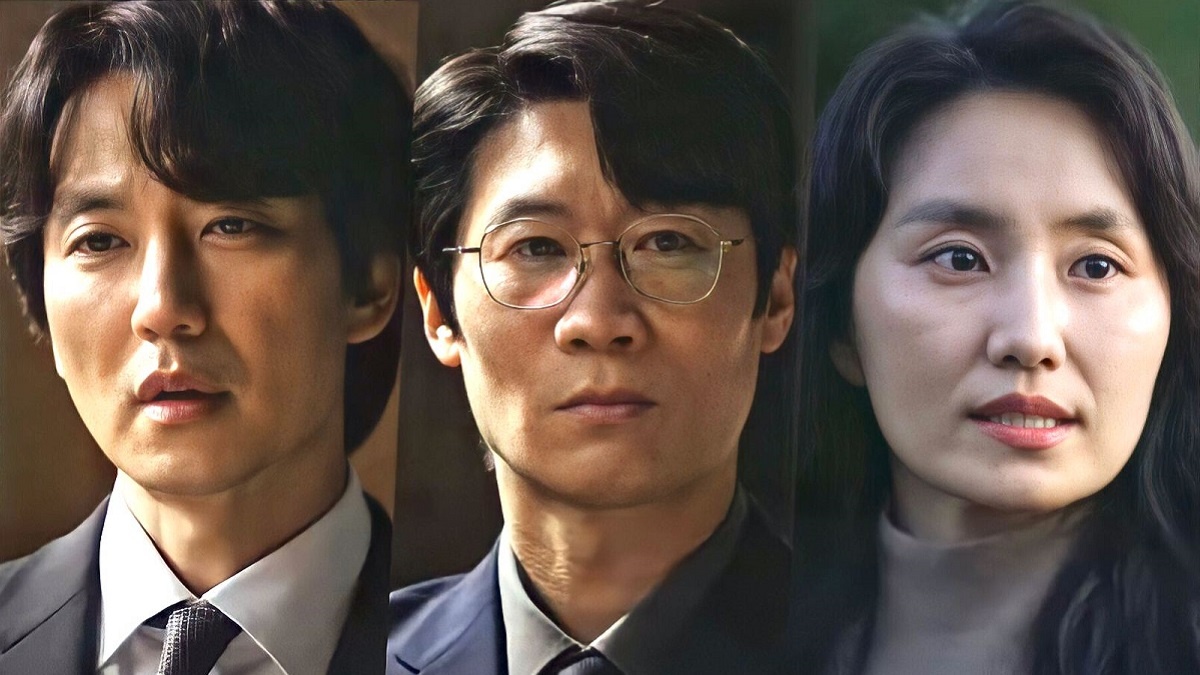
I have completed watching the 2022 South Korean Web Series Through The Darkness Season 1 which is based on the 2018 non-fiction book by the same title co-written by Korea’s first criminal profiler Kwon II-yong and journalist turned author Ko Na-mu. The book highlights Kwon’s field experiences.

Many draw parallel between Through The Darkness and 2017 American Psychological Crime Thriller Mindhunter which is again based on the 1995 true-crime book Mindhunter: Inside the FBI’s Elite Serial Crime Unit by retired FBI Special Agent, John E Douglas and author, Mark Olshaker.

However, both the thrillers are said to be dealing with different subjects though in the former there is reference to the book Mindhunter which inspires and influences the protagonists in their work.

Inspired by criminal profiling adopted in America, Head of the Forensics Department, Captain Kook Young Soo (Jin Seon-Kyu) sets up the Behavioural Analyst Team (BAT) within the Korean Police Force against all odds and oppositions. Captain Kook is already a legend in Forensics. Yet, he has to convince hard the concerned in the right places (who are also his contemporaries and friends) for BAT.

It is the first wing of its kind to sketch the psychological profile of hard-core criminals based on in-depth study of their behavioural patterns  in order to assist the investigation of serious and violent crimes. He handpicks his team mates – Inspector Song Ha-Young (Kim Nam-Gil) and Statistical Analyst , Jung Woo-Joo (Ryeo-Un). Jung Woo-Joo is a newbie whereas Song Ha-Young is an enigma and infamous for betraying his superiors. Inspite of being  sincere, dedicated, enviably focused in his work he is considered unreliable because he does not hesitate to point out to his superior if  action taken by him is not in line with the code of police conduct. He exudes quiet strength, restraint and determination. Remarkably composed he conveys his view point without mincing words or fear of jeopardising his prospects. The betrayer he is made out to be is actually  his core ethics which does not allow him to be a sycophant or show any ungainly loyalty to his immediate reporting officer.

It is also the time when South Korea is rocked by series of serial killings. Public is insecure and scared. The serial killers are too smart to get caught. Unfortunately, the Special Investigation Teams of the Korean Police Force are not suitably equipped or experienced to track down these psychopaths.

Captain Kook staunchly believes that profiling the psychology of the criminals by analysing their behaviour and modus operandi (the way they commit  crimes) will go a long way in facilitating the detectives to catch these killers with knowledge and insight.

But Kook’s strong conviction is challenged as the investigators deride the concept of criminal profiling and the crime reporters ridicule the Police Force for giving BAT access to not only examine the crime scenes and collect evidences  but also to interview the already convicted prisoners to understand the triggers behind their heinous crimes.

Despite the lack of appreciation of their hard work, Captain Kook and Inspector Song are unstoppable in delivering the goods. They draw out Profile Reports of one thousand convicts based on one-o-one interviews. These profilings help them analyze the psychological patterns of ongoing killings and finally extract confessions from the deranged criminals once they are arrested. The huge database on criminal profiles, thus created and maintained by BAT, is aimed to serve as  established referrals and according to Captain Kook also pave the path to minimising, if not eradicating criminal activities from society, in future. Once the psychology of the criminals is grasped, the social maladies catalysing criminal activities can be reformed leading to a better, crime free society. 

At first BAT is grudgingly given a year’s time to prove its worth. Subsequently, with Captain Kook’s painstaking, persevearant proddings, approval is accorded for extension of  tenure at regular intervals. The Team works day and night from a store room in the basement without Air Conditioning in blazing summers, Heating System in freezing winters, water coolers, coffee vending machines and other such amenities considered prerequisites to good and healthy working.

The detectives treat BAT as unnecessary intrusion messing up their line of investigation, stealing  credit of catching the outlaws due to them and undermining the labour of the frontliners who are putting their life in danger to perform their duty. They simply do not understand BAT’s methods and pass derisive remarks when they present their cases. Nonetheless, BAT strives on motivated to combat evil in society even if it takes a hard toll on their personal relationships and mental well being.

Slowly, very slowly, the detectives realize how much Inspector Song and Captain Kook are enduring in terms of mental pressure and personal deprivation in order to constantly and consistently provide positive and meaningful assistance in not only resolving complex criminal cases but also in evaluating the role of society in berthing perverted minds and neglecting the grieving families of the victims who are left to cope with their unjustified and irreparable losses in silence without any empathetic support. Slowly bias, non-cooperation and prejudice give way to mutual camaraderie, trust and respect.

Through The Darkness can be a grueling watch yet it is edge of the seat. The interviews with the criminals take a toll on the strongest of minds, especially, those wherein Inspector Song and Captain Kook have to partake food with the interviewees to make them feel comfortable and let them speak freely. Then there are other scheming ones who negotiate with Kook and Song for certain considerations in exchange of information. Tougher are the interrogations wherein the pscyhopaths either glorify their crimes or eagerly explain in detail how amusing and relaxing it is to kill. It is really unbelievable to what extent the killers will go to perfect the art of kill. One of them gets his entire body x-rayed to identify the most easily breakable points in human anatomy while there is another who keeps meticulous notes on all his successful preying attempts. The common denominator amongst them being the fetish for health and hygiene because longer they live larger number they can kill , thereby, becoming the numero uno serial killer in the history of mankind.

This nail biting journey of a pioneering team would have devolved into a docu series had it not been for Kim Nam-Gil’s superb performance as Inspector Song. He is extremely introvert, shy, soft hearted and sensitive to other’s feelings and pains. Outwardly, he is a man of reticence, grit and steel. This duality is his strength as well as a curse. How he portrays this paradox within himself is something to watch and wonder on!! Am sure you will fall in love with him as I have.

Captain Kook as a team leader is emphatically every employee’s dream boss. He is the cutter who knows his gems well. He identifies with ease who will best suit his team. Song is one whom he recognizes as tailormade for the job. He has observed him at work and keeps telling him to join him till he relents. He is encouraging and appreciative of good work, self motivated and motivates team members, is fatherly to his subordinates and even enjoys “happy hours” with them. He tells Song to maintain work-life balance, gives his mother emotional support in time of crisis and feels responsible and guilty when Inspector Song has to pay a heavy price on account of his exacting job as criminal profiler.

While the series pivots around BAT and its gradual evolution to being an indispensable and expanded arm of Korean Police Force, Through The Darkness also chronicles how the Special Crime Unit within gears up to handle unforeseeable crimes by constantly critiquing its own performance and concluding how best it can avoid delay in bringing the culprits to book. This evaluatory exercise takes place not in any soundproof conference hall of some plush five star Hotel but on the very seat where the detectives are working on day to day basis in the presence of their superiors who sit with them and coax a brainstorming session on their performance, thereby, making self-appraisal a part of their function and not outside it. There is much to learn for all law-enforcing agencies here if they care!

It is also a personal saga of two team, rather soulmates, conjoined  by a single umbilical cord – their passion for systematic and scientific investigative procedures in resolving nay eliminating the motives spurring crimes in society. How working in unison they grow together to the extent that when one withdraws the other is hard put not to crumble down. It is also how they come back together stronger, closer and need be said happier.

Before signing off I will recommend this masterpiece for all those who fancy police procedurals and are diehard fans of crime thrillers with a caveat that if you find it too nerve racking take breaks in between. That is how I watched it through. But do pull on till the end as there is much to absorb from this inspiring tale of two police personnel , their unflinching belief in scientific investigation and dauntless endeavour to bust the myth of infallibility of crime. As Song says time and again, “There is nothing called a perfect crime. It does not exist.”

I say amen to that …

Shared with Mouthshut.com

Being Religious


Do you practice religion?

Let me call this prompt my ‘comeback post’ after this long, self imposed hiatus.

It is too tempting a subject not to write on, though I have, for reasons best unrevealed, become an infrequent writer.

Self restraint, I realise, is very important for writing as well. Though not  inherently esoteric, the practice of self control itself is in-built into  religiousness.

Lately, being increasingly interested in South Korea as a country, I am surprised to learn that half of its population does not have or follow any religion. Then how and what do they live by?

The question stems from our age old belief that religion is what we are made up of. Our social, cultural, political and economic fabrics are intricately weaved into the matrix of religion. Our ethics and moral consciousness are deeply inspired by conventional religious teachings. We Indians cannot think away from or beyond religion. Whether we strictly follow religious rituals or not we think from the viewpoint of religion.

That’s how we are groomed by our elders. From listening to bedtime stories culled out of  religious or mythological scriptures to taking part in deeply ritualistic familial ceremonies, we get married to our religion in  infancy itself which is subsequently nurtured throughout our lives.

Breaking away from tradition is hard as it entails a carefree ‘don’t give a damn approach’ to  familial pressures, social castigation and fear of moving away from the cultural casement which we are so proud of.

In India it is difficult not to be religious. From our psyche to common conversation, everything tends to veer towards if not religion then definitely religious practices. Here I make a distinction between the two – the very concept and what we take away from it.

While  core religion has a vast connotation the practices are our take-aways. Indians are ritualistic as well as religious. If we do not follow rituals at given intervals we have this nagging self doubt that we are ignoring our religion. We all suffer from the dread of blasphemy!

Therefore, we are unable to conceptualize ethics, morality, good and healthy living and thinking, culture and social orderliness as standalone pillars of racial survival. Faced with an  emotional catastrophe, we are advised to seek strength from regular visits to places of worship. An aspirational dilemma, the best resolution is with God, “Ask from him.” Landing up with your coveted career, pay tribute to your family deity to preempt any untoward eventuality subsequently.

This  personal networking or perhaps negotiation with our ‘own Gods’ is omnipresent in our psyche – an anchor to rely on in times of need and deed. It may sound claustrophobic but it is not. Instead it is an abstract source of strength which lends confidance to our personalities, a backbone to avoid complete breakdown, a fibre keeping us afloat on the right side of humanism and a very special infusion of mystical compulsion to our day to day living.

Given the length and breadth of this sub continent what is grandly available to us is the freedom of how we wish to practice religion. It can be by following regular rituals, it can be through higher studies and contemplation, it can be by an ingrained child like faith in the Supreme Lord and it can be through pure and simple good thoughts and deeds. 

I guess I have spoken about this before. However, at the expense of repetition,  I shall re-tell  the story of a rich and spoilt girl who is made to believe she can have anything in this world because she is entitled to it. After losing her husband, whom she “owns” like all other possessions, to an ugly, older, scheming employee,  she turns to religion for strength to cope with her heartbreak. Surprisingly, she realises she has never been tutored to be religious. She accosts her parents with a compelling question, “Why have you left me ungroomed? Do you realise how lonely you have made me?”

Though this story belongs to someplace else,  the query is universal. How diffident and feeble we are without religion.

Although it is taught that religion has been instrumental in socially organizing the primitive hunters and later  tarnished history igniting feuds, factions, war and mass destruction, dissociating religion from politics is an impossibility in our country. Even economic growth is intertwined with religious perceptions. All this and many prove a basic fact that mankind has created religion for its own benefit but is now chained to it.

So not practising religion is out of question.

Yet what remains to be explored is how to make religion more relevant in today’s divided humanity. Where capturing the space is a political agenda, we blissfully give in to limit and objectify infinity into something controllable. Can an overambitious species grapple and be comfortable with the presence of an indefinable and invincible authority which has its own inexplicable machination of toppling down what we have cumulated so far so fastidiously? Perhaps not. That is why we want to comprehend and command the Universe.

Can we extricate ourselves from the realms of well purposed but decidedly narrow peripheries that religion provides to an elevated and unifying stature of spiritualism? I believe the thumb rules of all religions are the same. Unfortunately, we focus more on the variant paths in place of the ultimate goal to be reached.

Can we redirect our well targetted administrative plannings to building  an all comprehensive  ethos, irrespective of sovereign boundaries,  where our spiritual heritage will be safe for posterity ? I guess if imagination is employed in proper measure and horizons of a meaningful future is widened the project itself can be a singular, global endeavour.

I believe, in due course, of course.