
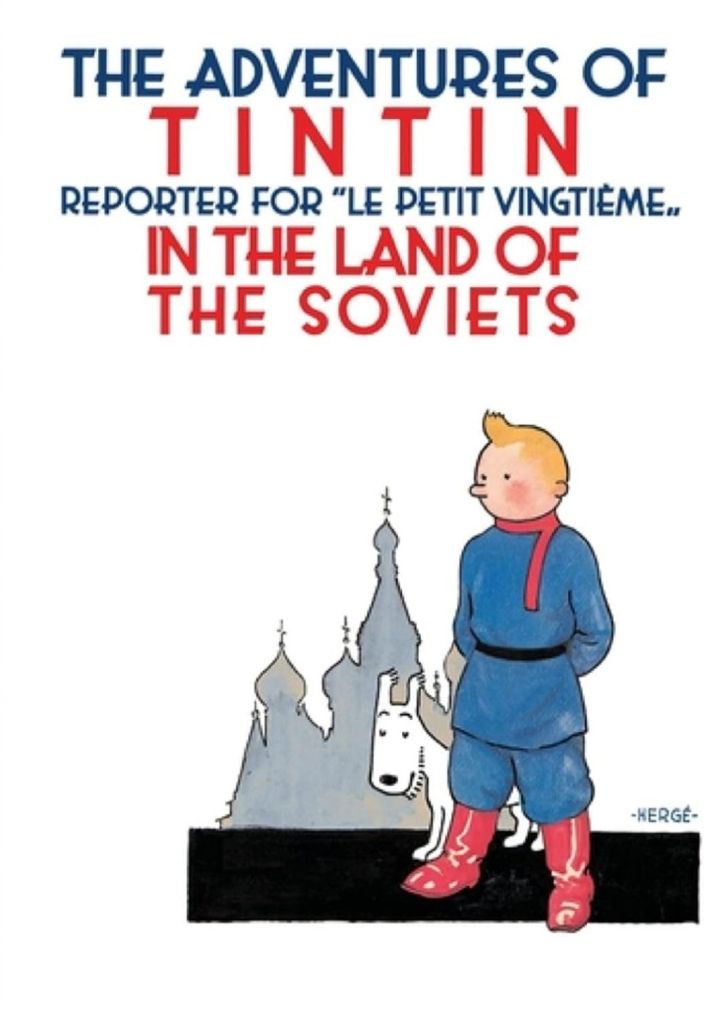
Who hasn’t grown up reading Tintin comics ?
They were so much a part and parcel of my childhood entertainment. The vivid, colourful graphics, the adorable characters and the exciting adventures combined to fascinate my malleable mind and wild imagination as a child! This despite the fact that my father discouraged bringing comics home whose literary worth he was critical of.
Till recently I had mistakenly thought that I had read all of Herge’s Tintin stories. But no, there were two about which I did not know at all – (1) The Adventures Of Tintin In The Land Of The Soviets (1929) and (2) Tintin In The Congo (1930).
These two are rare comics hard to get and a collector’s delight. Having procured the first one I am still looking for the second because the copy available on Amazon is quite expensive. Though the reasonably priced ones are available in Bangla and Hindi I’d prefer the English one because I am so used to the humour and storytelling in that language.
Tintin’s adventure in Soviet Land was the first in the series created by Herge. I was surprised to see that the graphics were in black and white unlike the others which are in vibrant colours. However, the storyline is very strong and significant because of its underlying theme.
I had learnt a while earlier that Herge had a detest and distrust for the communists which, in the Introduction to the book, is said was a reflection of that age.
Tintin and his canine sidekick, Snowy, land up in Moscow, Russia, to do some investigative journalism. Combatting bizarre plans to eliminate him from the face of this world, Tintin unearths the ‘true face’ of communism although his own survival tactics are equally bizarre.
He finds haystacks are being burnt inside factories to let out smoke from the chimneys to misleadingly indicate that production is under way where there’s none and food from poor peasants are being snatched away to export out of the country to build a fake image of prosperity. Tintin also discovers a secret underground storage where the personal wealth of Lenin, Stalin and Trotsky are stacked. In short, the message is communism as a system of governance is hollow, non-functional and merely a camouflage for the ruling oligarch to extort the least what they have from commoners and misappropriate resources to accumulate personal wealth.
In comparison, the other Tintin adventures are pure, simple, delightful reads for children. However, this is serious stuff that clearly reflects how sceptical Herge was of an ideology diametrically opposite to that of capitalism. Though illustrated in a humorous way the undertaking of a covert operation to investigate the “real goings on” of a country isolated from the rest of the world by the ‘iron curtain’ is a mirror of the doubt and disbelief of the then ‘liberal’ society and its intelligentsia who swore by the laissez faire principles.
Herge’s later graphics, where he uses vivid colours to create spectacular backdrops cutting across geographical boundaries, be it Tibet, the English countryside or his own country, Belgium and many others, lends vibrance to Tintin’s adventures , thereby making them more and more enjoyable. Not to forget the immortal characters – the ever blundering Captain Haddock, the stone deaf Professor Calculus, the bungling police duo Thomson and Thompson and their precise expressions suited to the occasions coupled with lucid, full of humour and engrossing storytelling – Herge really escalated graphic narration to another level all together.
As I love reading children’s and young adults’ books the adventurous exploits of Tintin hold a very special place in my heart and on my book shelves. I highly recommend that all kids should be exposed to Tintin’s fun-filled adventures and Herge’s graphic storytelling which is no less than classic masterpieces of artistic narrative.
Happy Browsing!!
***
Trivia : Herge’s real name was Georges Remi. He was a Belgian cartoonist and just twenty two years old with no formal training in art when his first strip comic Adventures Of Tintin In The Soviet Land was published in a children’s supplement to a Belgian daily newspaper where he was employed in the staff as an artist. His wit and originality made him a name in the world of comics series. The various adventures of Tintin are spread across almost forty nations and a few fictional ones though Herge himself never visited any of these countries.





Geeta, I LOVE Tintin and grew up reading the comics. I own all of them. I’m going to introduce them to my daughter soon. Great post! Have a wonderful day, my friend! 😊🌻💛☮️
LikeLiked by 1 person
Hi Tyler !
I have the same plan. I too wish to introduce Tintin to my grand niece. Great to know you are a Tintin fan too. Have a wonderful day 😊
LikeLiked by 1 person